

Last updated: October 2026 · 14 min read
Japan is a country where ancient temples stand beside futuristic cities, and its history explains why. Over 15,000 years, these islands produced some of the world’s oldest pottery, a refined imperial court, the samurai warrior class, centuries of isolation, a lightning-fast modernisation, a devastating war, and an economic miracle that made “Made in Japan” a global byword for quality. This guide covers the complete history of Japan period by period, with a Japanese history timeline infographic and Japan’s deep links with India.
Japan: quick facts
| Name | Japan (Nippon or Nihon, “origin of the sun”) |
|---|---|
| Capital | Tokyo |
| Government | Constitutional monarchy with a parliamentary system (the Diet) |
| Emperor | Naruhito (since 2019, Reiwa era) |
| Prime Minister | Sanae Takaichi (since October 2025), Japan’s first woman Prime Minister |
| Population | About 123 million |
| Main islands | Honshu, Hokkaido, Kyushu and Shikoku (plus about 14,000 smaller islands) |
| Currency | Japanese yen (JPY) |
| G7 membership | Founding member (1975), the first and only Asian member |
In this article
- Ancient Japan: Jōmon, Yayoi and Kofun
- Classical Japan: Asuka, Nara and Heian
- The age of the samurai
- The Edo period
- Opening and the Meiji Restoration
- Empire and World War II
- Post-war Japan and the economic miracle
- Japan today
- Timeline infographic
- FAQs
1. Ancient Japan: Jōmon, Yayoi and Kofun (to 538 CE)
The Jōmon period (about 14,000–300 BCE) is named after the “cord-marked” patterns on its pottery, among the oldest pottery in the world. Jōmon people lived by hunting, fishing and gathering.
In the Yayoi period (about 300 BCE–300 CE), migrants from the Asian mainland brought wet-rice farming, bronze and iron. Villages grew into small chiefdoms; Chinese records describe a queen named Himiko ruling a land called Wa in the 3rd century.
During the Kofun period (about 300–538), powerful rulers were buried in giant keyhole-shaped tombs (kofun). The Yamato clan became dominant in central Japan and is the ancestor of today’s imperial family, the oldest continuous hereditary monarchy in the world.
2. Classical Japan: Asuka, Nara and Heian (538–1185)
Buddhism arrived from Korea in the 6th century, along with Chinese writing, Confucian ideas and new arts. Prince Shōtoku (574–622) promoted Buddhism and wrote the Seventeen-Article Constitution, setting out ideals of harmonious government.
- Nara period (710–794): Japan’s first permanent capital was built at Nara, modelled on China’s capital. The giant bronze Buddha of Tōdai-ji temple was completed in 752.
- Heian period (794–1185): the capital moved to Heian-kyō (Kyoto), which remained the imperial capital for over 1,000 years. Aristocratic court culture flourished; around 1000 CE, court lady Murasaki Shikibu wrote The Tale of Genji, often called the world’s first novel. Japanese kana scripts developed, and the powerful Fujiwara family ruled behind the emperor.
3. The age of the samurai (1185–1603)
As central power weakened, warrior clans rose. After the Genpei War, Minamoto no Yoritomo founded the Kamakura shogunate in 1185 and was named shogun (military ruler) in 1192. For nearly 700 years, real power belonged to shoguns and the samurai class, while emperors remained symbolic figures.
- In 1274 and 1281, the Mongols of Kublai Khan invaded twice; both times typhoons, later called kamikaze (“divine winds”), helped destroy their fleets.
- Zen Buddhism, the tea ceremony, Noh theatre and ink painting developed under the Ashikaga shogunate (1336–1573).
- The Sengoku (“Warring States”) period (1467–1603) saw constant war between regional lords (daimyō). Portuguese traders brought guns in 1543, and Christian missionaries arrived.
Three great warlords reunified Japan: Oda Nobunaga, Toyotomi Hideyoshi and Tokugawa Ieyasu, who won the decisive Battle of Sekigahara in 1600. Grand castles such as Himeji Castle date from this era.

4. The Edo period (1603–1868)
In 1603 Tokugawa Ieyasu became shogun and ruled from Edo (today’s Tokyo). The Tokugawa shogunate brought more than 250 years of peace. It banned Christianity and adopted a policy of sakoku (“closed country”): foreigners were largely excluded and Japanese could not travel abroad, with limited trade through the Dutch and Chinese at Nagasaki.
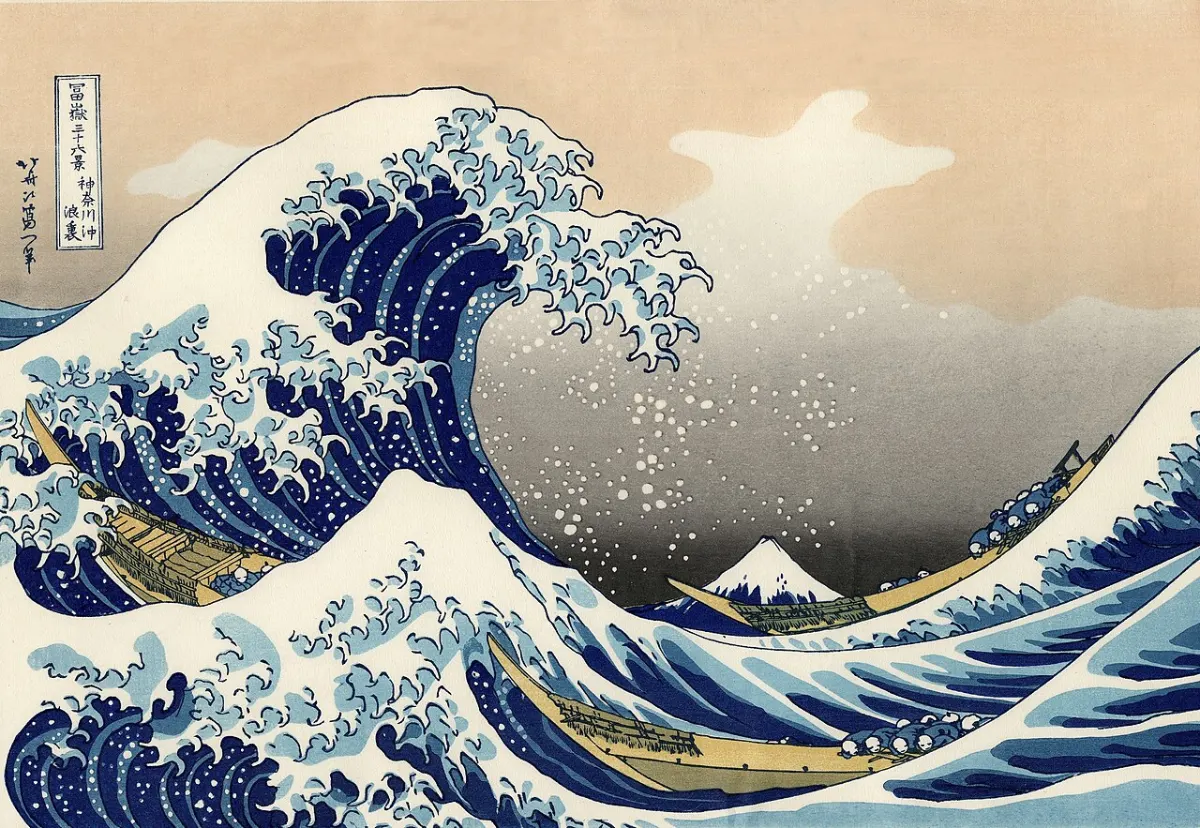
Society was strictly divided into samurai, farmers, artisans and merchants, but cities grew and a lively urban culture emerged: kabuki theatre, haiku poetry by Matsuo Bashō, and ukiyo-e woodblock prints. Katsushika Hokusai’s The Great Wave off Kanagawa (around 1831) is now one of the most recognisable images in the world.
5. Opening and the Meiji Restoration (1853–1912)
In 1853, US Commodore Matthew Perry arrived in Edo Bay with steam-powered “Black Ships” and demanded that Japan open to trade. The Treaty of Kanagawa (1854) and later “unequal treaties” ended isolation.

Humiliation and unrest led to the Meiji Restoration of 1868: the shogunate fell, and power was restored to the young Emperor Meiji. The capital moved to Edo, renamed Tokyo (“eastern capital”). Japan modernised at astonishing speed:
- The samurai class was abolished; a modern army and navy were built.
- Railways (first line 1872), factories, a postal system and universal education were introduced.
- The Meiji Constitution (1889) created Asia’s first parliament.
- Japan defeated China (1894–95) and then Russia (1904–05), the first modern victory of an Asian power over a European one, inspiring nationalists across Asia, including in India.
6. Empire and World War II (1912–1945)
Japan annexed Korea in 1910 and expanded its empire. The Great Kantō Earthquake of 1923 devastated Tokyo. In the 1930s, militarists gained control, Japan invaded Manchuria (1931) and launched full-scale war on China in 1937. On 7 December 1941, Japan attacked the US base at Pearl Harbor and swept across South-East Asia, reaching the borders of India in Burma (Battles of Imphal and Kohima, 1944).
The war caused immense suffering across Asia. In August 1945, the United States dropped atomic bombs on Hiroshima (6 August) and Nagasaki (9 August), killing well over 100,000 people. Japan surrendered on 15 August 1945.
7. Post-war Japan and the economic miracle (1945–1989)
Under US occupation (1945–1952), Japan adopted a new Constitution in 1947: the emperor became a symbol of the nation, women gained the vote, and Article 9 renounced war. Japan then achieved an economic miracle, becoming the world’s second-largest economy by 1968. Companies such as Toyota, Sony, Honda and Panasonic became global brands.
The 1964 Tokyo Olympics showcased the new Japan, and the Shinkansen bullet train opened the same year, the world’s first high-speed rail line.
8. Japan today (1989–present)
- 1990s: a property and stock bubble burst, leading to the “Lost Decades” of slow growth.
- 2011: the Tōhoku earthquake and tsunami killed nearly 20,000 people and caused the Fukushima nuclear accident.
- 2019: Emperor Akihito abdicated; Emperor Naruhito began the Reiwa era.
- 2021: Tokyo hosted the delayed 2020 Olympics.
- October 2025: Sanae Takaichi became Japan’s first woman Prime Minister.
Japan faces an ageing, shrinking population but remains a technology leader and a global cultural force through anime, manga, video games and cuisine.
Japanese history timeline (infographic)

Periods of Japanese history at a glance
| Period | Dates | Highlights |
|---|---|---|
| Jōmon | c. 14,000–300 BCE | Early pottery, hunter-gatherers |
| Yayoi | c. 300 BCE–300 CE | Rice farming, metal tools |
| Kofun & Asuka | 300–710 | Keyhole tombs, Buddhism arrives |
| Nara | 710–794 | First permanent capital |
| Heian | 794–1185 | Kyoto court, Tale of Genji |
| Kamakura & Muromachi | 1185–1573 | Shoguns, samurai, Zen |
| Azuchi-Momoyama | 1573–1603 | Unification, great castles |
| Edo | 1603–1868 | Tokugawa peace, isolation, ukiyo-e |
| Meiji | 1868–1912 | Modernisation |
| Taishō & Shōwa | 1912–1989 | War, recovery, economic miracle |
| Heisei | 1989–2019 | Lost Decades, 2011 disaster |
| Reiwa | 2019–present | Emperor Naruhito |
Japan and India: a friendship rooted in Buddhism
Buddhism, born in India, reached Japan via China and Korea and shaped Japanese culture deeply. In 752, an Indian monk, Bodhisena, performed the eye-opening ceremony of the Great Buddha at Tōdai-ji in Nara. Rabindranath Tagore visited Japan several times, and Indian judge Radhabinod Pal is remembered in Japan for his dissenting judgement at the post-war Tokyo Trials. Today Japan is one of India’s closest partners: Japanese support helped build the Delhi Metro, Maruti Suzuki transformed Indian car manufacturing, the Mumbai–Ahmedabad bullet train uses Shinkansen technology, and both countries are members of the Quad.
Japan in the G7
Japan was a founding member of the G7 in 1975 and for decades its only Asian member. It hosted the 2023 summit in Hiroshima, where Prime Minister Narendra Modi attended as a guest. See all G7 countries and their history.
Frequently asked questions
What is the oldest period of Japanese history?
The Jōmon period, which began around 14,000 BCE and is known for some of the oldest pottery in the world.
Who were the samurai?
The hereditary warrior class of Japan, who served lords and shoguns from the 12th century until they were abolished during the Meiji era in the 1870s.
What was the Meiji Restoration?
The 1868 political revolution that ended the Tokugawa shogunate, restored the emperor’s authority and launched Japan’s rapid modernisation.
Why was Japan isolated for over 200 years?
The Tokugawa shoguns feared foreign influence and Christianity, so from the 1630s to 1853 they restricted foreign contact under the sakoku policy.
Who is the current Emperor of Japan?
Emperor Naruhito, who ascended the throne on 1 May 2019, beginning the Reiwa era.
Explore the history of other G7 countries
- History of the United States
- History of the United Kingdom
- History of France
- History of Germany
- History of Italy
- History of Canada
- G7 countries: list, members and history
Related reading on Tiwaripedia
- World War II in brief
- Emperor Ashoka and the spread of Buddhism
- 10 incredible facts about electric vehicles
- More country-wise history
Facts are based on widely accepted historical sources at the time of writing. Images are from Wikimedia Commons under the licences credited in each caption. Spotted something that needs updating? Let us know.
Keep reading on Tiwaripedia
- 12 Incredible Facts About the Olympic Games
- History of France: French History Timeline From Lascaux to the Fifth Republic and G7 2026
- History of the United States: American History Timeline From Native Americans to 2026
- 12 Incredible Facts About the Taj Mahal
- G7 Countries List 2026: Members, History of the G7 and Each Nation, and India’s Role
- History of Italy: Italian History Timeline From Ancient Rome to the Modern Republic
More guides: All Country-wise History articles
