

Last updated: October 2026 · 14 min read
The history of the United States is the story of how thirteen small British colonies on the Atlantic coast grew into the world’s largest economy and most powerful nation in just 250 years. It is a story of Native American civilisations, revolution, civil war, waves of immigration, world wars, the space race and the digital age. In 2026 the country celebrates the 250th anniversary of the Declaration of Independence, which makes it a perfect time to understand the full American history timeline, from the first peoples to today.
United States: quick facts
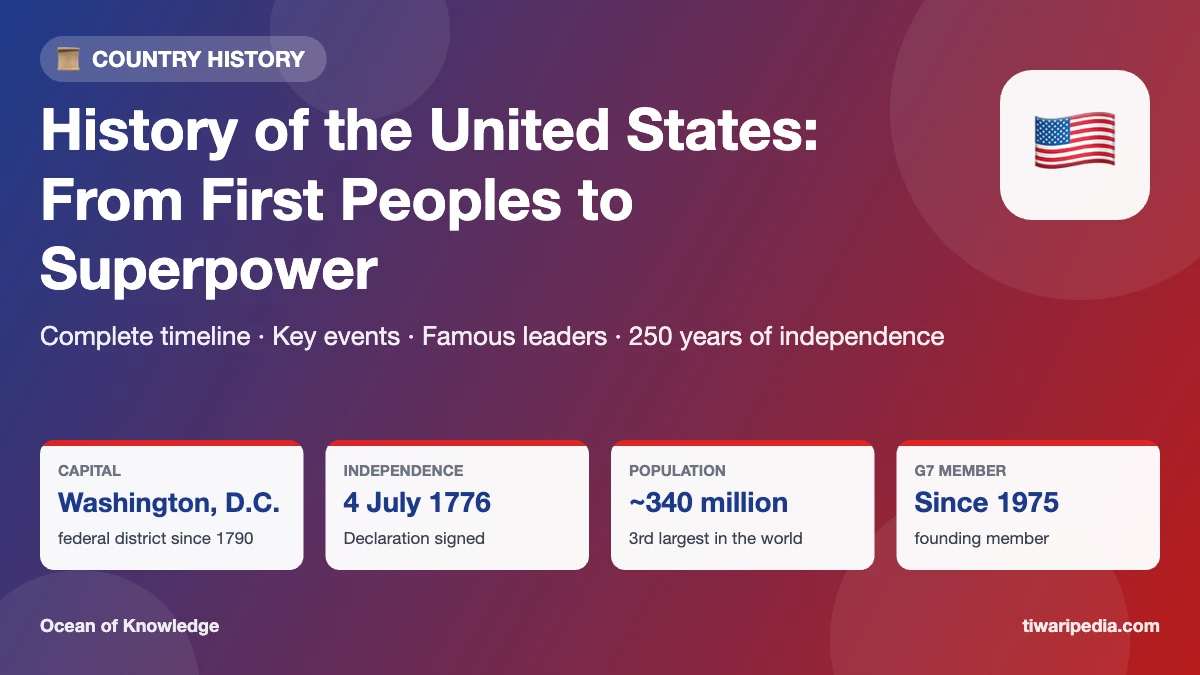
| Official name | United States of America (USA) |
|---|---|
| Capital | Washington, D.C. |
| Largest city | New York City |
| Independence | 4 July 1776 (from Great Britain) |
| Constitution | Signed 1787, in force 1789 (oldest written national constitution still in use) |
| Government | Federal presidential republic, 50 states |
| Population | About 340 million |
| Currency | US dollar (USD) |
| Current President | Donald Trump (since 20 January 2025) |
| G7 membership | Founding member (1975) |
In this article
- Native American civilisations
- European exploration and the Thirteen Colonies
- The American Revolution and independence
- A young nation expands westward
- The Civil War and Reconstruction
- The Gilded Age, industry and immigration
- World wars and the Great Depression
- Cold War, civil rights and the space race
- Modern America
- Timeline infographic
- FAQs
1. Native American civilisations (before 1492)
People reached North America at least 15,000 years ago, most likely crossing from Asia over a land bridge called Beringia or travelling along the Pacific coast. Over thousands of years they built hundreds of distinct nations with their own languages, religions and ways of life.
- Ancestral Puebloans in the south-west built cliff dwellings such as Mesa Verde.
- The Mississippian culture built Cahokia (near today’s St. Louis), which around 1100 CE was one of the largest cities in the world north of Mexico.
- The Haudenosaunee (Iroquois) Confederacy in the north-east created a union of nations with a council system that some historians link to later American ideas of federalism.
When Europeans arrived, millions of Native Americans lived across the continent. Diseases such as smallpox, wars and forced removals devastated their populations over the next four centuries.
2. European exploration and the Thirteen Colonies (1492–1763)
Christopher Columbus’s voyage in 1492 opened the Americas to European empires. Spain founded St. Augustine, Florida (1565), the oldest continuously inhabited European settlement in the US. France explored the Mississippi, and the Dutch founded New Amsterdam, which later became New York.
England’s first permanent settlement was Jamestown, Virginia (1607). In 1620 the Pilgrims arrived on the Mayflower and founded Plymouth Colony in Massachusetts. By 1732 there were thirteen British colonies along the Atlantic coast, from New Hampshire to Georgia.
- New England colonies had farming, fishing, shipbuilding and town meetings.
- Middle colonies such as Pennsylvania and New York were religiously diverse trading hubs.
- Southern colonies grew tobacco, rice and indigo on plantations that depended on enslaved Africans. The first enslaved Africans were brought to Virginia in 1619.
3. The American Revolution and independence (1763–1789)
After Britain won the French and Indian War (1754–1763), it tried to make the colonies pay for the war through taxes such as the Stamp Act (1765) and taxes on tea. Colonists protested with the slogan “No taxation without representation”. Tensions led to the Boston Massacre (1770) and the Boston Tea Party (1773).
Fighting began at Lexington and Concord in April 1775. On 4 July 1776, the Continental Congress adopted the Declaration of Independence, written mainly by Thomas Jefferson, which declared that “all men are created equal”. With help from France, General George Washington’s Continental Army won the decisive Battle of Yorktown in 1781, and Britain recognised American independence in the Treaty of Paris (1783).
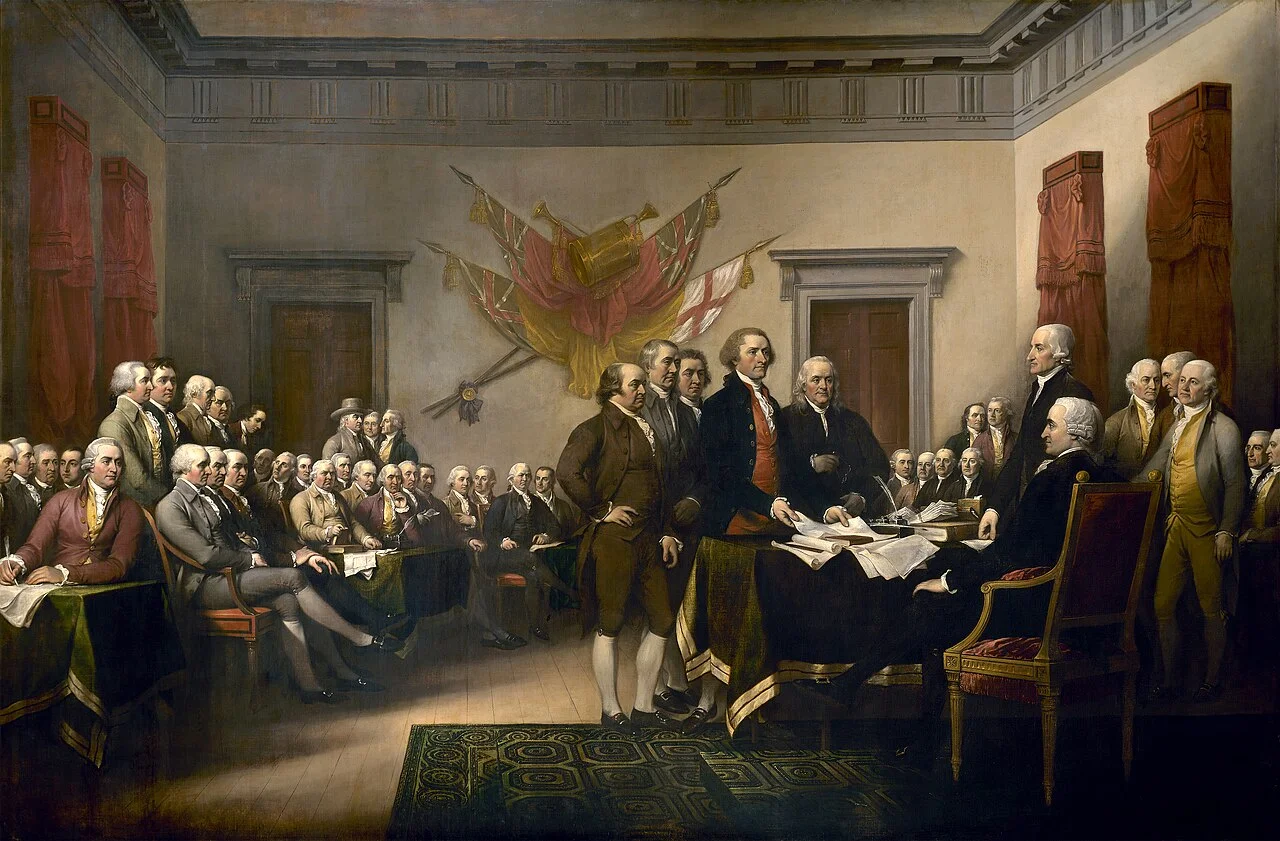
The first government under the Articles of Confederation was too weak, so delegates met in Philadelphia in 1787 to write the US Constitution. It created three branches of government (executive, legislative and judicial) with checks and balances. The Bill of Rights (first ten amendments, 1791) protected freedoms of speech, religion and the press. George Washington became the first President in 1789.
4. A young nation expands westward (1789–1860)
- Louisiana Purchase (1803): President Jefferson bought a vast territory from Napoleon’s France for about $15 million, roughly doubling the country’s size. Lewis and Clark explored it from 1804 to 1806.
- War of 1812: The US fought Britain again; the White House was burned in 1814, but the war ended in a stalemate and boosted American nationalism.
- Manifest Destiny: The belief that Americans were destined to spread across the continent drove the annexation of Texas (1845), the Oregon Territory (1846) and the Mexican-American War (1846–1848), which added California and the south-west.
- Trail of Tears (1830s): Under the Indian Removal Act, tens of thousands of Cherokee and other Native Americans were forced from their homelands; thousands died on the journey.
- California Gold Rush (1848–1855) brought hundreds of thousands of migrants west.
Meanwhile, the industrial North and the slave-based agricultural South grew further apart over whether slavery should spread into new western states.
5. The Civil War and Reconstruction (1861–1877)
After Abraham Lincoln was elected President in 1860, eleven southern states left the Union and formed the Confederate States of America. The Civil War (1861–1865) was the deadliest war in American history, with an estimated 620,000 to 750,000 soldiers killed.
- Lincoln’s Emancipation Proclamation (1863) declared enslaved people in Confederate states free.
- The Union victory at Gettysburg (1863) was a turning point; Lincoln’s Gettysburg Address became one of the most famous speeches in history.
- The Confederacy surrendered in April 1865. Days later, Lincoln was assassinated.
- The 13th Amendment (1865) abolished slavery; the 14th and 15th Amendments granted citizenship and voting rights to Black men.
During Reconstruction, the South was rebuilt and formerly enslaved people gained rights, but after 1877 southern states passed “Jim Crow” laws that enforced racial segregation for nearly a century.
6. The Gilded Age, industry and immigration (1870–1914)
The completion of the Transcontinental Railroad in 1869 linked the east and west coasts. Inventors like Thomas Edison (light bulb), Alexander Graham Bell (telephone) and later the Wright brothers (first powered flight, 1903) made America a centre of innovation. Industrialists such as Andrew Carnegie (steel), John D. Rockefeller (oil) and J.P. Morgan (banking) built huge fortunes.
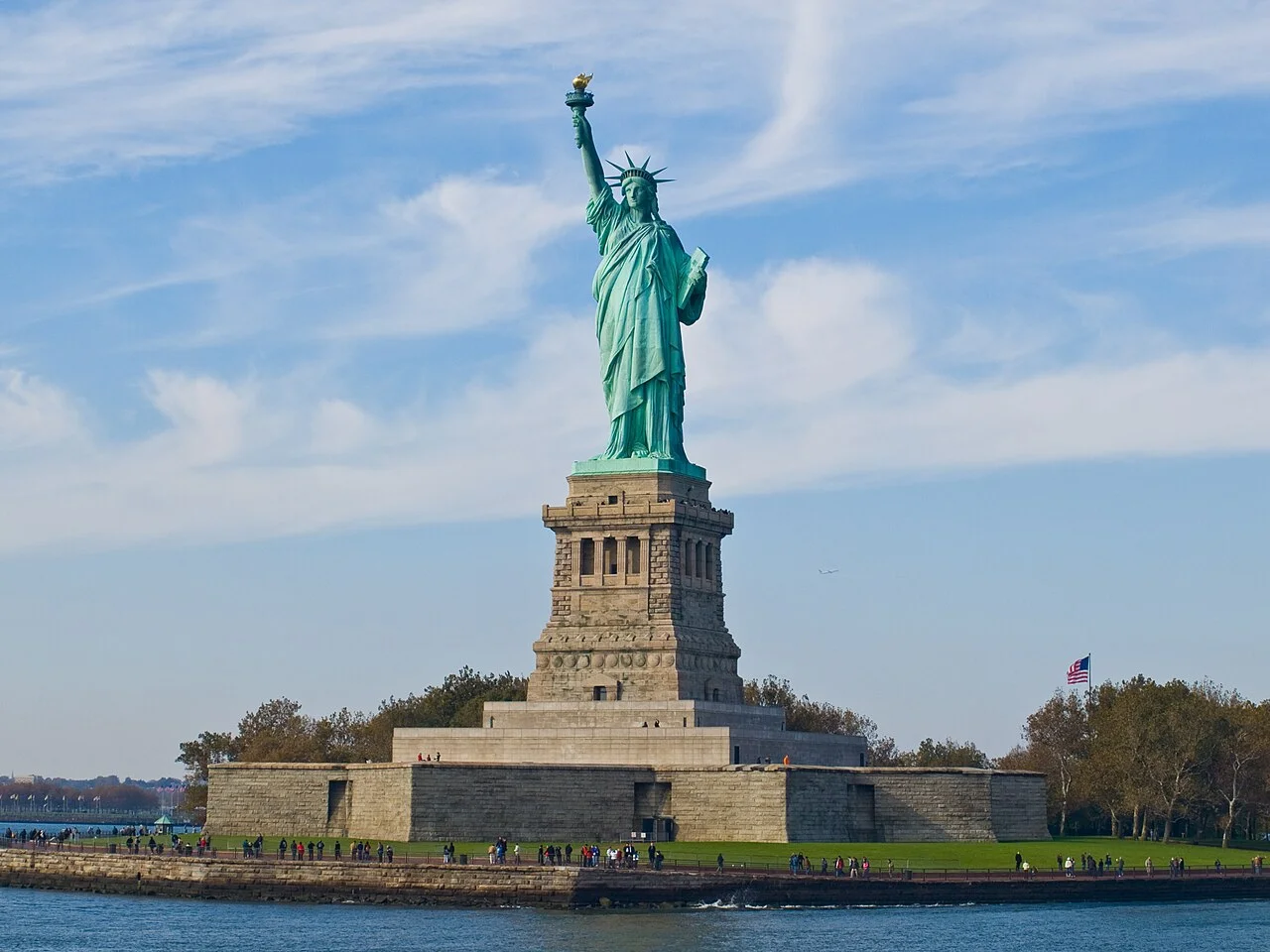
Between 1880 and 1920, more than 20 million immigrants arrived, many through Ellis Island in New York, from Italy, Ireland, Germany, Eastern Europe and elsewhere. The Statue of Liberty, a gift from France dedicated in 1886, became the symbol of welcome for newcomers.
In 1898 the US won the Spanish-American War and gained Puerto Rico, Guam and the Philippines, becoming a world power. Hawaii was annexed the same year.
7. World wars and the Great Depression (1914–1945)
- World War I: The US entered in 1917 and helped the Allies win in 1918. President Woodrow Wilson proposed the League of Nations.
- Roaring Twenties: Cars, radio, jazz and cinema boomed. Women won the right to vote with the 19th Amendment (1920).
- Great Depression: The stock market crash of October 1929 triggered the worst economic crisis in modern history; unemployment reached about 25%. President Franklin D. Roosevelt’s New Deal created jobs programmes, Social Security and bank regulations.
- World War II: After Japan attacked Pearl Harbor on 7 December 1941, the US joined the war. American industry became the “arsenal of democracy”. The war ended in 1945 after D-Day in Europe and the atomic bombings of Hiroshima and Nagasaki.
8. Cold War, civil rights and the space race (1945–1991)
After 1945 the US and the Soviet Union became rival superpowers in the Cold War. The US led NATO (1949), funded Europe’s recovery through the Marshall Plan, and fought wars in Korea (1950–1953) and Vietnam (US combat role mainly 1965–1973). The Cuban Missile Crisis (1962) brought the world close to nuclear war.
At home, the civil rights movement challenged segregation. Key moments include the Supreme Court’s Brown v. Board of Education (1954), Rosa Parks and the Montgomery bus boycott (1955), and Martin Luther King Jr.’s “I Have a Dream” speech (1963), inspired partly by Mahatma Gandhi’s non-violence. The Civil Rights Act (1964) and Voting Rights Act (1965) outlawed discrimination.
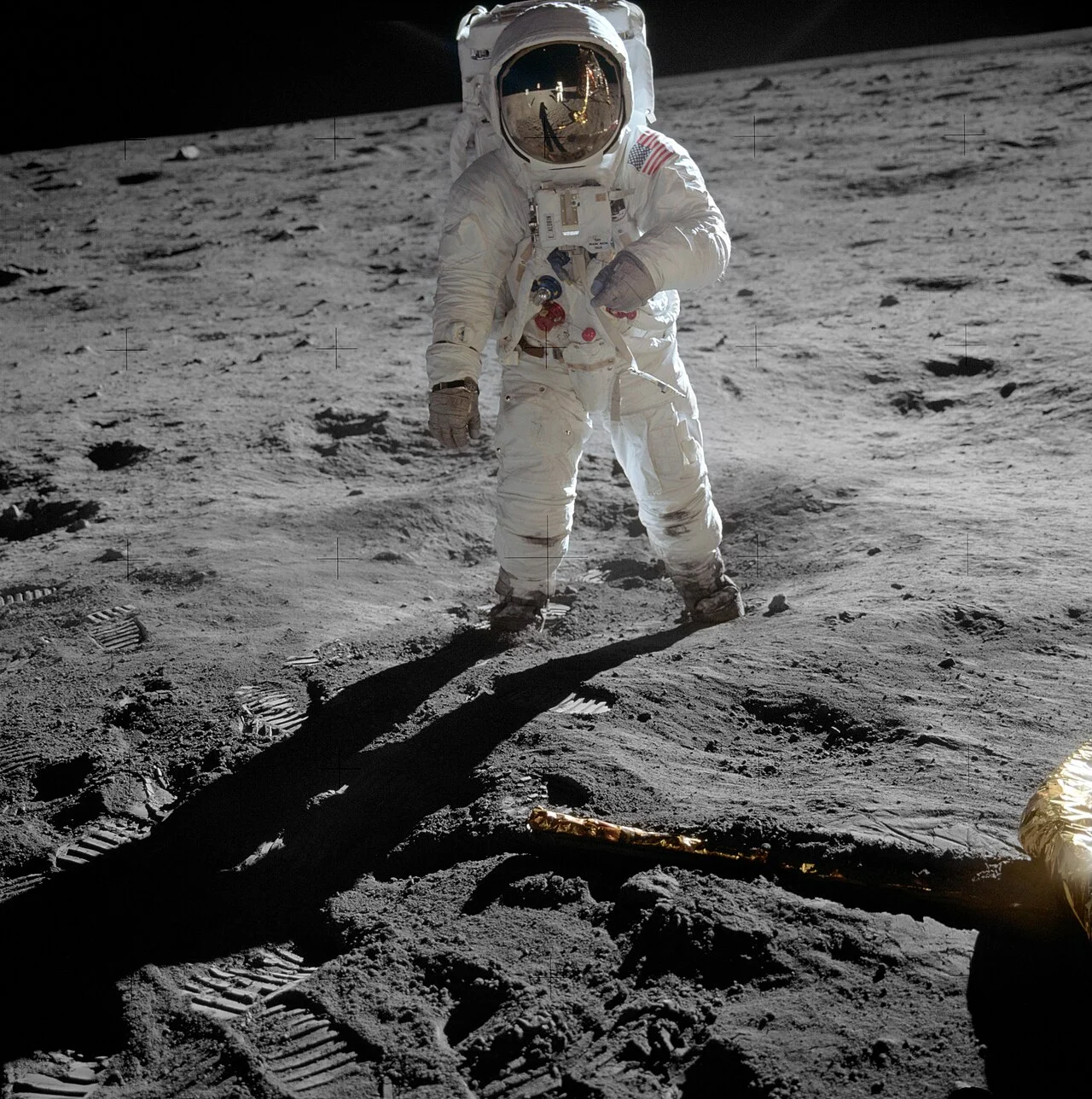
The space race began when the Soviet Union launched Sputnik in 1957. NASA answered with the Apollo programme, and on 20 July 1969, Neil Armstrong and Buzz Aldrin became the first humans to walk on the Moon.
9. Modern America (1991–today)
The Cold War ended with the collapse of the Soviet Union in 1991, leaving the US as the world’s only superpower. The 1990s brought the internet boom and the rise of Silicon Valley companies that now shape daily life worldwide.
- 11 September 2001: Terrorist attacks killed nearly 3,000 people, leading to wars in Afghanistan (2001–2021) and Iraq (2003–2011).
- 2008: A global financial crisis began with the US housing market. The same year, Barack Obama was elected as the first African American President.
- 2020: The COVID-19 pandemic hit the US hard.
- 2025: Donald Trump returned to the White House for a second, non-consecutive term.
- 2026: The nation marks its 250th birthday (semiquincentennial) on 4 July 2026.
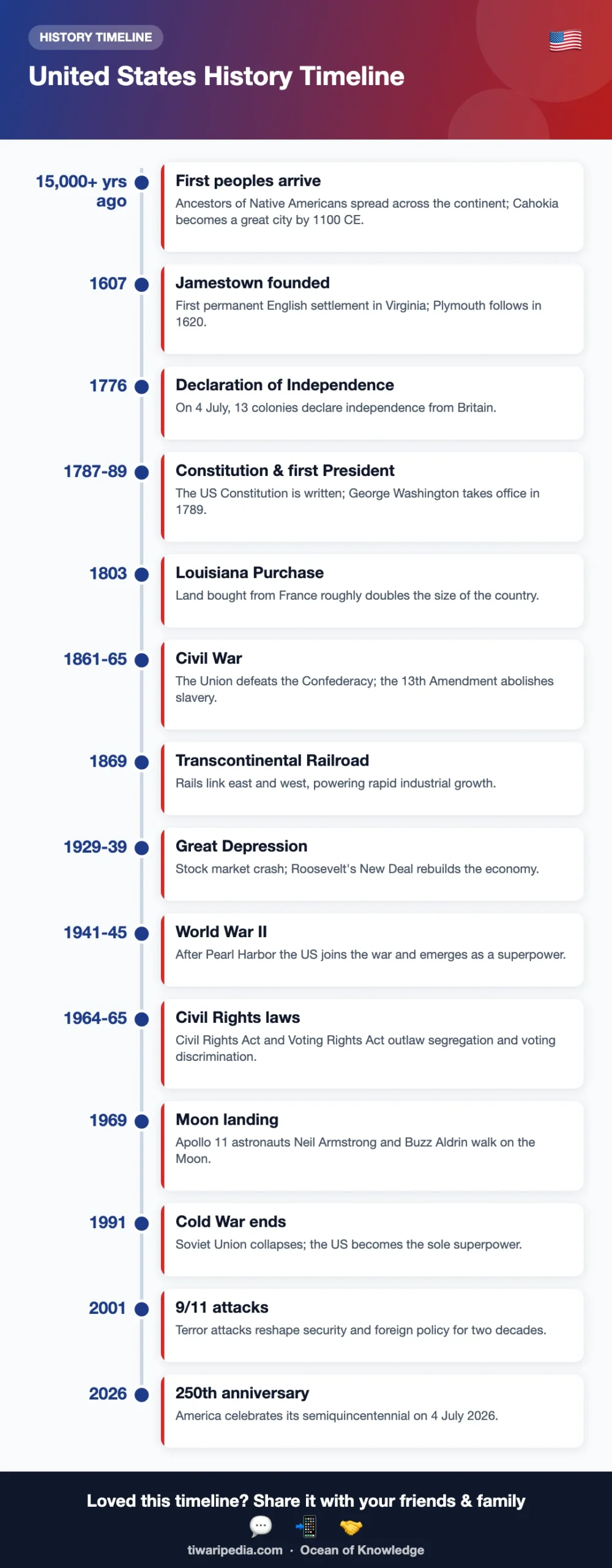
United States history timeline (infographic)
Famous American Presidents
| President | Term | Known for |
|---|---|---|
| George Washington | 1789–1797 | First President; set the two-term tradition |
| Thomas Jefferson | 1801–1809 | Wrote the Declaration; Louisiana Purchase |
| Abraham Lincoln | 1861–1865 | Won the Civil War; ended slavery |
| Theodore Roosevelt | 1901–1909 | National parks; Panama Canal |
| Franklin D. Roosevelt | 1933–1945 | New Deal; led the US in World War II; only President elected four times |
| John F. Kennedy | 1961–1963 | Cuban Missile Crisis; Moon goal; assassinated in 1963 |
| Ronald Reagan | 1981–1989 | End of the Cold War era |
| Barack Obama | 2009–2017 | First African American President |
The United States and India
India-US ties go back a long way. Swami Vivekananda’s famous speech at the Parliament of the World’s Religions in Chicago in 1893 introduced Indian philosophy to America. American scientist Norman Borlaug helped India’s Green Revolution in the 1960s. The 2008 India-US civil nuclear agreement transformed relations, and both countries now work together in the Quad with Japan and Australia. The Indian-American community of around 5 million people is one of the most successful immigrant groups in the US, with leaders at companies like Google and Microsoft.
The United States in the G7
The US was one of the six founding members of the G7 at the first summit in Rambouillet, France, in 1975. As the largest economy in the group, it plays a central role on trade, security, sanctions and technology. The US is set to hold the G7 presidency in 2027. Read our guide to the G7 countries and their history.
Frequently asked questions
When did the United States become independent?
The Declaration of Independence was adopted on 4 July 1776. Britain formally recognised independence in the Treaty of Paris in 1783.
Who was the first President of the United States?
George Washington, who served two terms from 1789 to 1797.
How many states are there in the USA?
There are 50 states. Alaska and Hawaii were the last to join, both in 1959.
What caused the American Civil War?
The main cause was slavery, especially whether it would spread to new western territories, combined with disputes over states’ rights and economic differences between North and South.
Why is 2026 important in American history?
2026 marks 250 years since the Declaration of Independence, celebrated as America’s semiquincentennial.
Explore the history of other G7 countries
- History of the United Kingdom
- History of France
- History of Germany
- History of Italy
- History of Japan
- History of Canada
- G7 countries: list, members and history
Related reading on Tiwaripedia
Facts are based on widely accepted historical sources at the time of writing. Images are from Wikimedia Commons under the licences credited in each caption. Spotted something that needs updating? Let us know.
Keep reading on Tiwaripedia
- 12 Incredible Facts About Apollo 11 and the First Moon Landing
- 15 Famous Monuments of India With Location & Builder
- 12 Incredible Facts About the Taj Mahal
- The Silk Road: History of the World’s Most Famous Trade Route
- History of Italy: Italian History Timeline From Ancient Rome to the Modern Republic
- G7 Countries List 2026: Members, History of the G7 and Each Nation, and India’s Role
More guides: All Country-wise History articles
