

Last updated: October 2026 · 14 min read
Italy has more UNESCO World Heritage Sites than almost any other country, and for good reason. In this boot-shaped peninsula, Rome built an empire that ruled the Mediterranean for centuries, the Catholic Church made its home, and the Renaissance gave the world Leonardo da Vinci and Michelangelo. Yet Italy itself only became a single country in 1861. This guide covers the complete history of Italy, from the Etruscans and ancient Rome to the Risorgimento, fascism and the modern Republic, with an Italian history timeline infographic.
Italy: quick facts
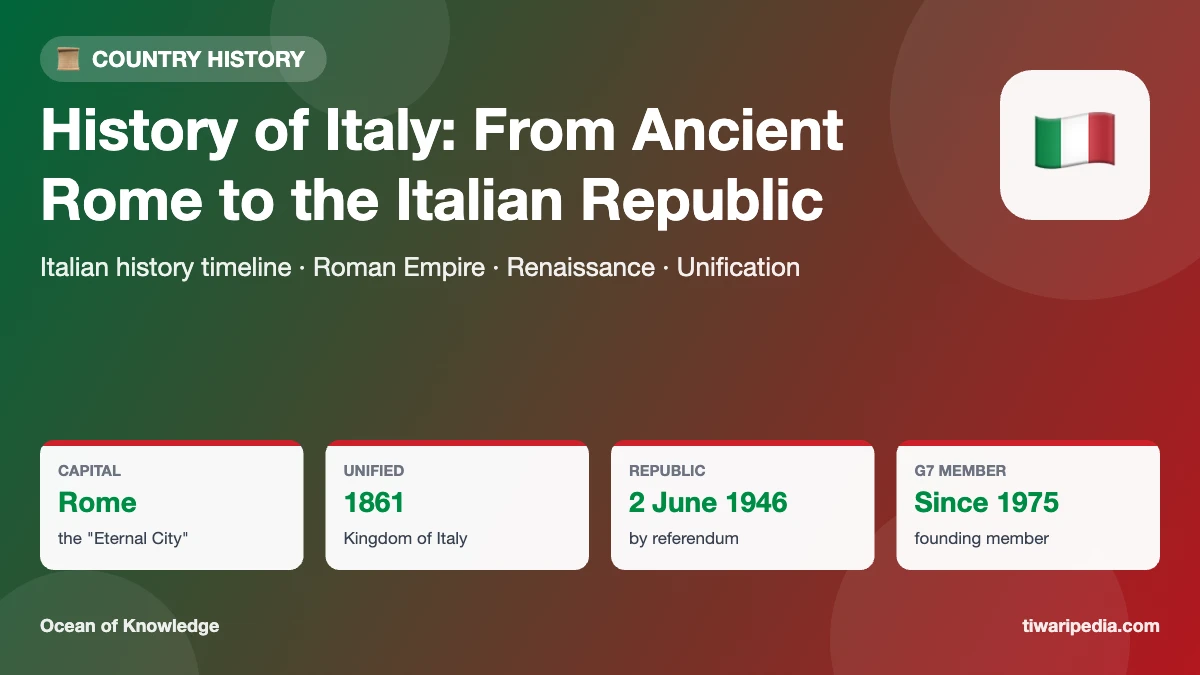
| Official name | Italian Republic (Repubblica Italiana) |
|---|---|
| Capital | Rome |
| Unification | 17 March 1861 |
| Republic | Since 2 June 1946 (Festa della Repubblica) |
| Government | Parliamentary republic, 20 regions |
| Prime Minister | Giorgia Meloni (since October 2022) |
| Population | About 59 million |
| Currency | Euro (EUR) |
| G7 membership | Founding member (1975) |
In this article
- Early Italy and the Etruscans
- Ancient Rome: kingdom, republic and empire
- The Middle Ages and the city-states
- The Renaissance
- Foreign rule (1500–1815)
- The Risorgimento: unifying Italy
- World wars and fascism
- The Italian Republic
- Timeline infographic
- FAQs
1. Early Italy and the Etruscans (before 509 BCE)
Humans have lived in Italy for hundreds of thousands of years. In the first millennium BCE, many peoples shared the peninsula: Latins, Samnites, Umbrians and others. The most advanced were the Etruscans of Tuscany, skilled in metalwork, engineering and art, who strongly influenced early Rome. Greek colonists settled in the south and Sicily (called “Magna Graecia”), founding cities like Naples (Neapolis) and Syracuse.
2. Ancient Rome: kingdom, republic and empire (753 BCE–476 CE)
According to legend, Romulus founded Rome in 753 BCE. After a period of kings, the Romans set up the Roman Republic in 509 BCE, ruled by two elected consuls and the Senate. Rome conquered Italy, then defeated Carthage in the Punic Wars (including the famous invasion by Hannibal and his elephants), and came to dominate the Mediterranean.
Civil wars ended the Republic. Julius Caesar became dictator and was assassinated in 44 BCE. His heir Octavian became the first emperor, Augustus, in 27 BCE, beginning two centuries of relative peace known as the Pax Romana. At its height around 117 CE, the empire stretched from Britain to Egypt and Iraq.
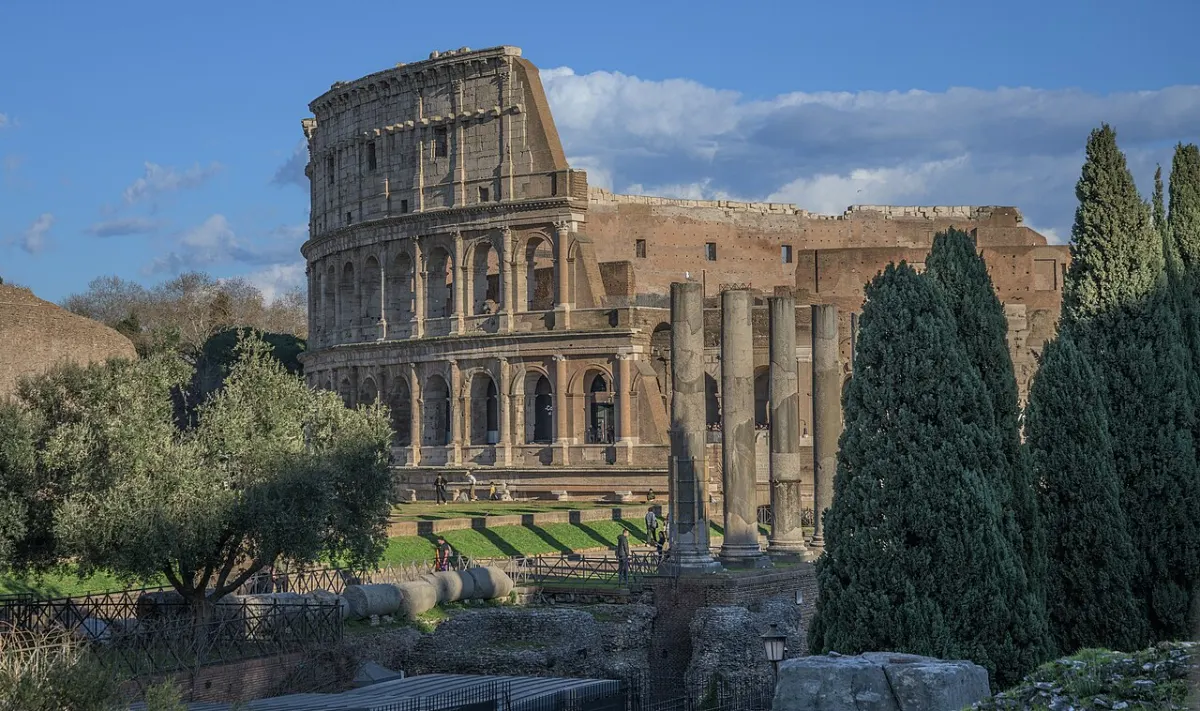
- Romans built roads, aqueducts, bridges and huge buildings like the Colosseum (opened 80 CE) and the Pantheon.
- Roman law, Latin and the calendar shaped European civilisation.
- In 79 CE, Mount Vesuvius buried Pompeii and Herculaneum, preserving them for archaeologists.
- Christianity spread and, under Emperor Constantine, became favoured from 313 CE.
The empire was split into East and West. The Western Empire, weakened by invasions and economic problems, ended in 476 CE, when the last emperor, Romulus Augustulus, was deposed. Read more in our guide to the rise and fall of the Roman Empire.
3. The Middle Ages and the city-states (476–1400)
After Rome’s fall, Italy was divided among Ostrogoths, the Byzantine Empire, Lombards and Franks. The Pope in Rome ruled the Papal States in central Italy, while Arabs and later Normans controlled Sicily and the south.
From around 1000 CE, northern and central Italy saw the rise of powerful, self-governing city-states:
- Venice and Genoa became great maritime republics trading with the Byzantine and Islamic worlds and beyond. The Venetian merchant Marco Polo travelled to China and India in the late 13th century.
- Florence grew rich on wool and banking; its gold florin was trusted across Europe.
- Milan, Bologna (home of the world’s oldest university, founded 1088) and Pisa also flourished.
The poet Dante Alighieri wrote the Divine Comedy (early 1300s) in the Tuscan dialect, which became the basis of modern Italian.
4. The Renaissance (about 1400–1550)
The Renaissance (“rebirth”) began in Florence, supported by wealthy patrons like the Medici family. Artists and thinkers rediscovered ancient Greek and Roman learning and placed new focus on human potential.
- Leonardo da Vinci painted the Mona Lisa and The Last Supper and sketched flying machines.
- Michelangelo sculpted David and painted the Sistine Chapel ceiling.
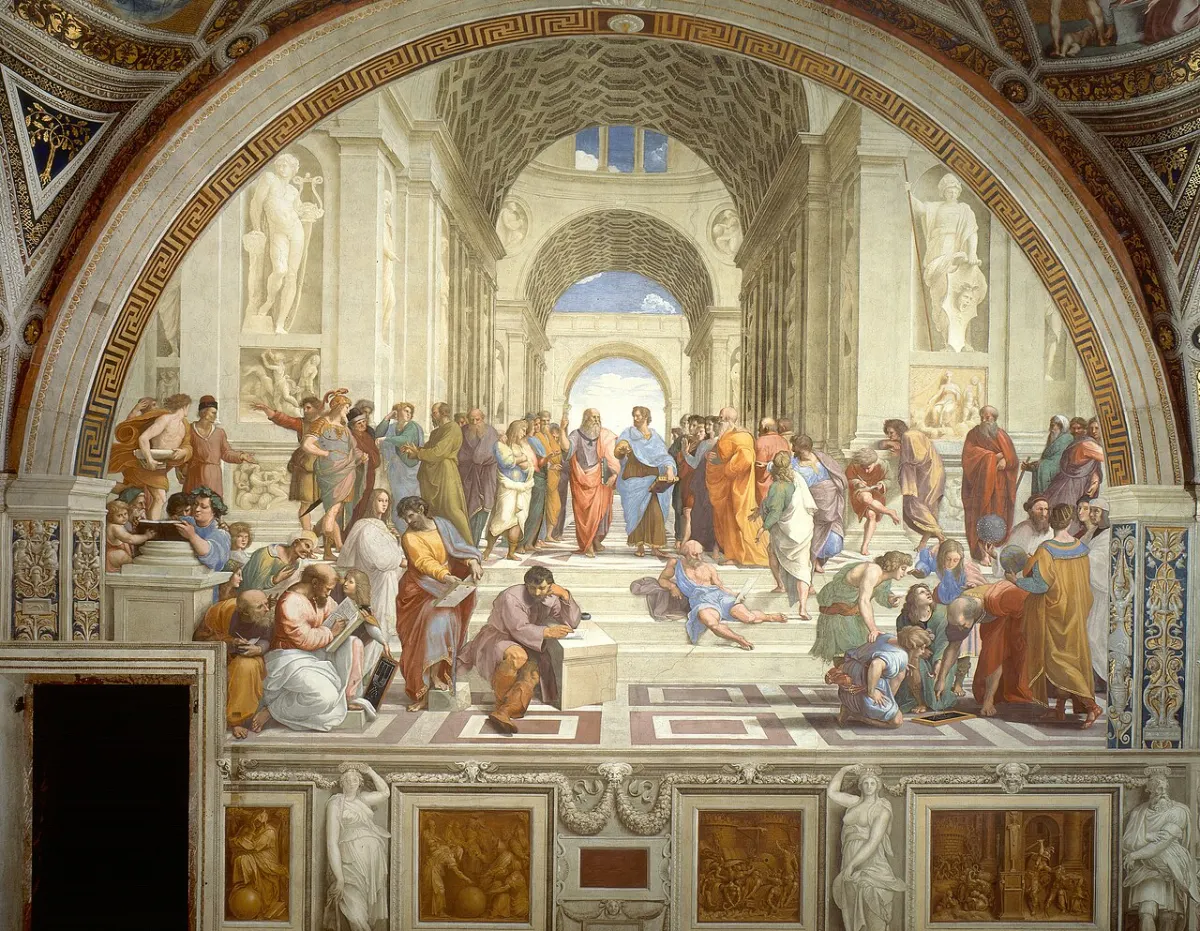
- Raphael painted The School of Athens in the Vatican.
- Brunelleschi built the great dome of Florence Cathedral.
- Machiavelli wrote The Prince (1513), a founding work of political science.
Italian explorers also reshaped the world map: Christopher Columbus (from Genoa) reached the Americas in 1492, and Amerigo Vespucci (from Florence) gave his name to “America”. Later, Galileo Galilei used the telescope to support the idea that the Earth moves around the Sun.
5. Foreign rule (1500–1815)
Divided and rich, Italy became a battleground for Europe’s great powers. From the Italian Wars (1494–1559) onward, much of the peninsula was controlled by Spain and later Austria. Napoleon conquered Italy in the 1790s and briefly created a Kingdom of Italy, spreading ideas of nationhood. After his defeat in 1815, Austria regained power in the north.
6. The Risorgimento: unifying Italy (1815–1871)
The Risorgimento (“resurgence”) was the movement to unite Italy. Its three great heroes were:
- Giuseppe Mazzini, the idealist who inspired young nationalists.
- Count Camillo Cavour, the clever Prime Minister of Piedmont-Sardinia, who won French support against Austria.
- Giuseppe Garibaldi, the soldier whose “Expedition of the Thousand” (Redshirts) conquered Sicily and Naples in 1860.

On 17 March 1861, the Kingdom of Italy was proclaimed, with Victor Emmanuel II as king. Venice was added in 1866, and in 1870 Italian troops entered Rome, which became the capital in 1871. The Pope withdrew to the Vatican; Vatican City became an independent state in 1929.
Millions of Italians, especially from the poor south, emigrated to the Americas between 1880 and 1915, spreading Italian food and culture around the world.
7. World wars and fascism (1915–1945)
Italy joined World War I on the Allied side in 1915 and gained territory, but suffered heavy losses and economic hardship. In 1922, Benito Mussolini and his Fascist Party seized power after the “March on Rome”. Mussolini built a dictatorship, invaded Ethiopia (1935) and allied with Hitler. Italy entered World War II in 1940. After Allied landings in Sicily in 1943, Mussolini was overthrown; Italy switched sides, and the Resistance fought the German occupiers. Mussolini was captured and executed by partisans in April 1945.
8. The Italian Republic (1946–today)
- 2 June 1946: in a referendum, Italians voted to abolish the monarchy and create a republic. Women voted nationally for the first time.
- 1948: the new Constitution came into force.
- 1950s–60s: the “economic miracle” transformed Italy into an industrial power, famous for Fiat cars, Vespa scooters, fashion and design.
- 1957: Italy co-founded the EEC with the Treaty of Rome.
- 2002: the euro replaced the lira.
- 2020: Italy was the first European country hit hard by COVID-19.
- 2022: Giorgia Meloni became Italy’s first woman Prime Minister.
- 2026: Milan and Cortina d’Ampezzo hosted the Winter Olympics in February.
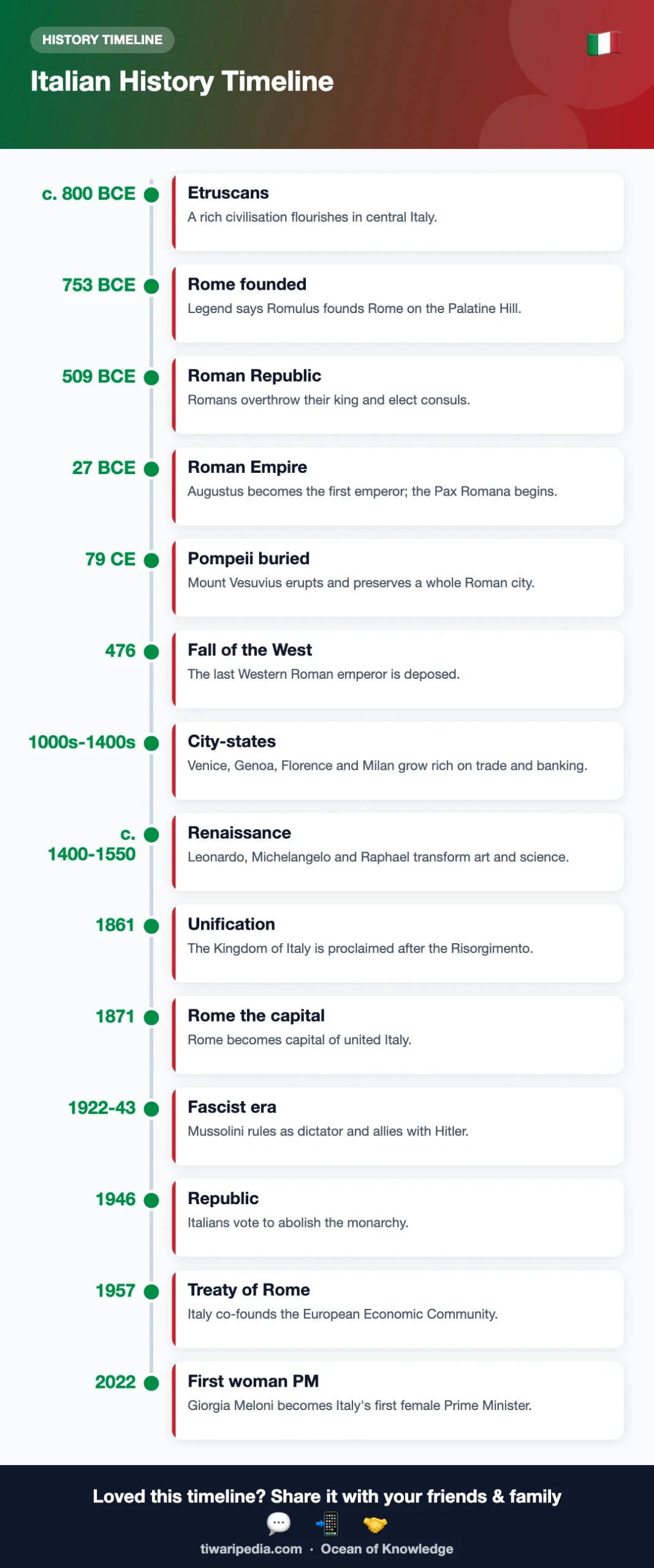
Italian history timeline (infographic)
Famous figures in Italian history
| Name | Period | Known for |
|---|---|---|
| Julius Caesar | 100–44 BCE | Conquered Gaul, ended the Republic |
| Augustus | 27 BCE–14 CE | First Roman emperor |
| Dante Alighieri | 1265–1321 | Divine Comedy, father of the Italian language |
| Leonardo da Vinci | 1452–1519 | Mona Lisa, inventions |
| Michelangelo | 1475–1564 | David, Sistine Chapel |
| Galileo Galilei | 1564–1642 | Father of modern science |
| Giuseppe Garibaldi | 1807–1882 | Hero of unification |
| Giorgia Meloni | 2022–present | First woman Prime Minister |
Italy and India: 2,000 years of links
Trade between Rome and India was booming 2,000 years ago. Roman ships sailed to the ports of Muziris in Kerala and Arikamedu near Puducherry for pepper, spices, gems and fine cloth, and hoards of Roman gold coins have been found across south India. In World War II, Indian soldiers fought with great bravery in the Italian campaign, including at Monte Cassino. Today Italy is a major trading partner, and a large Indian community, especially Punjabis working in agriculture and dairy farming in northern Italy, lives in the country.
Italy in the G7
Italy was one of the six countries at the first G7 summit in 1975 and has hosted it several times, most recently at Borgo Egnazia in Puglia in June 2024, where Prime Minister Narendra Modi attended as a guest. See all G7 countries and their history.
Frequently asked questions
When did Italy become a country?
The Kingdom of Italy was proclaimed on 17 March 1861. Rome became the capital in 1871, and Italy became a republic on 2 June 1946.
Who unified Italy?
Mainly Cavour (the statesman), Garibaldi (the soldier), Mazzini (the idealist) and King Victor Emmanuel II.
Why did the Renaissance start in Italy?
Italy’s rich trading cities, wealthy patrons like the Medici, Roman ruins and contact with Greek scholars from Byzantium created the perfect conditions.
When did the Roman Empire fall?
The Western Roman Empire fell in 476 CE. The Eastern (Byzantine) Empire survived until 1453.
Is Vatican City part of Italy?
No. Vatican City is an independent country inside Rome, created in 1929, and is the world’s smallest state.
Explore the history of other G7 countries
- History of the United States
- History of the United Kingdom
- History of France
- History of Germany
- History of Japan
- History of Canada
- G7 countries: list, members and history
Related reading on Tiwaripedia
- The Roman Empire: rise and fall
- 12 incredible facts about Kerala
- World War II in brief
- More country-wise history
Facts are based on widely accepted historical sources at the time of writing. Images are from Wikimedia Commons under the licences credited in each caption. Spotted something that needs updating? Let us know.
Keep reading on Tiwaripedia
- History of Japan: Japanese History Timeline From the Jōmon Period to Modern Japan
- 12 Incredible Facts About the Olympic Games
- 15 Famous Monuments of India With Location & Builder
- History of the United Kingdom: British History Timeline From Stonehenge to King Charles III
- 12 Incredible Facts About Indian Railways
- 12 Incredible Facts About Apollo 11 and the First Moon Landing
More guides: All Country-wise History articles
