

Last updated: October 2026 · 14 min read
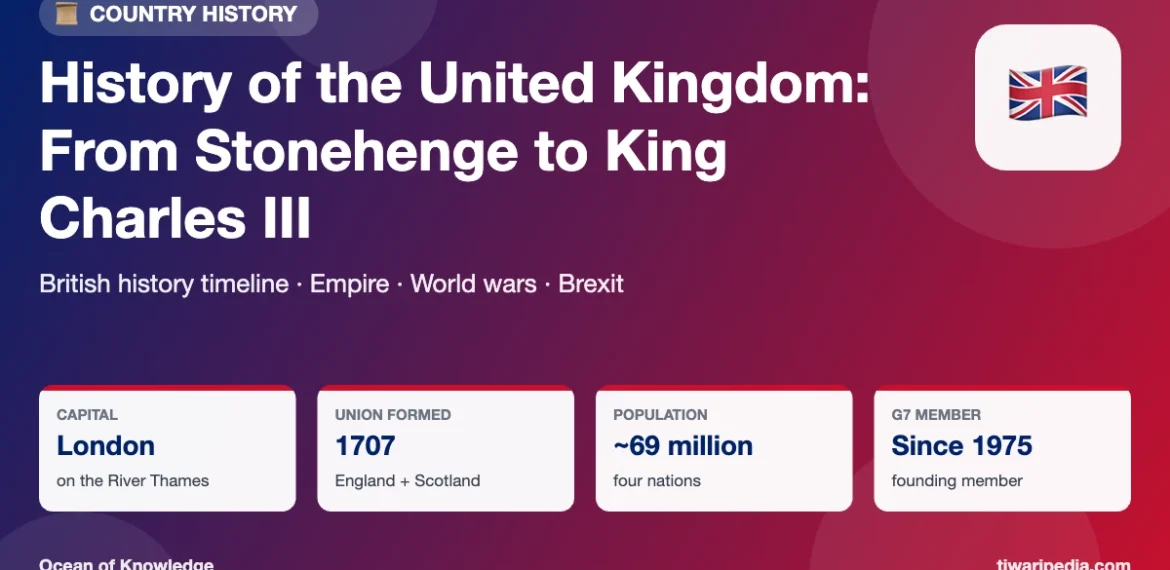
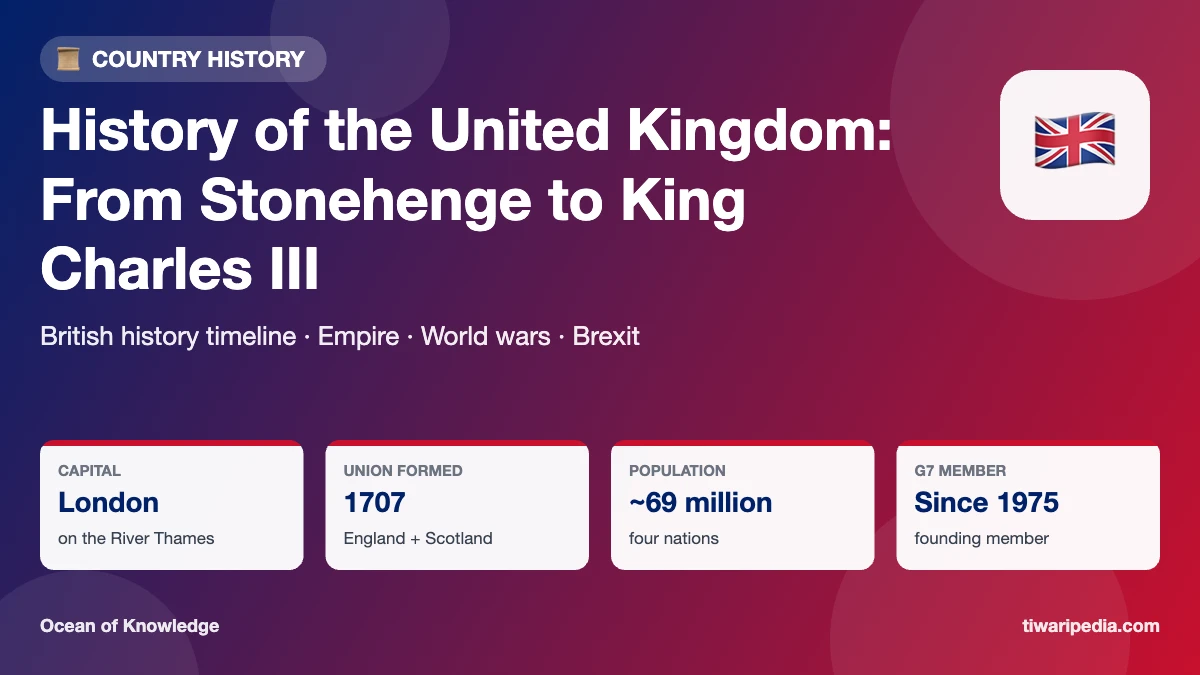
Few countries have shaped the modern world as much as Britain. The English language, parliamentary democracy, the Industrial Revolution, modern sport like cricket and football, and an empire that once covered a quarter of the planet all trace back to these islands off north-west Europe. This guide covers the history of the United Kingdom in detail, from Stonehenge and the Romans to the Tudors, the British Empire, two world wars, Brexit and King Charles III, with a complete British history timeline infographic.
United Kingdom: quick facts
| Official name | United Kingdom of Great Britain and Northern Ireland |
|---|---|
| Capital | London |
| Nations | England, Scotland, Wales and Northern Ireland |
| Formed | 1707 (Great Britain), 1801 (with Ireland), 1922 (current form) |
| Government | Constitutional monarchy and parliamentary democracy |
| Head of state | King Charles III (since 2022) |
| Prime Minister | Keir Starmer (since July 2024) |
| Population | About 69 million |
| Currency | Pound sterling (GBP) |
| G7 membership | Founding member (1975) |
Britain vs UK vs England: England is one nation. Great Britain is the island containing England, Scotland and Wales. The United Kingdom adds Northern Ireland.
In this article
- Prehistoric Britain
- Roman, Anglo-Saxon and Viking Britain
- Medieval England and Magna Carta
- The Tudors and Stuarts
- Union, Parliament and the Industrial Revolution
- The Victorian era and the British Empire
- The two world wars
- Post-war Britain, Europe and Brexit
- Timeline infographic
- FAQs
1. Prehistoric Britain (before 43 CE)
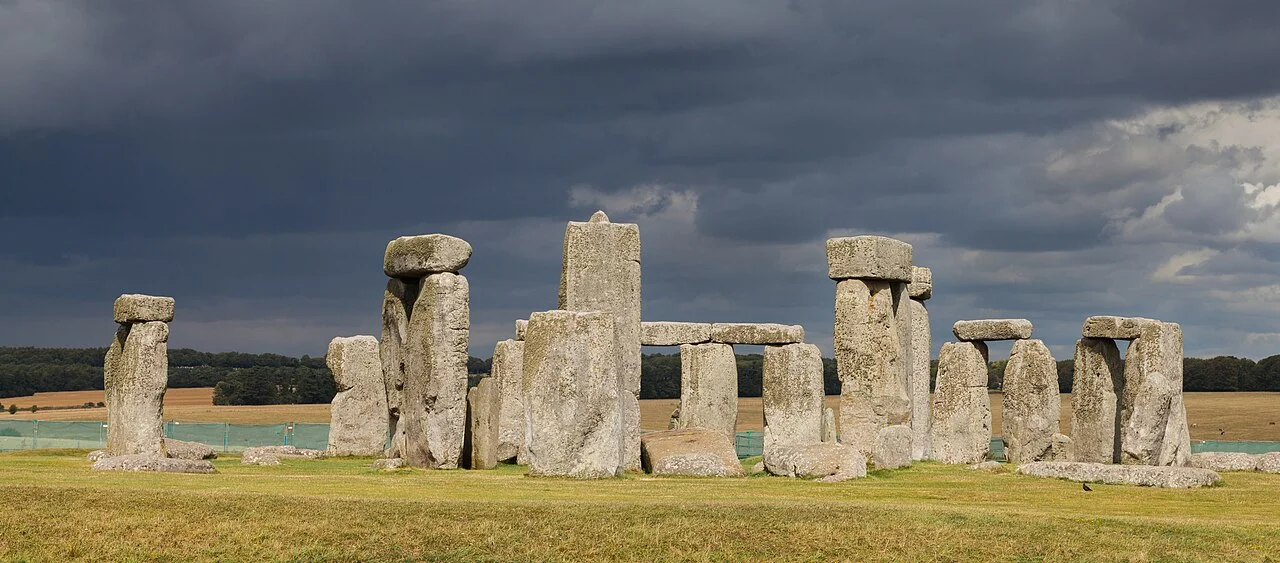
Humans have lived in Britain on and off for nearly a million years. Around 6000 BCE, rising seas cut Britain off from mainland Europe, making it an island. Neolithic farmers built huge monuments, including Stonehenge (begun around 3000 BCE) and Avebury, aligned with the sunrise and sunset of the solstices. In the Iron Age, Celtic tribes built hill forts and traded with Europe.
2. Roman, Anglo-Saxon and Viking Britain (43–1066)
The Romans invaded in 43 CE under Emperor Claudius. They founded Londinium (London), built roads, towns and baths, and constructed Hadrian’s Wall (from 122 CE) to guard the northern frontier. Queen Boudica of the Iceni led a famous revolt in 60–61 CE. Roman rule ended around 410 CE.
Germanic peoples, the Angles, Saxons and Jutes, then settled much of the land, which became known as England (“land of the Angles”). Christianity spread from 597 CE. From 793, Vikings raided and settled large areas. King Alfred the Great of Wessex resisted them, and his descendants united England as one kingdom in the 10th century.
3. Medieval England and Magna Carta (1066–1485)
In 1066, William of Normandy defeated King Harold at the Battle of Hastings. The Norman Conquest brought castles, feudalism, French words into English, and the Domesday Book (1086), a great survey of the kingdom.
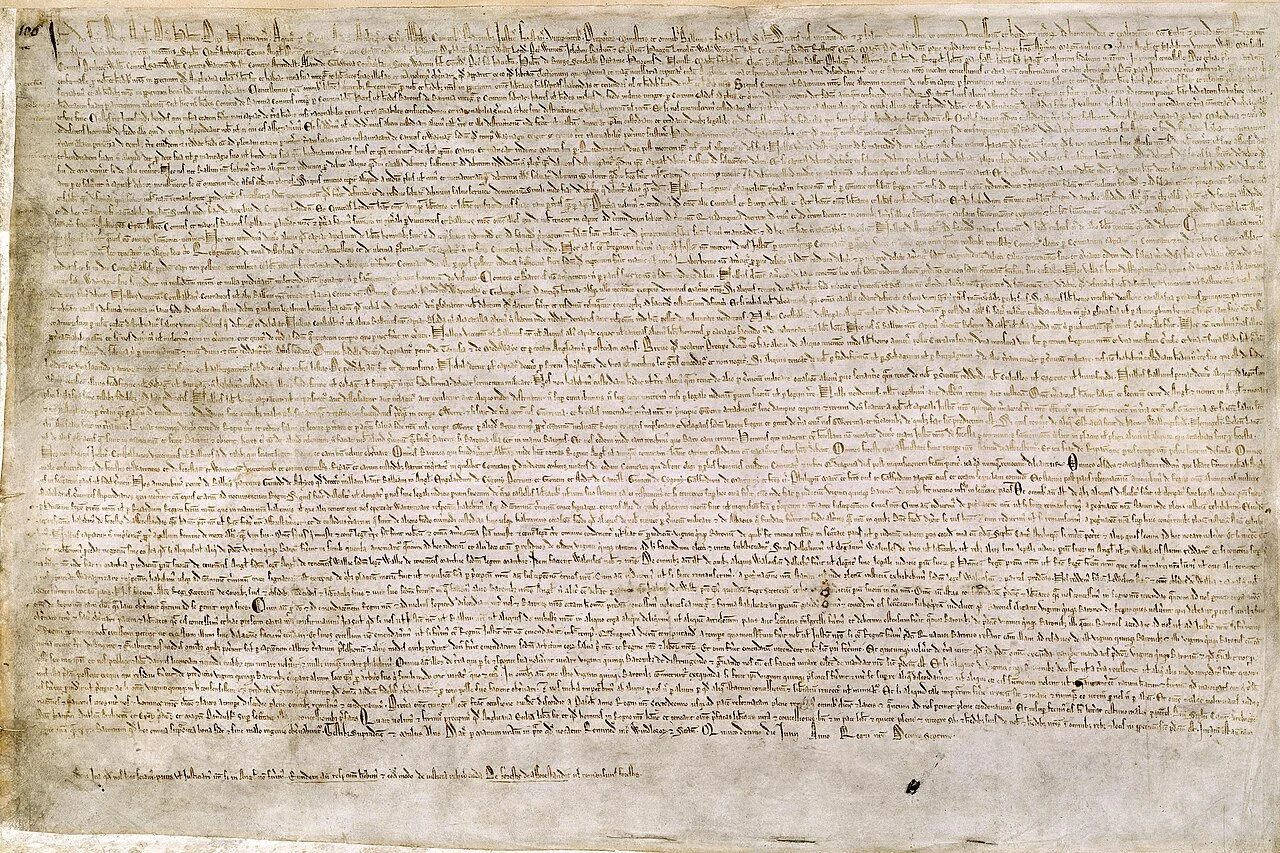
In 1215, rebel barons forced King John to seal Magna Carta (“Great Charter”). It said that even the king must obey the law and that free men could not be imprisoned without lawful judgement. Magna Carta inspired later documents including the US Bill of Rights and the Universal Declaration of Human Rights.
- The first Parliament with representatives of towns met in 1265.
- Edward I conquered Wales in the 1280s; Scotland kept its independence after victories by William Wallace and Robert the Bruce (Bannockburn, 1314).
- The Black Death (1348–1350) killed perhaps a third or more of the population.
- The Hundred Years’ War with France (1337–1453) and the Wars of the Roses (1455–1485) between the Houses of Lancaster and York followed.
4. The Tudors and Stuarts (1485–1688)
Henry VII founded the Tudor dynasty in 1485. His son Henry VIII, famous for his six wives, broke with the Pope and created the Church of England (1534). His daughter Elizabeth I (1558–1603) presided over a golden age: the defeat of the Spanish Armada in 1588, voyages of exploration, and the plays of William Shakespeare. The East India Company was founded in 1600, beginning Britain’s long and complicated relationship with India.
In 1603 James VI of Scotland became James I of England, uniting the two crowns. Conflict between king and Parliament led to the English Civil War (1642–1651); King Charles I was executed in 1649 and Oliver Cromwell ruled until the monarchy was restored in 1660. The Glorious Revolution of 1688 replaced James II with William and Mary, and the Bill of Rights (1689) established that Parliament, not the monarch, held supreme power.
5. Union, Parliament and the Industrial Revolution (1707–1837)
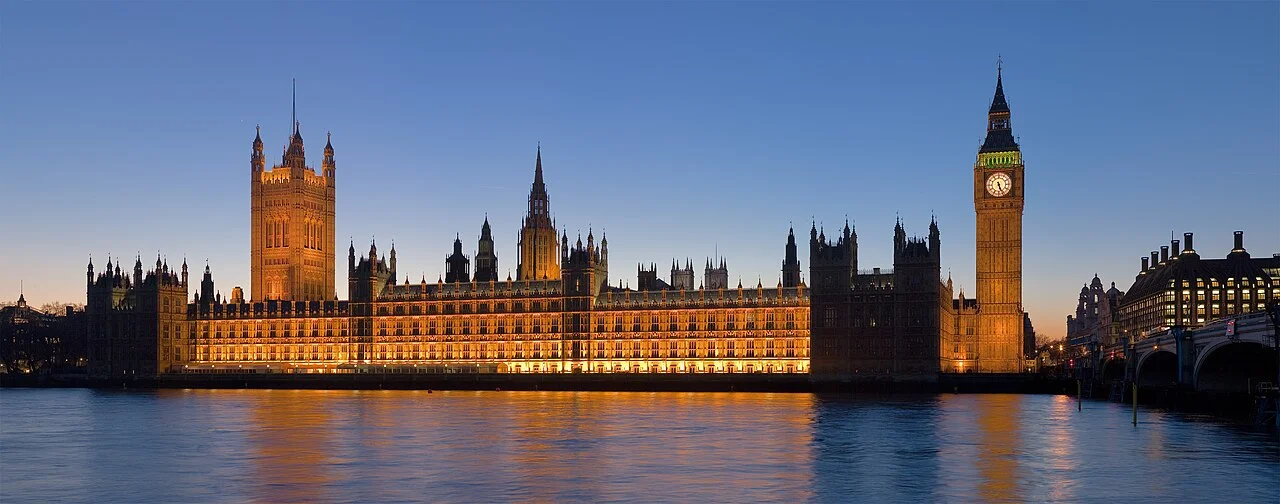
The Acts of Union 1707 joined England (including Wales) and Scotland into the Kingdom of Great Britain, with one Parliament at Westminster. Ireland was added in 1801. Robert Walpole is regarded as the first Prime Minister (from 1721).
From the 1760s, Britain led the Industrial Revolution: James Watt’s improved steam engine, textile mills, coal mining, canals and, from the 1820s, railways. Britain lost its American colonies in 1783 but defeated Napoleon at Trafalgar (1805) and Waterloo (1815), becoming the world’s leading power. Parliament abolished the slave trade in 1807 and slavery across most of the empire in 1833.
6. The Victorian era and the British Empire (1837–1914)
Queen Victoria reigned from 1837 to 1901. It was said that “the sun never set” on the British Empire, which at its peak in the early 20th century covered about a quarter of the world’s land and people, including India, Canada, Australia, large parts of Africa and many islands.
- After the 1857 uprising in India, the British Crown took direct control from the East India Company in 1858 (the British Raj), and Victoria became Empress of India in 1877.
- London hosted the Great Exhibition of 1851 and became the world’s largest city and financial centre.
- Reforms expanded voting rights, introduced public schools and improved factory conditions.
7. The two world wars (1914–1945)
Britain fought in World War I (1914–1918) alongside France and Russia; nearly a million soldiers from Britain and the Empire died, including Indian troops on the Western Front. Women over 30 won the vote in 1918 (equal voting in 1928). Most of Ireland became independent in 1922, leaving Northern Ireland in the UK.
In World War II (1939–1945), Prime Minister Winston Churchill led Britain after 1940. The country survived the Battle of Britain and the Blitz, and with the US, the Soviet Union and Commonwealth forces (including over 2.5 million Indian volunteers) helped defeat Nazi Germany.
8. Post-war Britain, Europe and Brexit (1945–today)
- 1945–1951: Clement Attlee’s government created the National Health Service (1948) and the welfare state.
- 1947: India and Pakistan became independent, beginning decolonisation; most colonies became independent by the 1960s and joined the Commonwealth.
- 1952: Elizabeth II became Queen; she reigned for 70 years, the longest in British history.
- 1973: The UK joined the European Economic Community.
- 1979–1990: Margaret Thatcher, the first woman Prime Minister, transformed the economy.
- 1998: The Good Friday Agreement brought peace to Northern Ireland; Scotland and Wales gained their own parliaments.
- 2016–2020: In the Brexit referendum, 52% voted to leave the EU; the UK left on 31 January 2020.
- 2022: Queen Elizabeth II died; King Charles III was crowned in 2023.
- 2024: Keir Starmer’s Labour Party won the general election.
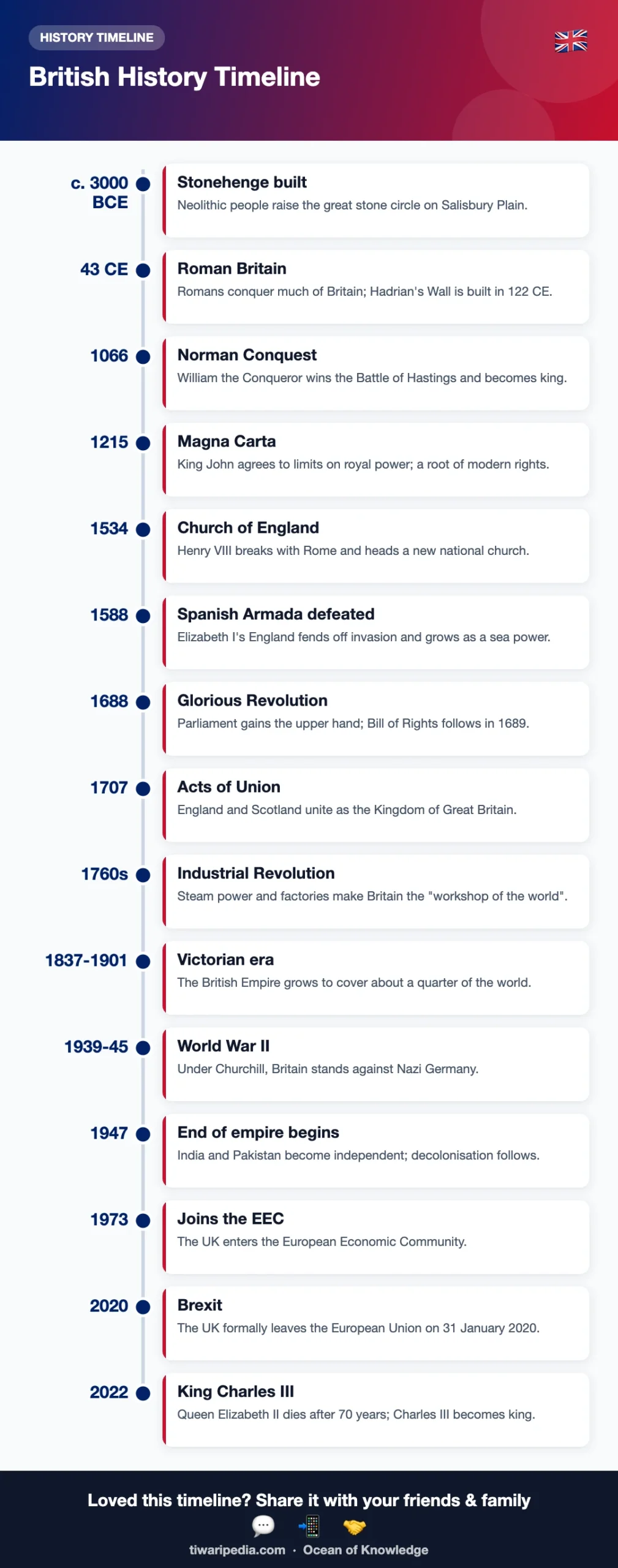
British history timeline (infographic)
Famous British monarchs and Prime Ministers
| Name | Period | Known for |
|---|---|---|
| William the Conqueror | 1066–1087 | Norman Conquest, Domesday Book |
| Henry VIII | 1509–1547 | Church of England, six wives |
| Elizabeth I | 1558–1603 | Armada victory, Shakespeare’s age |
| Queen Victoria | 1837–1901 | Height of the British Empire |
| Winston Churchill (PM) | 1940–45, 1951–55 | Wartime leader against Hitler |
| Elizabeth II | 1952–2022 | Longest-reigning British monarch |
| Charles III | 2022–present | Current King |
Britain and India: a shared and complex history
The East India Company arrived in India in the early 1600s. After victory at the Battle of Plassey (1757), it gradually took control of much of the subcontinent. British rule brought railways, English education and a unified administration, but also famines, economic drain and the violent end of empire in the Partition of 1947. Today the two countries are close partners: about 1.8 million people of Indian origin live in the UK, and India and the UK signed a free trade agreement in 2025.
The UK in the G7
The United Kingdom was a founding member of the G7 in 1975 and has hosted summits many times, most recently at Carbis Bay, Cornwall, in 2021. See all G7 countries and their history.
Frequently asked questions
When was the United Kingdom formed?
Great Britain was formed in 1707 when England and Scotland united. Ireland joined in 1801, creating the United Kingdom of Great Britain and Ireland. The current name dates from 1927, after most of Ireland became independent in 1922.
Why is Magna Carta important?
Signed in 1215, it established the idea that everyone, including the king, is subject to the law. It influenced democracies and human rights laws around the world.
How big was the British Empire?
At its peak around 1920 it covered about 35 million square kilometres, roughly a quarter of the world’s land, and ruled over about 450 million people.
When did the UK leave the European Union?
The UK left the EU on 31 January 2020, after the 2016 referendum.
Who is the current monarch of the UK?
King Charles III, who became king on 8 September 2022 after the death of Queen Elizabeth II.
Explore the history of other G7 countries
- History of the United States
- History of France
- History of Germany
- History of Italy
- History of Japan
- History of Canada
- G7 countries: list, members and history
Related reading on Tiwaripedia
Facts are based on widely accepted historical sources at the time of writing. Images are from Wikimedia Commons under the licences credited in each caption. Spotted something that needs updating? Let us know.
Keep reading on Tiwaripedia
- 15 Famous Monuments of India With Location & Builder
- The Silk Road: History of the World’s Most Famous Trade Route
- History of Germany: German History Timeline From the Holy Roman Empire to Reunification
- History of the United States: American History Timeline From Native Americans to 2026
- History of Canada: Canadian History Timeline From First Nations to Confederation and Today
- 12 Incredible Facts About the Taj Mahal
More guides: All Country-wise History articles
