Last updated: October 2026 · 5 min read
Rising on the banks of the Yamuna in Agra, the Taj Mahal is one of the most beautiful buildings ever made and a symbol of India around the world. Here are 12 incredible facts about it.
12 incredible facts about the Taj Mahal
1. It was built as a memorial of love
Mughal emperor Shah Jahan built the Taj Mahal in memory of his wife Mumtaz Mahal, who died in 1631 while giving birth to their 14th child.
2. It took about two decades
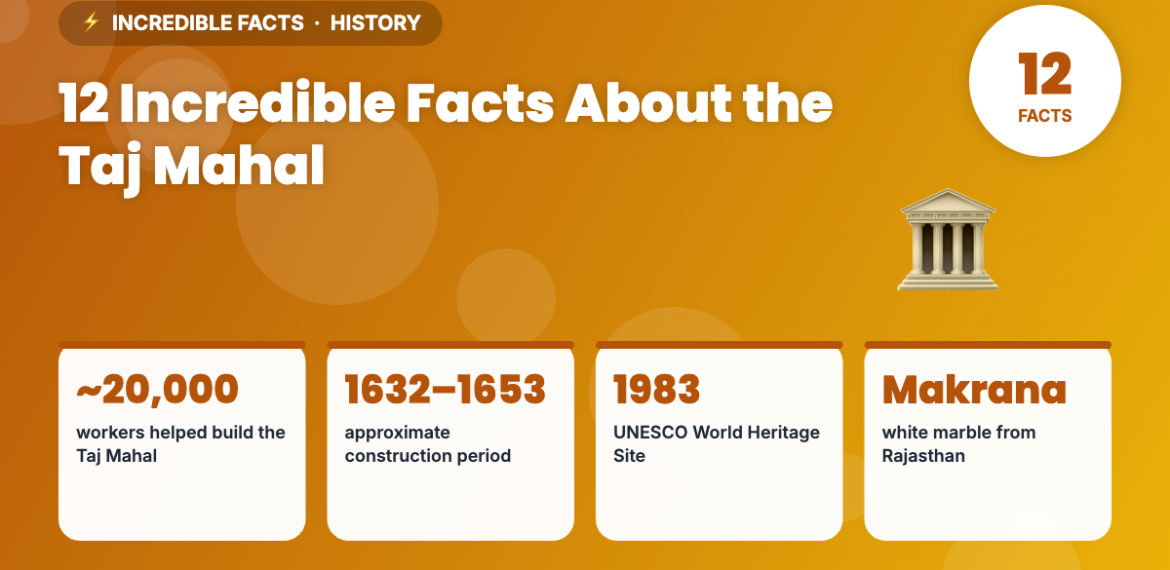
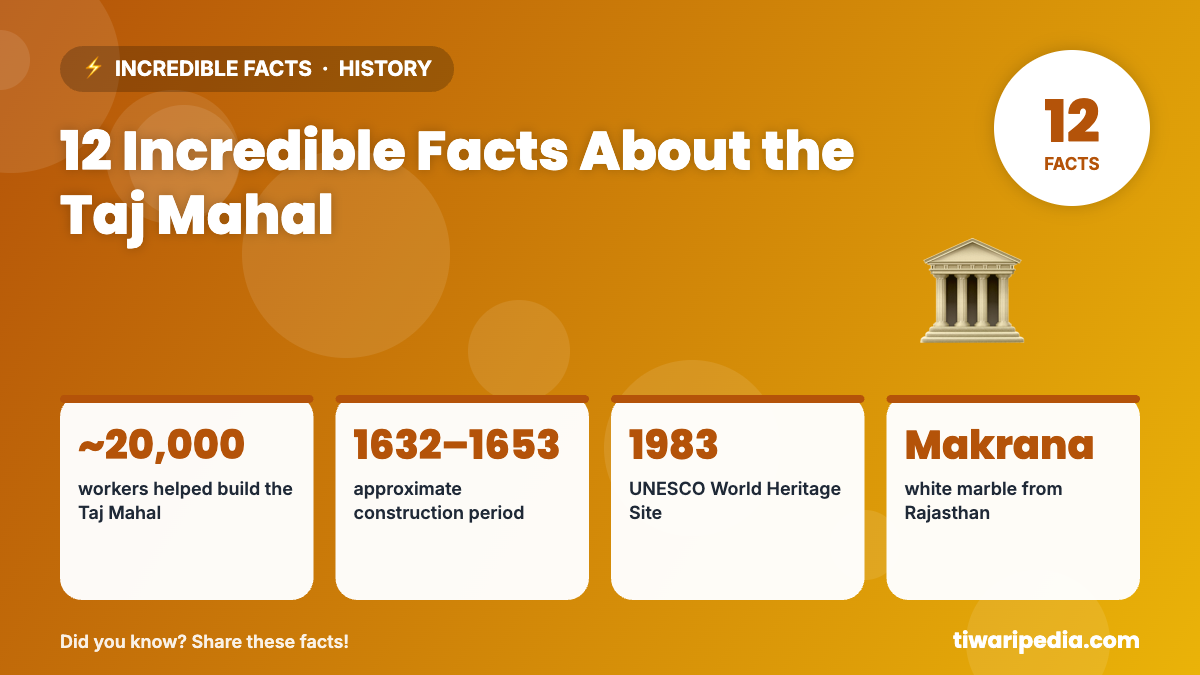
Work began around 1632. The main mausoleum was finished first, and the whole complex, with gardens, mosque and gateway, was completed around 1653.
3. About 20,000 workers built it
Masons, stone-cutters, inlay artists, calligraphers and labourers from across the Mughal empire and beyond worked on the project.
4. Its chief architect is believed to be Ustad Ahmad Lahauri
Historians generally credit Ustad Ahmad Lahauri as the principal designer.
5. Its marble came from Rajasthan
The gleaming white marble was brought from Makrana in Rajasthan, and elephants and bullock carts were used to transport materials.
6. It changes colour through the day
The marble looks pinkish at dawn, dazzling white at midday and golden at sunset, and appears silvery under moonlight.
7. Its minarets lean outward on purpose
The four minarets tilt very slightly outward, so that if they ever fell they would fall away from the main tomb.
8. It is decorated with precious stones
Flowers and patterns were made with pietra dura, an inlay technique using semi-precious stones such as jade, lapis lazuli and carnelian set into marble.
9. Its symmetry has one exception
Almost everything is perfectly symmetrical. The exception is Shah Jahan’s own cenotaph, added beside Mumtaz Mahal’s after his death in 1666.
10. It was disguised during wars
During World War II and the India–Pakistan wars of 1965 and 1971, the monument was covered to protect it from possible air attacks.
11. It is a UNESCO and “New Seven Wonders” site
The Taj Mahal became a UNESCO World Heritage Site in 1983 and was named one of the New Seven Wonders of the World in 2007.
12. Pollution rules protect it
To protect the marble from yellowing, India’s Supreme Court created the Taj Trapezium Zone with strict pollution controls around Agra.
Taj Mahal at a glance
| Detail | Answer |
|---|---|
| Location | Agra, Uttar Pradesh, on the south bank of the Yamuna |
| Built by | Mughal emperor Shah Jahan |
| Built for | His wife Mumtaz Mahal |
| Construction | About 1632 to 1653 |
| Main material | White Makrana marble with inlaid semi-precious stones |
| Style | Mughal architecture, blending Persian, Islamic and Indian elements |
| UNESCO World Heritage Site | Since 1983 |
| Closed | Fridays (open for prayers at the mosque only) |
Parts of the Taj Mahal complex
- The great gate (Darwaza-i-Rauza): a red sandstone gateway that frames the first view of the tomb.
- The charbagh garden: a formal garden divided into four parts by water channels, symbolising the gardens of paradise.
- The mausoleum: the white marble tomb on a raised platform, with its famous central dome and four minarets.
- The mosque and the jawab: two matching red sandstone buildings on either side of the tomb, which keep the design symmetrical.
The art inside: pietra dura and calligraphy
The marble walls are decorated with pietra dura, a technique in which precious and semi-precious stones such as jasper, jade, carnelian and lapis lazuli are cut and set into the marble to form flowers and vines. Verses from the Quran are inlaid in black marble around the arches. The calligraphy gets slightly larger towards the top, so that it looks the same size when viewed from the ground.
Inside the tomb
The main chamber holds the cenotaphs of Mumtaz Mahal and Shah Jahan, surrounded by a finely carved marble screen. These are memorial tombs; the actual graves lie in a quieter chamber below. Mumtaz Mahal’s cenotaph is at the exact centre, while Shah Jahan’s, placed later beside it, is the only element that breaks the perfect symmetry of the building.
Protecting the Taj Mahal
Air pollution can turn the white marble yellow. To protect it, polluting vehicles are restricted near the monument, industries in the surrounding Taj Trapezium Zone face strict controls, and the Archaeological Survey of India periodically cleans the surface with a special clay pack called multani mitti that draws out dirt without damaging the stone.
Tips for visiting
- Book tickets online through the official ASI portal and carry a valid ID.
- Arrive at sunrise for fewer crowds and the best light.
- Night viewing is allowed on a few nights around the full moon, with limited tickets.
- Food, tripods and large bags are not allowed inside.
For timings and tickets, visit the Archaeological Survey of India.
Frequently asked questions
Where is the Taj Mahal?
In Agra, Uttar Pradesh, on the southern bank of the Yamuna River.
When is the Taj Mahal closed?
It is closed to general visitors on Fridays, when the mosque is used for prayers.
Who is buried in the Taj Mahal?
Mumtaz Mahal and Shah Jahan. Their actual graves are in a lower chamber beneath the cenotaphs.
Keep exploring
Facts are based on widely accepted scientific, historical and official sources at the time of writing. Spotted something that needs updating? Let us know.
Keep reading on Tiwaripedia
- History of France: French History Timeline From Lascaux to the Fifth Republic and G7 2026
- 10 Incredible Facts About Robots
- History of Germany: German History Timeline From the Holy Roman Empire to Reunification
- 12 Incredible Facts About Mumbai, the City of Dreams
- History of Italy: Italian History Timeline From Ancient Rome to the Modern Republic
- 12 Incredible Facts About Indian Railways
More guides: All Facts articles