Last updated: October 2026 · 5 min read
Robots build our cars, explore other planets and even help surgeons operate. Here are 10 incredible facts about the machines that are reshaping our world.

10 incredible facts about robots
1. “Robot” comes from a Czech play
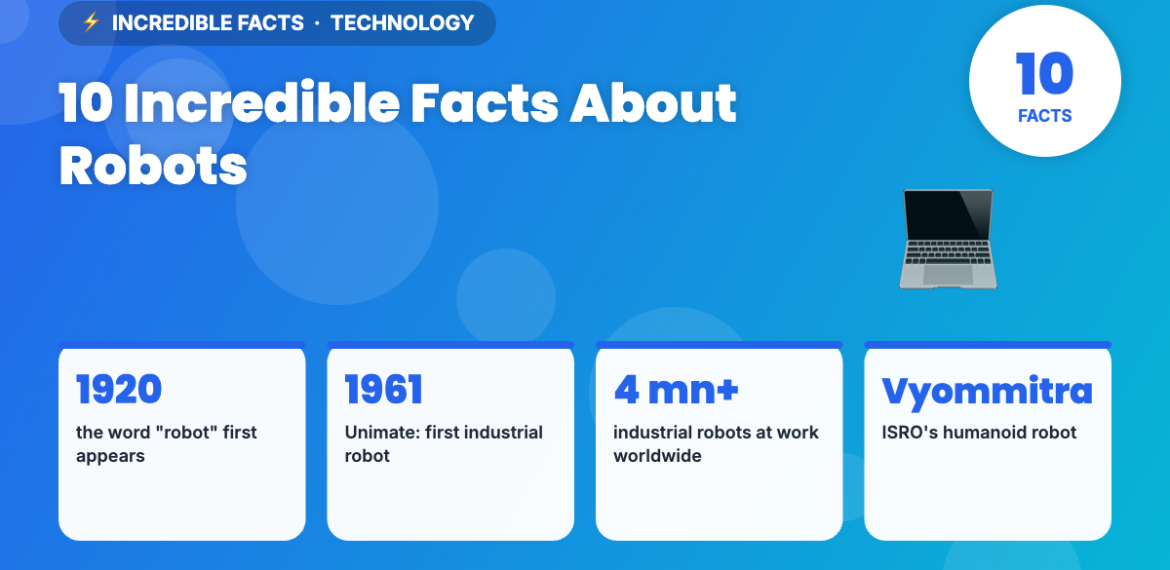
The word first appeared in Karel Čapek’s 1920 play “R.U.R.” It comes from the Czech word “robota”, meaning forced labour, and was suggested by his brother Josef.
2. A science fiction writer created robot laws
In 1942, author Isaac Asimov introduced his famous “Three Laws of Robotics”, which still influence discussions about robot ethics.
3. The first factory robot started in 1961
Unimate, the first industrial robot, began work on a General Motors assembly line in 1961, handling hot metal parts.
4. Millions of robots work in factories
More than 4 million industrial robots operate in factories worldwide, according to the International Federation of Robotics.
5. South Korea has the most robots per worker
South Korea has the highest robot density in manufacturing, with around 1,000 robots for every 10,000 factory workers.
6. Robots explore other planets
Rovers such as NASA’s Curiosity and Perseverance are robots that drive across Mars, studying rocks and searching for signs of ancient life.
7. Robots help surgeons
Robotic surgical systems let surgeons perform precise, minimally invasive operations using tiny instruments controlled from a console.
8. ISRO has a humanoid robot
Vyommitra is a half-humanoid robot developed by ISRO to fly on uncrewed test missions of the Gaganyaan programme.
9. Robots go where humans cannot
Robots inspect pipelines, defuse bombs, explore the deep sea and enter disaster zones such as damaged nuclear plants.
10. Most robots look nothing like humans
The majority of robots are arms, vehicles or machines designed for specific tasks, not human-shaped androids.
Types of robots at a glance
| Type | What it does | Example |
|---|---|---|
| Industrial robots | Weld, paint, assemble and move parts in factories | Robot arms on car assembly lines |
| Collaborative robots (cobots) | Work safely next to people with sensors that stop on contact | Small arms that help with packing and testing |
| Service robots | Clean, deliver or guide people | Robot vacuum cleaners, hotel delivery robots |
| Medical robots | Assist surgery, rehabilitation and lab work | Robotic surgical systems |
| Space and exploration robots | Explore places humans cannot easily reach | Mars rovers, deep-sea vehicles |
| Humanoid robots | Copy the human body shape to work in human spaces | ISRO’s Vyommitra, research humanoids |
How a robot works
Almost every robot follows the same loop: sense, think, act.
- Sensors such as cameras, lidar, touch and temperature sensors gather information about the surroundings.
- The controller, a computer running software, decides what to do. Modern robots increasingly use AI to recognise objects and plan movements.
- Actuators such as electric motors, hydraulics and grippers turn those decisions into movement.
- A power source, usually batteries or mains electricity, keeps everything running.
Robots in India
Indian factories, especially in the automobile and electronics sectors, are adding industrial robots every year, and Indian start-ups build robots for warehouses, agriculture, cleaning and defence. Robots are also used in hospitals for surgery and in the space programme. Many engineering colleges and schools now run robotics labs and competitions, making it a popular career path for students interested in mechanical, electrical and computer engineering.
Will robots take away jobs?
Robots replace some repetitive, dangerous or very precise tasks, but they also create new jobs in programming, maintenance, design and supervision. History shows that automation tends to change the kind of work people do rather than simply removing work. The skills most in demand are those robots find hard: creativity, judgement, communication and the ability to work with machines.
Future of robotics
- General-purpose humanoid robots being tested in warehouses and factories.
- AI models that let robots learn tasks from demonstrations instead of line-by-line programming.
- Soft robots made of flexible materials for delicate jobs like picking fruit.
- Swarm robotics, where many small robots cooperate like ants or bees.
Global industrial robot statistics are published every year by the International Federation of Robotics.
How to start learning robotics
- Learn basic programming in Python or C++.
- Build simple projects with Arduino or Raspberry Pi boards.
- Study basic electronics: sensors, motors and circuits.
- Join a robotics club, online course or competition.
- Explore ROS (Robot Operating System), widely used in research and industry.
Key takeaways
- The word robot is over 100 years old.
- Most robots are task-specific machines, not humanoids.
- AI is making robots more capable and flexible every year.
Frequently asked questions
What is the difference between a robot and AI?
A robot is a physical machine that can sense and act. AI is software that can learn and make decisions. Many modern robots use AI, but not all.
Will robots take all jobs?
Robots automate some tasks, especially repetitive ones, but also create new jobs in design, maintenance and programming.
What was the first robot?
Unimate (1961) is considered the first industrial robot, though inventors built automatic machines centuries earlier.
Keep exploring
Facts are based on widely accepted scientific, historical and official sources at the time of writing. Spotted something that needs updating? Let us know.
Keep reading on Tiwaripedia
- 12 Incredible Facts About the Universe That Will Make You Feel Tiny
- 12 Incredible Facts About the Taj Mahal
- Free Financial Calculators for India: EMI, SIP, Income Tax 2026-27, PPF & More
- Free Online PDF Tools & Passport Size Photo Maker (No Upload)
- 10 Incredible Facts About the Human Brain You Probably Didn’t Know
- 10 Incredible Facts About Trees, From Giant Redwoods to the Great Banyan
More guides: All Facts articles