


Last updated: October 2026 · 14 min read
Germany is Europe’s largest economy and the home of the printing press, the Reformation, Beethoven, Einstein and the modern car. Its history is one of the most dramatic in the world: centuries as a patchwork of small states, unification in 1871, two world wars, the horrors of the Nazi era, division by the Berlin Wall, and a peaceful reunification in 1990. This guide explains the history of Germany step by step, with a complete German history timeline infographic.
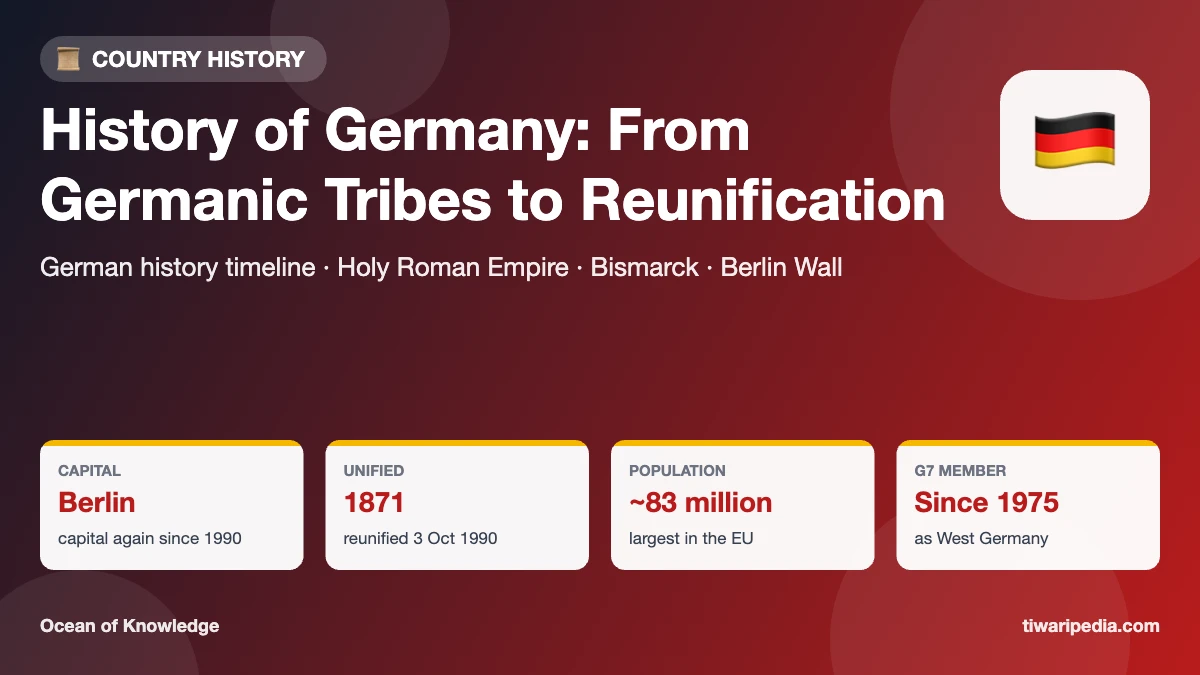
Germany: quick facts
| Official name | Federal Republic of Germany (Bundesrepublik Deutschland) |
|---|---|
| Capital | Berlin |
| Government | Federal parliamentary republic, 16 states (Länder) |
| Chancellor | Friedrich Merz (since May 2025) |
| Population | About 83 million (largest in the EU) |
| Currency | Euro (EUR) |
| National day | 3 October (German Unity Day) |
| G7 membership | Founding member (1975, as West Germany) |
In this article
- Germanic tribes and Rome
- The Holy Roman Empire
- Printing press and Reformation
- The rise of Prussia
- Unification under Bismarck
- World War I and the Weimar Republic
- Nazi Germany and World War II
- Division and the Berlin Wall
- Reunification and modern Germany
- Timeline infographic
- FAQs
1. Germanic tribes and Rome (before 500 CE)
In ancient times, many Germanic tribes, such as the Cherusci, Saxons, Franks and Goths, lived east of the Rhine and north of the Danube. Rome conquered lands up to the Rhine but failed to go further. In 9 CE, the chieftain Arminius (Hermann) ambushed and destroyed three Roman legions in the Battle of the Teutoburg Forest, keeping most of Germany outside the Roman Empire. Roman cities such as Cologne, Trier and Mainz still survive along the Rhine. As Rome weakened in the 4th and 5th centuries, Germanic peoples moved across Europe and helped bring the Western Roman Empire to an end in 476.
2. The Holy Roman Empire (800–1806)
The Frankish king Charlemagne united much of western Europe and was crowned emperor in 800. His empire later split, and the eastern part became the core of Germany. In 962, Otto I was crowned emperor, starting what became known as the Holy Roman Empire. It was not a single country but a loose union of hundreds of kingdoms, duchies, bishoprics and free cities, with an elected emperor. Trading cities of the Hanseatic League, such as Lübeck and Hamburg, dominated commerce in the Baltic and North Sea. The empire lasted until Napoleon dissolved it in 1806.
3. Printing press and the Reformation (1450–1648)
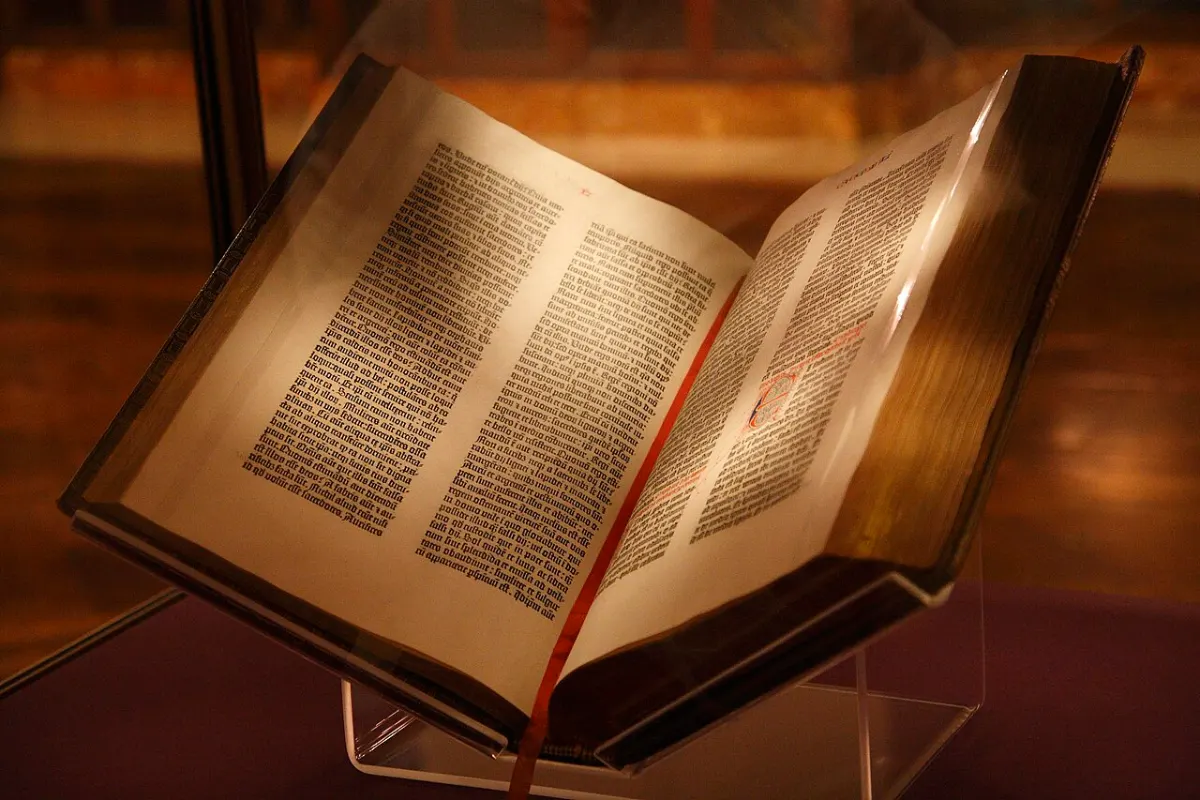
Around 1450 in Mainz, Johannes Gutenberg developed printing with movable metal type. His famous Gutenberg Bible (about 1455) began a revolution in communication that spread knowledge across Europe.
In 1517, the monk Martin Luther published his 95 Theses criticising the Catholic Church. Thanks to printing, his ideas spread rapidly, starting the Protestant Reformation. Luther also translated the Bible into German, helping to shape the modern German language. Religious divisions led to the Thirty Years’ War (1618–1648), one of the most destructive wars in European history; some regions lost a third or more of their population. The Peace of Westphalia (1648) ended it and is often seen as the start of the modern system of sovereign states.
4. The rise of Prussia (1648–1815)
The northern state of Prussia, ruled by the Hohenzollern family from Berlin, grew strong through an efficient army and administration. Frederick the Great (1740–1786) made Prussia a great power, promoted religious tolerance and enjoyed music and philosophy. Germany at this time produced giants of culture: composers Bach, Handel and Beethoven, and writers Goethe and Schiller. After the Napoleonic Wars, the Congress of Vienna (1815) created a loose German Confederation of 39 states.
5. Unification under Bismarck (1815–1914)
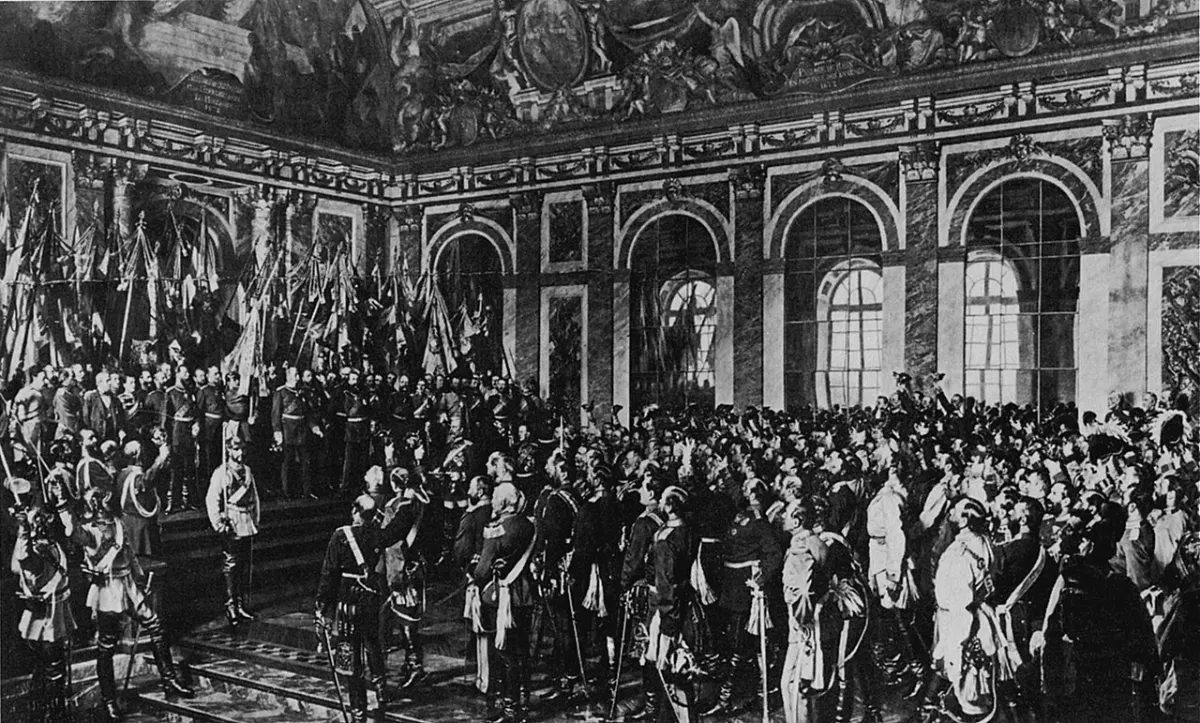
The 1848 revolutions failed to unite Germany, but Prussian Minister-President Otto von Bismarck succeeded through “blood and iron”. After wars against Denmark (1864), Austria (1866) and France (1870–71), the German states united. On 18 January 1871, Wilhelm I was proclaimed German Emperor (Kaiser) in the Hall of Mirrors at Versailles.
The new German Empire industrialised rapidly, becoming a leader in steel, chemicals and electrical engineering. Karl Benz built the first practical motor car in 1885–86. Bismarck introduced the world’s first national social insurance system (health, accident and old-age pensions), a model for welfare states worldwide.
6. World War I and the Weimar Republic (1914–1933)
Germany entered World War I in 1914 as an ally of Austria-Hungary. After four years of trench warfare, it was defeated in 1918; Kaiser Wilhelm II abdicated, and Germany became a republic. The Treaty of Versailles (1919) forced Germany to accept blame, pay reparations and give up territory. The new Weimar Republic suffered hyperinflation in 1923, when money became almost worthless, and then the Great Depression after 1929, which left about six million people unemployed.
7. Nazi Germany and World War II (1933–1945)
Exploiting economic misery and resentment, Adolf Hitler and his Nazi Party came to power in January 1933 and quickly created a dictatorship. Opponents were jailed, and Jews were stripped of their rights. Germany invaded Poland on 1 September 1939, starting World War II. The Nazis and their collaborators murdered six million Jews in the Holocaust, along with millions of others including Roma, disabled people and political prisoners. Germany surrendered on 8 May 1945, its cities in ruins. Modern Germany remembers this history openly through memorials and education.
8. Division and the Berlin Wall (1945–1989)
After the war, Germany was divided into four occupation zones. In 1949, two states were founded: the democratic Federal Republic of Germany (West Germany), with its capital in Bonn, and the communist German Democratic Republic (East Germany). West Germany’s “economic miracle” (Wirtschaftswunder) under Chancellor Konrad Adenauer made it prosperous, and it became a founding member of the EEC (1957).
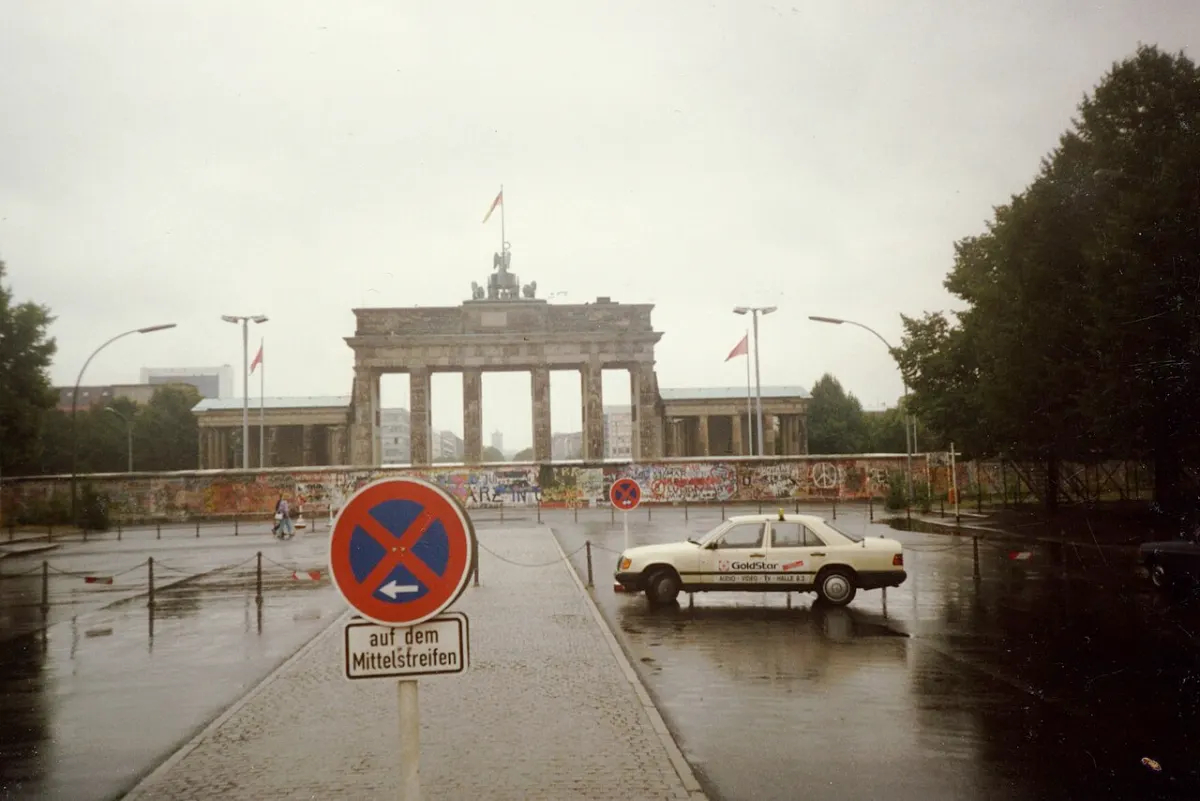
To stop people fleeing to the West, East Germany built the Berlin Wall in 1961, splitting the city for 28 years. On 9 November 1989, after mass peaceful protests, the border opened and crowds began tearing down the Wall.
9. Reunification and modern Germany (1990–today)
- 3 October 1990: East and West Germany reunited under Chancellor Helmut Kohl; Berlin became the capital again.
- 2002: the euro replaced the Deutsche Mark.
- 2005–2021: Angela Merkel, the first woman Chancellor, led Germany through the euro crisis and the 2015 refugee crisis.
- 2023: Germany shut down its last nuclear power plants as part of its energy transition.
- 2025: Friedrich Merz became Chancellor, with plans for major investment in defence and infrastructure.
Today Germany is famous for engineering and brands like Volkswagen, BMW, Mercedes-Benz, Siemens and SAP.
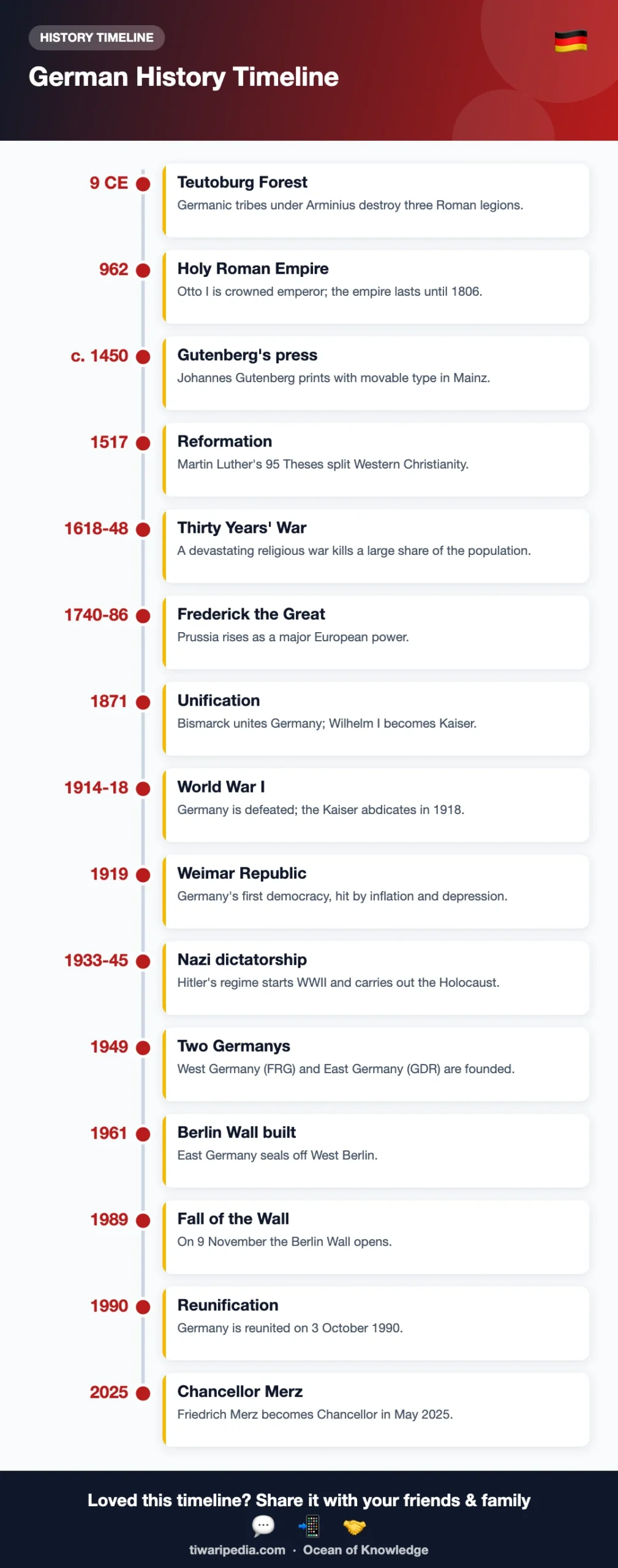
German history timeline (infographic)
Famous German leaders and figures
| Name | Period | Known for |
|---|---|---|
| Charlemagne | 768–814 | Emperor, united western Europe |
| Martin Luther | 1483–1546 | Protestant Reformation |
| Frederick the Great | 1740–1786 | Made Prussia a great power |
| Otto von Bismarck | Chancellor 1871–1890 | Unified Germany, social insurance |
| Konrad Adenauer | 1949–1963 | First West German Chancellor |
| Helmut Kohl | 1982–1998 | Chancellor of reunification |
| Angela Merkel | 2005–2021 | First woman Chancellor |
| Friedrich Merz | 2025–present | Current Chancellor |
Germany and India
German scholars such as Max Müller translated the Rig Veda and brought Sanskrit and Indian philosophy to European audiences in the 19th century. Today, Germany is one of India’s biggest trading partners in Europe and a key source of investment and technology. Indians form one of the largest groups of international students at German universities, attracted by low or no tuition fees, and many Indian engineers and IT professionals work in Germany.
Germany in the G7
West Germany was a founding member of the G7 in 1975, and reunified Germany has continued as a member. Germany hosted the summit most recently at Schloss Elmau, Bavaria, in 2022. See all G7 countries and their history.
Frequently asked questions
When was Germany unified?
Germany was first unified as a nation-state on 18 January 1871 under Bismarck. After being divided in 1949, it was reunified on 3 October 1990.
Why was the Berlin Wall built?
East Germany built it in 1961 to stop its citizens from escaping to West Berlin and West Germany. It fell on 9 November 1989.
What was the Holy Roman Empire?
A union of hundreds of German and central European states under an elected emperor, from 962 until 1806.
Who invented the printing press?
Johannes Gutenberg developed printing with movable metal type in Mainz around 1450.
What is German Unity Day?
Germany’s national holiday on 3 October, marking reunification in 1990.
Explore the history of other G7 countries
- History of the United States
- History of the United Kingdom
- History of France
- History of Italy
- History of Japan
- History of Canada
- G7 countries: list, members and history
Related reading on Tiwaripedia
- The printing press: the invention that spread knowledge
- World War II in brief
- 10 incredible facts about SAP, the software giant from Germany
- More country-wise history
Facts are based on widely accepted historical sources at the time of writing. Images are from Wikimedia Commons under the licences credited in each caption. Spotted something that needs updating? Let us know.
Keep reading on Tiwaripedia
- 12 Incredible Facts About the Olympic Games
- History of Japan: Japanese History Timeline From the Jōmon Period to Modern Japan
- 12 Incredible Facts About Apollo 11 and the First Moon Landing
- History of France: French History Timeline From Lascaux to the Fifth Republic and G7 2026
- Indus Valley Civilization: Cities, Town Planning, Trade, Script and Decline
- 12 Incredible Facts About the Taj Mahal
More guides: All Country-wise History articles
