

Last updated: October 2026 · 14 min read
France is the most visited country on Earth, and much of its appeal comes from its history: Stone Age cave paintings, Roman ruins, Gothic cathedrals, the palace of Versailles, the Revolution of 1789, Napoleon, and the Eiffel Tower. Ideas born in France, such as “Liberty, Equality, Fraternity” and the rights of man, changed politics worldwide. This guide covers the full history of France, with a detailed French history timeline, famous rulers and France’s role in the G7, which it led in 2026.
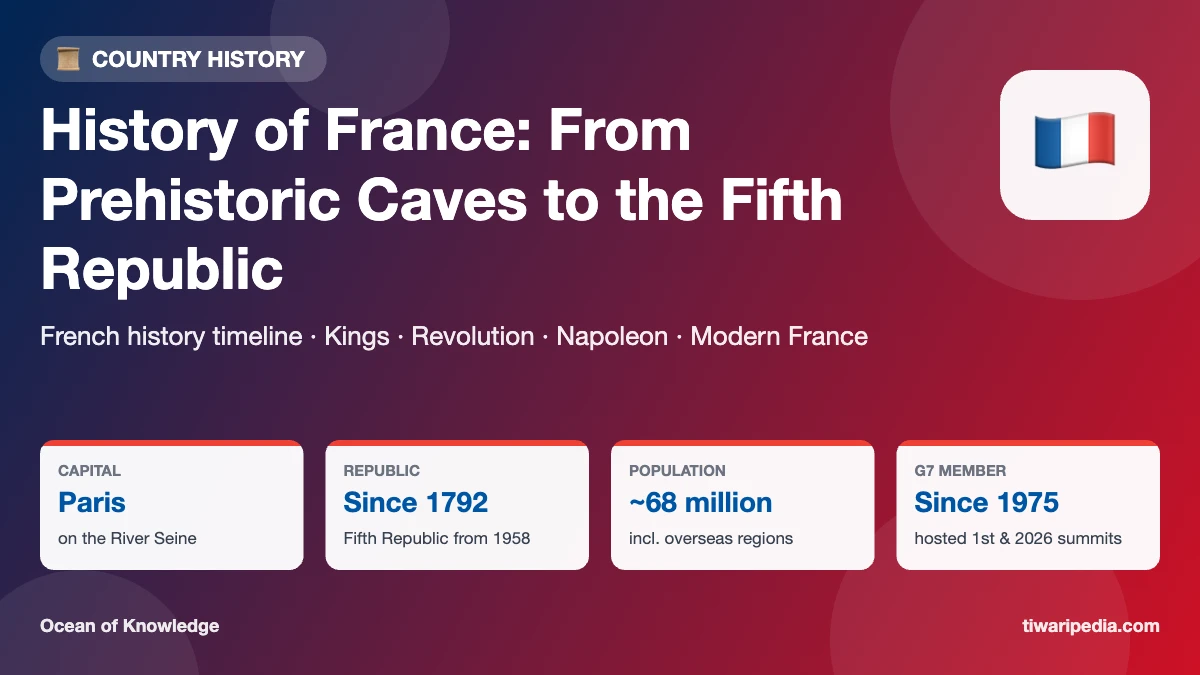
France: quick facts
| Official name | French Republic (République française) |
|---|---|
| Capital | Paris |
| Motto | Liberté, Égalité, Fraternité |
| Government | Semi-presidential republic (Fifth Republic, since 1958) |
| President | Emmanuel Macron (since 2017) |
| Population | About 68 million |
| Currency | Euro (EUR) |
| National day | 14 July (Bastille Day) |
| G7 membership | Founding member; hosted the first summit (1975) and the 2026 summit |
In this article
- Prehistoric and Celtic France
- Roman Gaul and the Franks
- Medieval France
- The age of absolute monarchy
- The French Revolution
- Napoleon and the 19th century
- France in the world wars
- The Fifth Republic and modern France
- Timeline infographic
- FAQs
1. Prehistoric and Celtic France
France has some of the world’s oldest art. About 17,000 years ago, Stone Age people painted horses, bulls and deer on the walls of the Lascaux caves in the Dordogne; the even older Chauvet cave paintings date back around 36,000 years. Around 4500–2000 BCE, Neolithic people raised thousands of standing stones at Carnac in Brittany.
By the Iron Age, Celtic tribes known to the Romans as Gauls lived across the region. They were skilled metalworkers and farmers, ruled by warrior chiefs and druid priests.
2. Roman Gaul and the Franks (125 BCE–987)
Rome first took southern Gaul (Provence, from the Latin “provincia”) around 121 BCE. Between 58 and 50 BCE, Julius Caesar conquered the rest, defeating the Gallic leader Vercingetorix at Alesia (52 BCE). Five centuries of Roman rule brought Latin (the parent of French), cities such as Lyon (Lugdunum), roads, aqueducts like the Pont du Gard, and Christianity.
As Rome declined, Germanic peoples moved in. The Franks, who gave France its name, were united under King Clovis (around 481–511), who converted to Christianity and made Paris his capital. On Christmas Day in the year 800, the Pope crowned Charlemagne as Emperor. His empire covered most of western Europe, and he encouraged learning and education. After his death it split; the western part became the Kingdom of France.
3. Medieval France (987–1500)
In 987, Hugh Capet became king, founding the Capetian dynasty whose branches ruled France for over 800 years. Kings slowly expanded royal power from a small area around Paris.
- French knights led many of the Crusades (from 1096).
- Builders created masterpieces of Gothic architecture: Notre-Dame de Paris (begun 1163), Chartres and Reims cathedrals.
- The University of Paris (Sorbonne) became one of Europe’s leading centres of learning.
- The Hundred Years’ War (1337–1453) with England devastated France. The teenage peasant Joan of Arc inspired the French to lift the siege of Orléans in 1429 and crowned Charles VII at Reims. She was burned by the English in 1431 and later declared a saint.
4. The age of absolute monarchy (1500–1789)
During the Renaissance, King Francis I invited Leonardo da Vinci to France (the Mona Lisa came with him) and built grand châteaux in the Loire Valley. The 16th century saw bitter Wars of Religion between Catholics and Protestant Huguenots, ended by Henry IV’s Edict of Nantes (1598), which granted religious tolerance.
Louis XIV, the “Sun King”, ruled for 72 years (1643–1715), the longest reign of any major European monarch. He famously embodied absolute monarchy and moved the court to the magnificent Palace of Versailles. France became Europe’s leading power in war, art, fashion and the French language.

In the 18th century, Enlightenment thinkers such as Voltaire, Rousseau and Montesquieu questioned the power of kings and the Church. France also competed with Britain for colonies in India and North America and lost most of them after the Seven Years’ War (1756–1763). Heavy war debts and an unfair tax system pushed the kingdom towards crisis.
5. The French Revolution (1789–1799)
With the treasury empty and bread prices soaring, Louis XVI called the Estates-General in May 1789. The Third Estate (commoners) declared itself the National Assembly. On 14 July 1789, crowds stormed the Bastille, a royal fortress and prison in Paris; the date is now France’s national day.
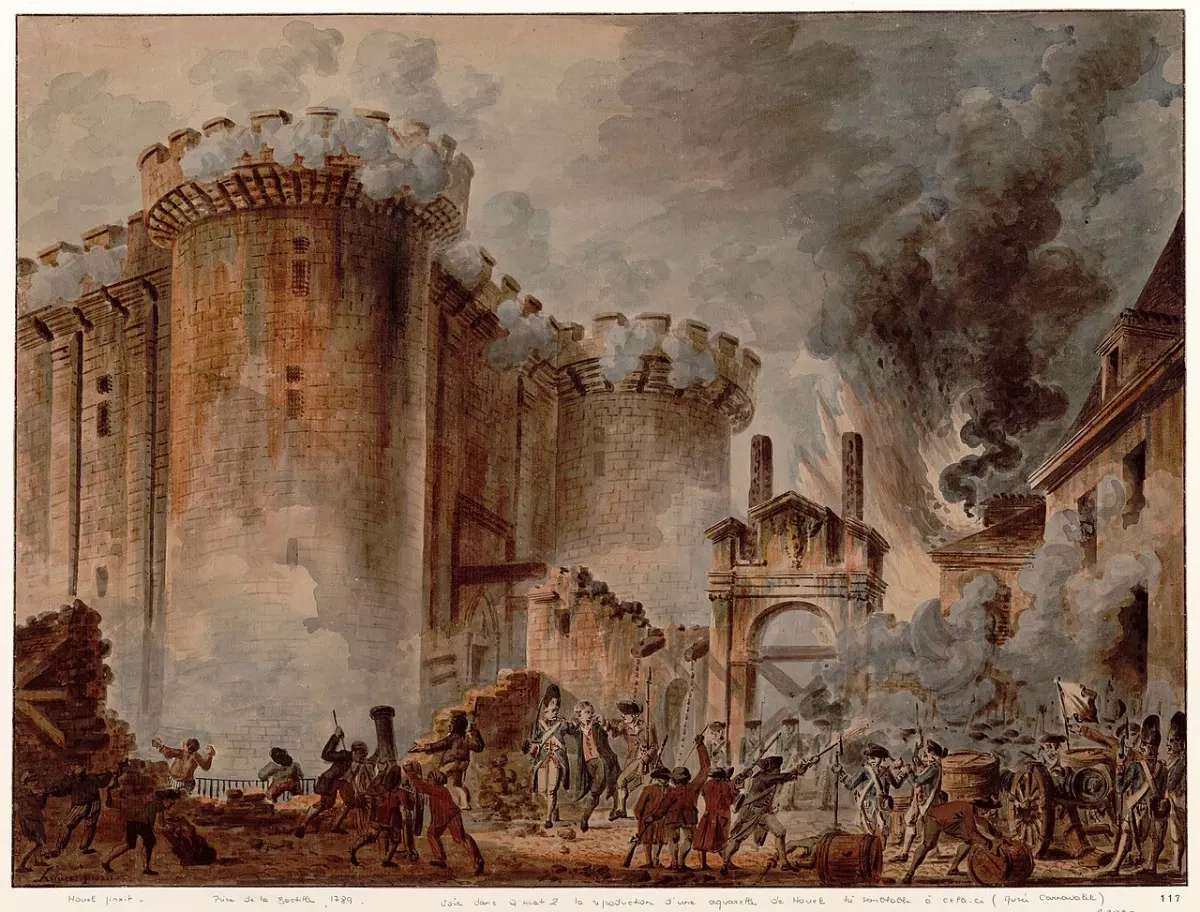
- August 1789: feudal privileges were abolished and the Declaration of the Rights of Man and of the Citizen was adopted.
- 1792: France became a republic; Louis XVI and Queen Marie Antoinette were executed in 1793.
- 1793–1794: the Reign of Terror under Robespierre saw thousands guillotined.
- The Revolution introduced the metric system, ended many church privileges and spread ideas of citizenship and equality across Europe.
For a deeper look, read our guide to the French Revolution: causes, key events and impact.
6. Napoleon and the 19th century (1799–1914)
General Napoleon Bonaparte seized power in 1799 and crowned himself Emperor in 1804. His Napoleonic Code (1804) created a modern legal system that still influences laws in dozens of countries. His armies conquered much of Europe before the disastrous invasion of Russia (1812) and final defeat at Waterloo (1815). He died in exile on Saint Helena in 1821.
The 19th century brought more upheaval: the restored monarchy, revolutions in 1830 and 1848, and Napoleon III’s Second Empire, which rebuilt Paris with wide boulevards. Defeat by Prussia in 1870–71 led to the Third Republic, which lasted until 1940. France built a large colonial empire in Africa and Indochina, while Paris became the capital of art, home to Impressionists such as Monet and Renoir. The Eiffel Tower rose for the 1889 World’s Fair, marking 100 years since the Revolution.

7. France in the world wars (1914–1945)
Much of World War I was fought on French soil. Battles such as the Marne (1914) and Verdun (1916) became symbols of sacrifice; around 1.4 million French soldiers died. Indian soldiers also fought and died in France, remembered at the Neuve-Chapelle memorial.
In World War II, Germany defeated France in just six weeks in 1940. The north was occupied, while the collaborationist Vichy regime ruled the south. General Charles de Gaulle led the Free French from London, and the Resistance fought at home. Allied forces landed in Normandy on D-Day, 6 June 1944, and Paris was liberated in August 1944. French women voted for the first time in 1945.
8. The Fifth Republic and modern France (1945–today)
- European unity: France and Germany became partners; France co-founded the European Coal and Steel Community (1951) and the EEC (Treaty of Rome, 1957), today’s European Union.
- Decolonisation: wars in Indochina (ended 1954) and Algeria (independence 1962).
- 1958: Charles de Gaulle founded the Fifth Republic with a strong president.
- May 1968: student protests and strikes reshaped French society.
- 2002: the euro replaced the franc.
- 2019: fire badly damaged Notre-Dame; it reopened in December 2024 after restoration.
- 2024: Paris hosted the Summer Olympics for the third time.
- 2026: France held the G7 presidency and hosted the summit at Évian-les-Bains (15–17 June), with India among the invited countries.
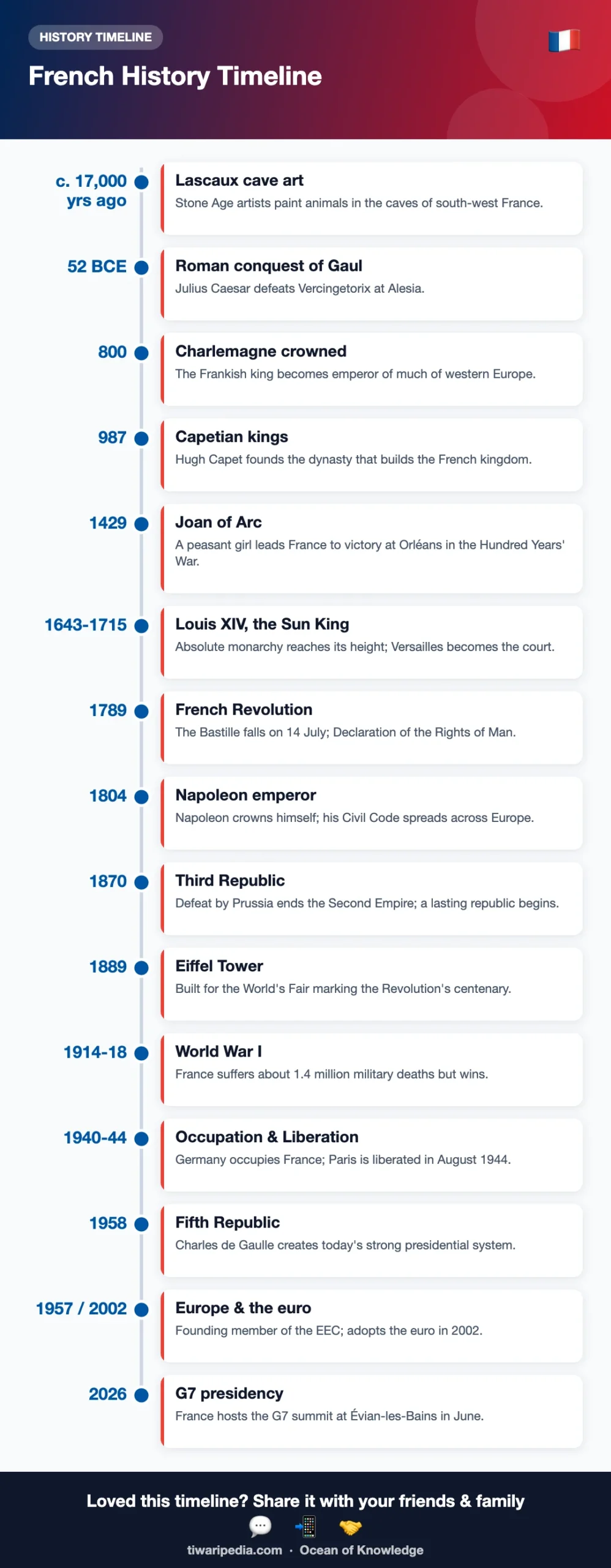
French history timeline (infographic)
Famous French rulers and leaders
| Ruler | Period | Known for |
|---|---|---|
| Charlemagne | 768–814 | Emperor of western Europe |
| Louis IX (Saint Louis) | 1226–1270 | Justice, Crusades, Sainte-Chapelle |
| Henry IV | 1589–1610 | Edict of Nantes, religious peace |
| Louis XIV | 1643–1715 | The Sun King, Versailles |
| Napoleon Bonaparte | 1799–1815 | Emperor, Napoleonic Code |
| Charles de Gaulle | 1944–46, 1959–69 | Free French leader, Fifth Republic |
| Emmanuel Macron | 2017–present | Current President |
France and India
France once had trading posts in India, including Pondicherry (Puducherry), Karaikal, Mahe, Yanam and Chandernagore. The French East India Company competed with the British in the 18th century under leaders like Dupleix. Pondicherry was transferred to India in 1954, and its French Quarter remains a popular attraction. Today, France and India are close strategic partners (since 1998) in defence (Rafale jets, Scorpène submarines), space, nuclear energy and the International Solar Alliance.
France in the G7
The G7 was born in France: President Valéry Giscard d’Estaing invited leaders to the Château de Rambouillet in November 1975 for the first summit. France held the rotating presidency again in 2026, focusing on Ukraine, critical minerals, global economic imbalances and health. See all G7 countries and their history.
Frequently asked questions
Why is 14 July celebrated in France?
It marks the storming of the Bastille on 14 July 1789, the symbolic start of the French Revolution.
Who was the most famous French king?
Louis XIV, the “Sun King”, who reigned for 72 years and built the Palace of Versailles.
What is the Fifth Republic?
France’s current system of government, created by Charles de Gaulle in 1958, with a powerful directly elected president and a prime minister.
How did France get its name?
From the Franks, a Germanic people who ruled the region after the fall of the Roman Empire.
Why was the Eiffel Tower built?
As the entrance arch for the 1889 World’s Fair in Paris, celebrating the centenary of the French Revolution.
Explore the history of other G7 countries
- History of the United States
- History of the United Kingdom
- History of Germany
- History of Italy
- History of Japan
- History of Canada
- G7 countries: list, members and history
Related reading on Tiwaripedia
- The French Revolution explained
- The Roman Empire: rise and fall
- World War II in brief
- More country-wise history
Facts are based on widely accepted historical sources at the time of writing. Images are from Wikimedia Commons under the licences credited in each caption. Spotted something that needs updating? Let us know.
Keep reading on Tiwaripedia
- G7 Countries List 2026: Members, History of the G7 and Each Nation, and India’s Role
- History of the United States: American History Timeline From Native Americans to 2026
- History of Japan: Japanese History Timeline From the Jōmon Period to Modern Japan
- 12 Incredible Facts About Indian Railways
- The Silk Road: History of the World’s Most Famous Trade Route
- Indus Valley Civilization: Cities, Town Planning, Trade, Script and Decline
More guides: All Country-wise History articles
