

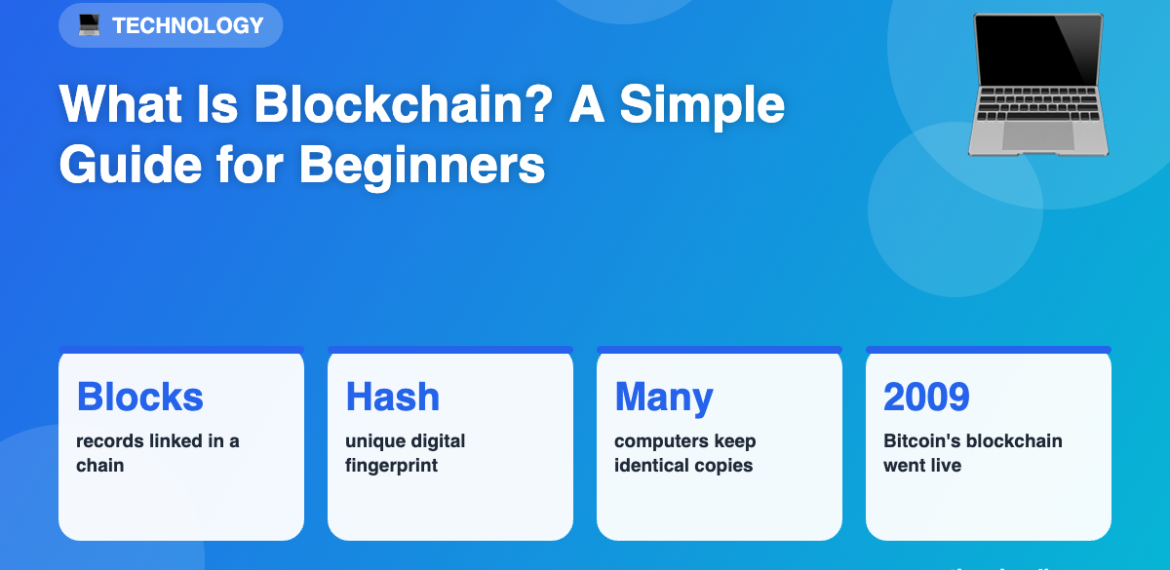
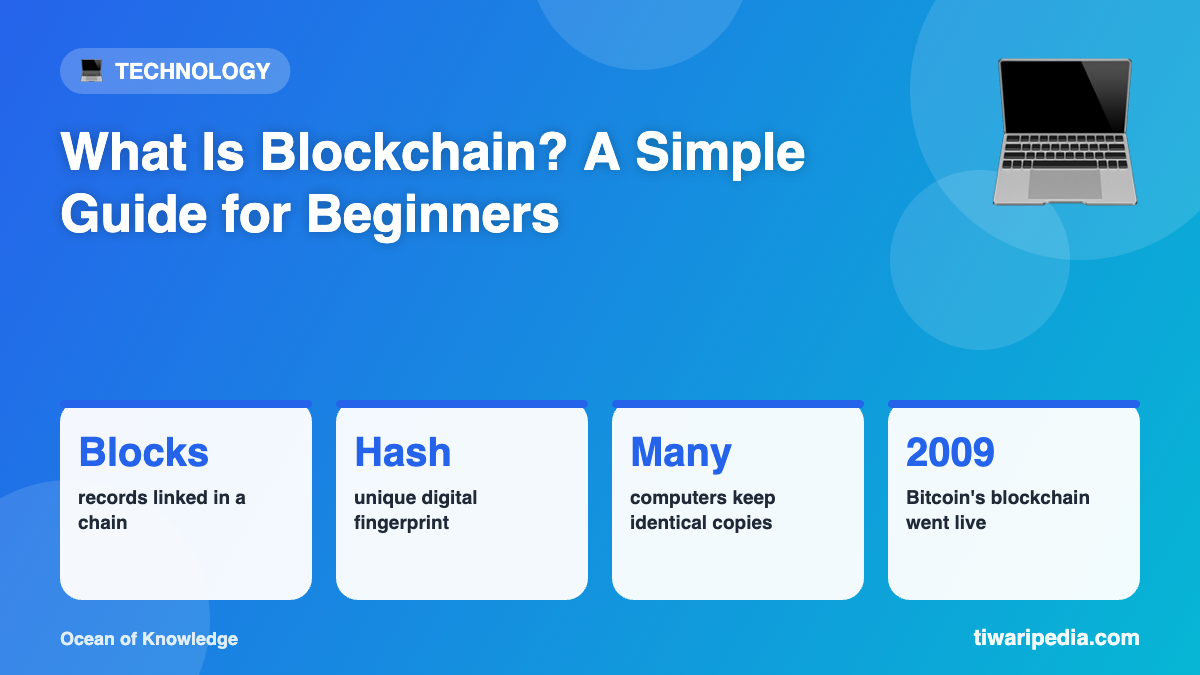
Blockchain is a way of recording information so that it is very difficult to change, hack or cheat. It became famous as the technology behind Bitcoin, but its uses go far beyond cryptocurrency.
Think of a shared notebook
Imagine a notebook that thousands of people each hold an identical copy of. Whenever a new entry is added, everyone’s copy is updated. If one person tries to secretly change an old entry, their copy no longer matches everyone else’s, and the change is rejected. That is the basic idea of a blockchain, also called a distributed ledger.
Blocks and chains
- A block holds a batch of records, such as transactions.
- Each block contains a hash, a unique digital fingerprint calculated from its contents.
- Each block also stores the hash of the previous block, linking them into a chain.
- Changing any old block changes its hash, which breaks the link to every block after it, making tampering easy to detect.
Decentralised: no single owner
Traditional records are kept by one central authority, such as a bank. A public blockchain is maintained by many independent computers (called nodes) that agree on which new blocks are valid using rules called consensus mechanisms.
Uses beyond cryptocurrency
- Supply chains: tracking food or medicines from farm or factory to shop.
- Land and property records: tamper-proof ownership histories.
- Certificates: verifying educational degrees and documents.
- Trade finance: sharing documents securely between banks and businesses.
Limitations
- Some blockchains use a lot of electricity.
- They can be slower than traditional databases.
- A blockchain cannot guarantee that the information entered is true in the first place.
Note: cryptocurrencies are highly volatile and risky. This article explains the technology and is not investment advice.




