

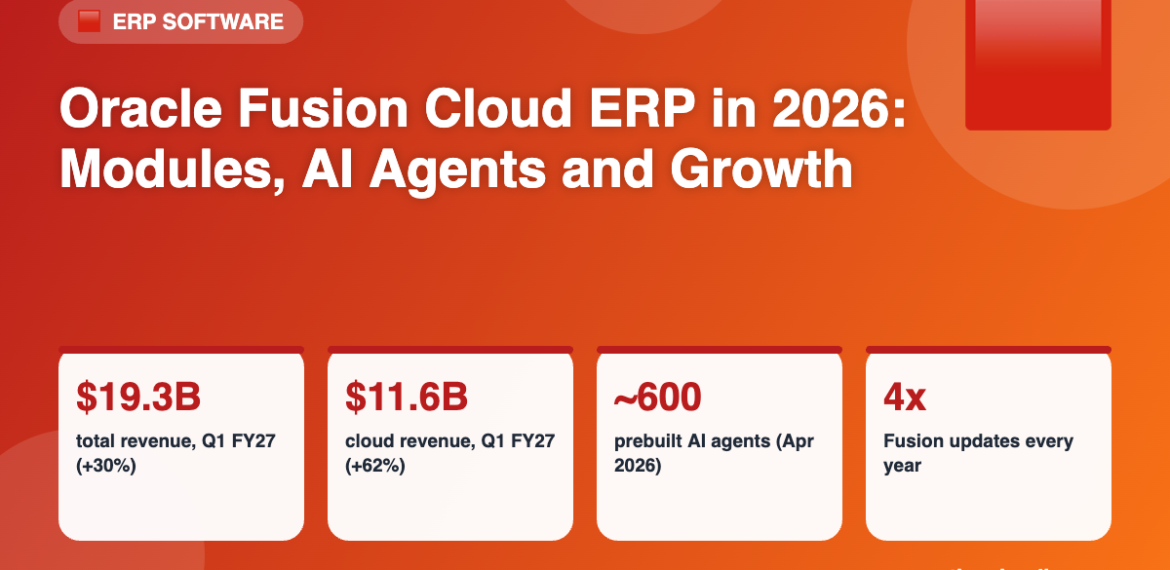
Oracle is best known for its database, but it is also one of the world’s largest enterprise application vendors. Its flagship ERP, Oracle Fusion Cloud ERP, competes head-to-head with SAP S/4HANA and is used by thousands of organisations worldwide for finance, procurement, projects and supply chain.
Oracle’s ERP family
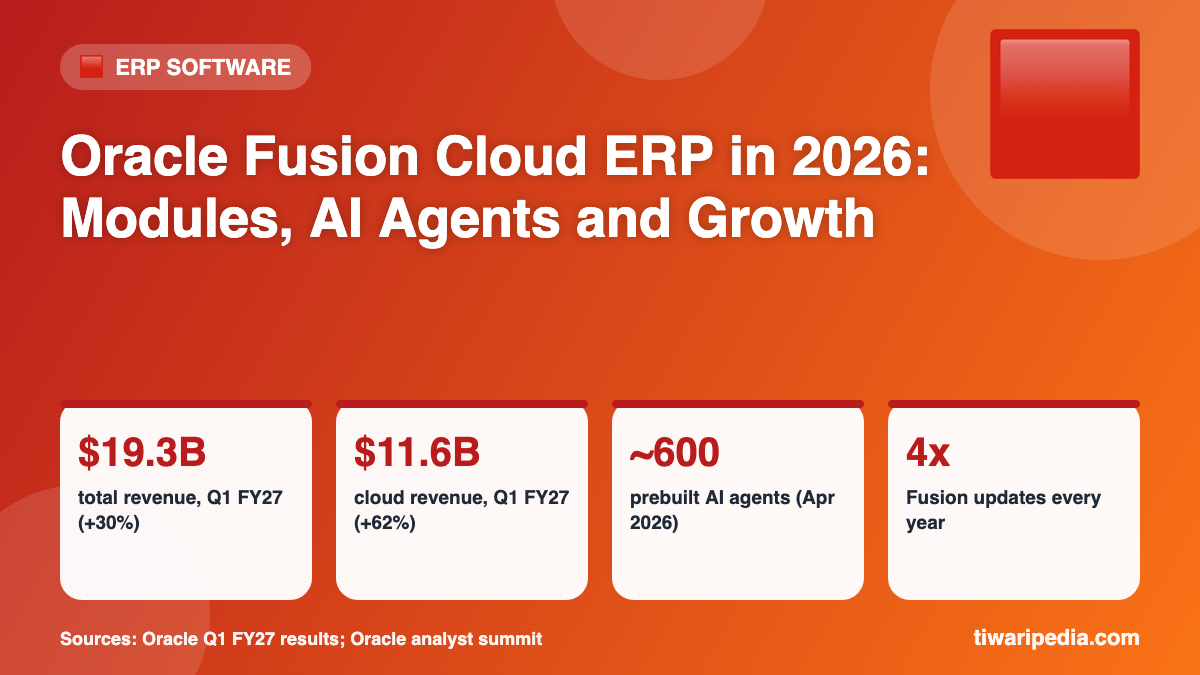
- Oracle Fusion Cloud ERP: Oracle’s modern, cloud-only (SaaS) suite, updated four times a year (releases are named like 26A, 26B, 26C, 26D).
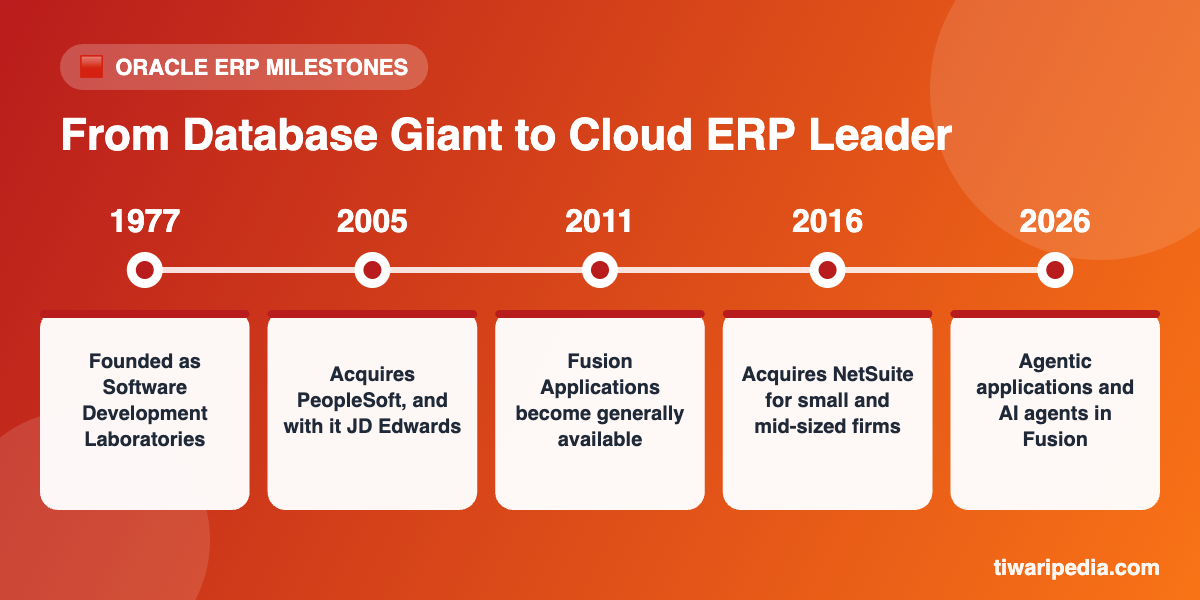
- Oracle NetSuite: a cloud ERP for small and mid-sized businesses, acquired in 2016.
- Oracle E-Business Suite (EBS): Oracle’s older, widely used on-premise ERP.
- JD Edwards and PeopleSoft: on-premise products Oracle acquired through its 2005 PeopleSoft purchase. PeopleSoft is still strong in HR, higher education and government.
Oracle continues to support its on-premise products, but new innovation, especially AI, is focused on Fusion Cloud.
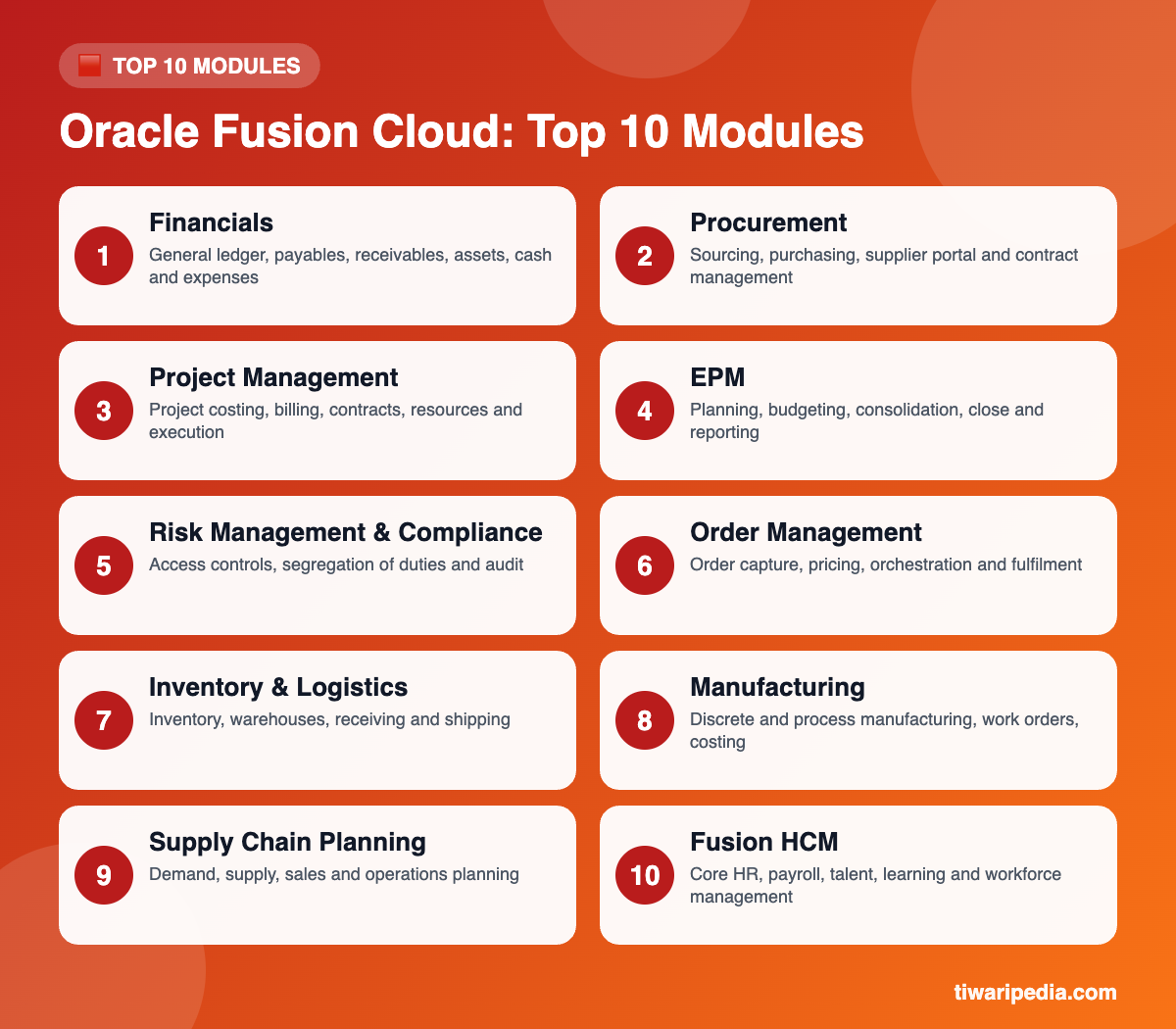
Top 10 Oracle Fusion Cloud modules
1. Financials
The core of Oracle ERP: General Ledger, Payables, Receivables, Fixed Assets, Cash Management and Expenses. Oracle is known for a flexible accounting structure (chart of accounts with segments) and strong multi-entity, multi-currency support.
2. Procurement
Covers self-service requisitions, purchasing, sourcing (RFQs and auctions), supplier qualification and a supplier portal, plus procurement contracts, supporting a complete procure-to-pay cycle.
3. Project Management (PPM)
Project financial management (costing, budgets, billing and revenue), project contracts, grants management, resource management and task execution, popular with services, construction and engineering firms.
4. Enterprise Performance Management (EPM)
Oracle’s EPM Cloud is a market leader for budgeting, forecasting, financial consolidation, account reconciliation, narrative reporting and close management. It often runs alongside non-Oracle ERPs too.
5. Risk Management and Compliance
Automates controls such as segregation of duties, monitors user access and transactions, and supports audits, helping companies meet regulations like the Sarbanes-Oxley Act.
6. Order Management
Captures orders from many channels, applies pricing and promotions, and orchestrates fulfilment across warehouses, suppliers and drop-ship partners.
7. Inventory and Logistics
Manages inventory across organisations, receiving, warehouse operations, shipping and transportation, with real-time visibility of stock.
8. Manufacturing
Supports discrete, process and mixed-mode manufacturing with work definitions, work orders, quality and cost management, including Internet of Things (IoT) integration for smart factories.
9. Supply Chain Planning
Demand management, supply planning, replenishment and sales and operations planning (S&OP) to balance customer demand with production and inventory.
10. Fusion HCM
Oracle’s cloud HR suite covering core HR, global payroll, talent management, learning, recruiting and workforce management, tightly integrated with Fusion ERP on one data model.
Oracle’s AI strategy: from assistants to agents
- AI agents built into Fusion: At an April 2026 analyst summit, Oracle described around 600 prebuilt AI agents, more than 100 partner-built agents and an AI Agent Studio for customers and partners to build their own.
- Agentic applications: Oracle is packaging agents into ready-made “agentic apps” for jobs such as ledger management, consolidation and financial planning, with more planned for collections and revenue processes.
- No extra charge for embedded agents: Oracle says AI agents embedded in Fusion are included for Fusion customers.
- Cloud-only innovation: Oracle has said these AI agents are for its SaaS applications, not for E-Business Suite, JD Edwards or PeopleSoft, which encourages customers to move to Fusion.
Latest Oracle market updates (2026)
- Record growth: For Q1 of fiscal 2027 (quarter ended 31 August 2026, reported 10 September 2026), Oracle reported total revenue of about $19.3 billion, up 30%, and cloud revenue of about $11.6 billion, up 62%.
- AI cloud boom: Oracle Cloud Infrastructure (OCI) revenue more than doubled, driven by demand for AI training and inference capacity.
- Cloud applications: SaaS revenue grew about 10% to roughly $4.2 billion.
- Huge order book: Remaining performance obligations reached about $664 billion, largely from multi-year cloud infrastructure contracts.
Careers in Oracle ERP
- In-demand roles: Oracle Fusion Financials consultant, SCM consultant, PPM consultant, HCM consultant, EPM consultant, Oracle Integration Cloud (OIC) developer and technical consultants (BI Publisher, OTBI, reports).
- Certifications: Oracle University offers cloud certifications for each Fusion area.
- Tip: EBS consultants who learn Fusion are in strong demand as companies migrate.
SAP vs Oracle: quick comparison
- Strengths of SAP: manufacturing, supply chain, deep industry solutions and a very large global customer base.
- Strengths of Oracle: finance and EPM, a cloud-native SaaS suite with quarterly updates, and its own cloud infrastructure and database.
- Both are investing heavily in AI agents, and both are pushing customers from older on-premise systems to the cloud.
Figures are from Oracle’s Q1 FY2027 results and reporting on Oracle’s April 2026 Applications Analyst Summit. Always check Oracle’s official announcements for the latest details.
Sources: Oracle Q1 FY2027 results summary; Forrester on Oracle’s 2026 analyst summit.




