

Artificial intelligence may seem new, but scientists have been working on it for more than 70 years. Its history is a story of big dreams, setbacks and breakthroughs.
1950: Alan Turing’s question
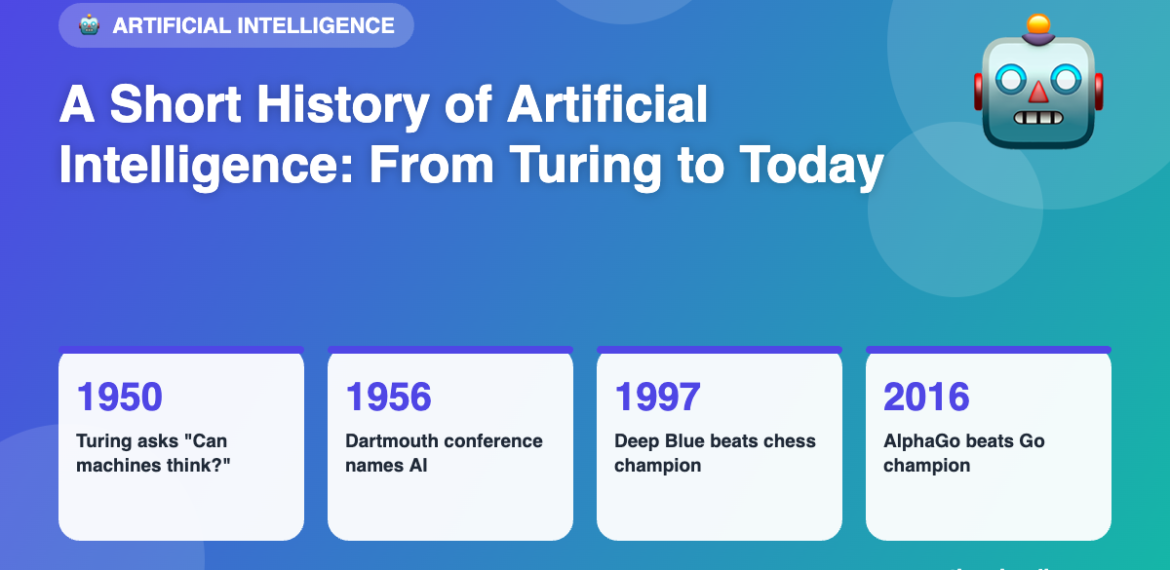
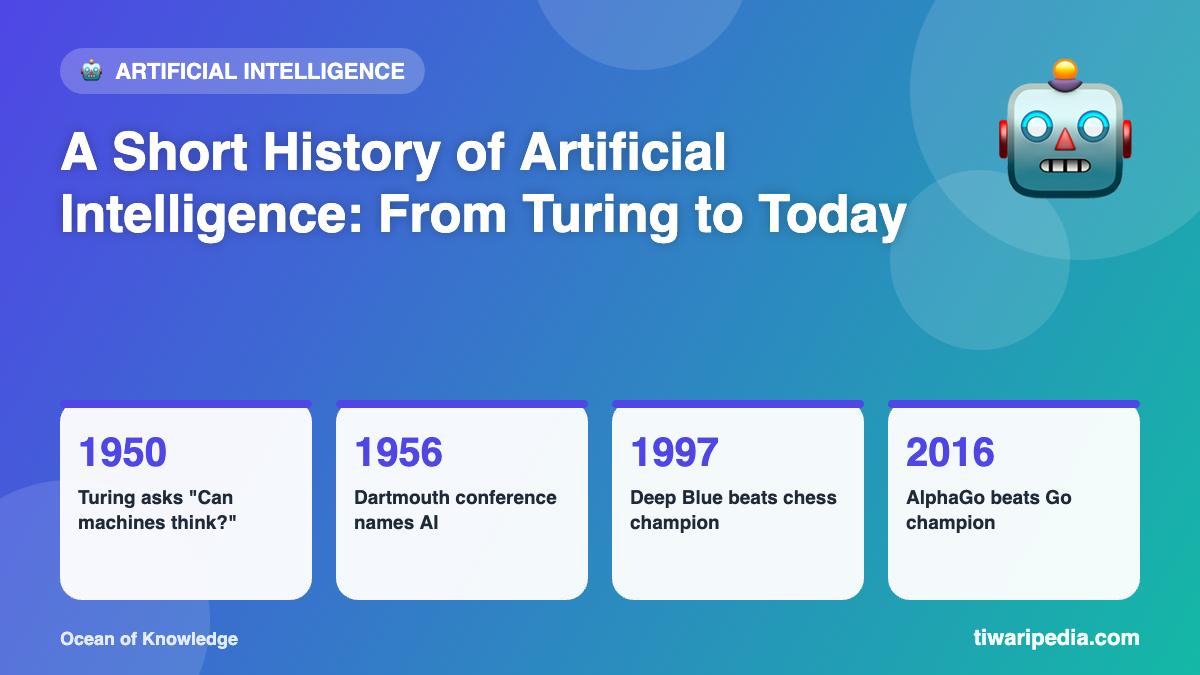
British mathematician Alan Turing published a paper asking “Can machines think?”. He proposed the Turing Test: if a machine’s conversation could not be told apart from a human’s, it could be considered intelligent.
1956: AI gets its name
At a summer workshop at Dartmouth College in the USA, researchers including John McCarthy and Marvin Minsky officially launched the field and used the term “artificial intelligence”.
1960s–70s: Early optimism
Early programs could solve maths problems and play simple games. ELIZA (1966) was an early chatbot. But computers were slow and expectations were too high.
AI winters
When progress fell short of promises, funding dried up in periods known as “AI winters”, notably in the 1970s and late 1980s.
1980s: Expert systems
Rule-based expert systems captured specialists’ knowledge for business and medicine, but they were hard to maintain.
1997: Deep Blue
IBM’s Deep Blue defeated world chess champion Garry Kasparov, a landmark moment.
2010s: The deep learning revolution
Big data, powerful graphics chips (GPUs) and improved neural networks led to rapid progress. In 2012, a deep learning system dramatically improved image recognition in the ImageNet competition. In 2016, DeepMind’s AlphaGo defeated Go champion Lee Sedol, a game long thought too complex for computers.
2017: Transformers
Researchers introduced the transformer architecture, which became the foundation for modern large language models.
2020s: Generative AI goes mainstream
AI chatbots and image generators became available to the public, and hundreds of millions of people began using AI for writing, learning, coding and creativity. AI research was recognised with Nobel Prizes in Physics and Chemistry in 2024.
What’s next?
Researchers are working to make AI more capable, reliable and safe, while governments around the world develop rules for its responsible use.




