

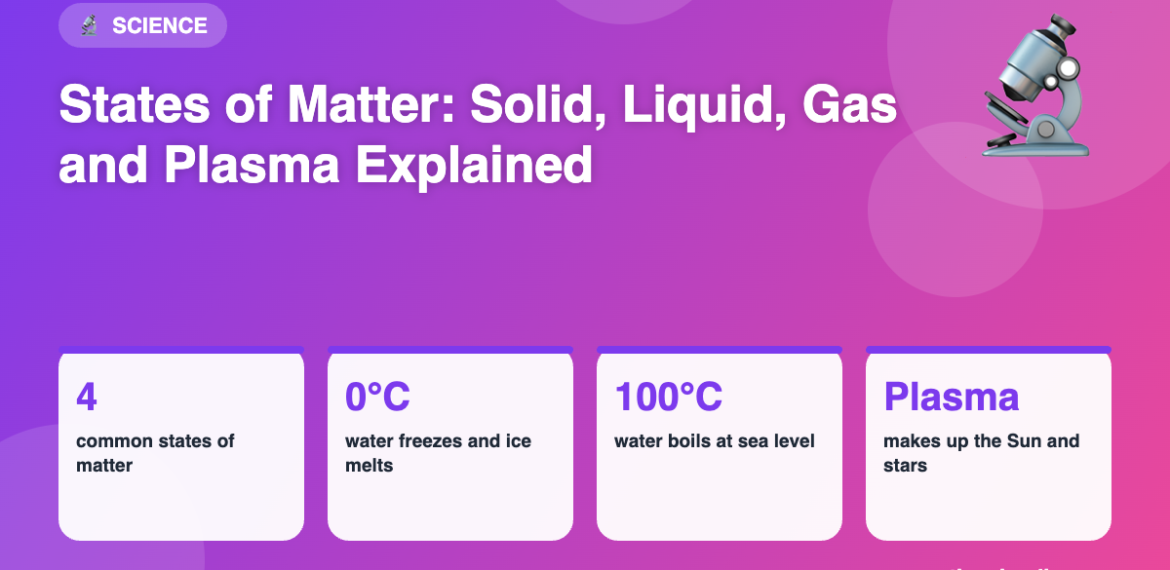
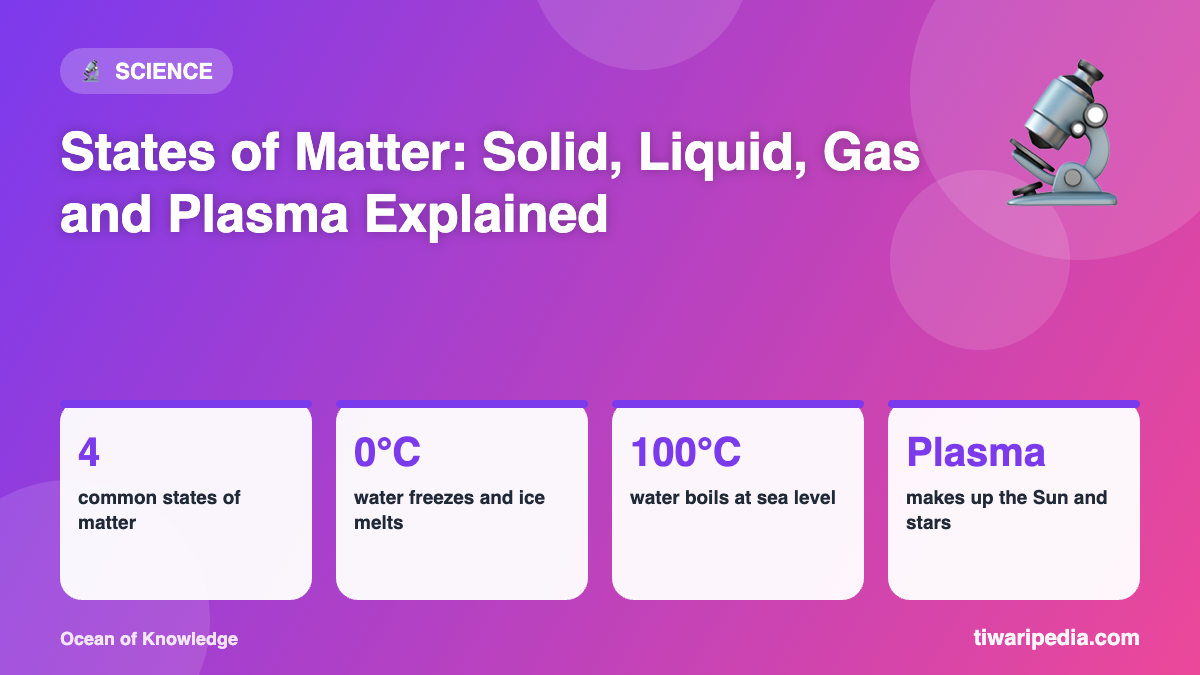
Anything that has mass and takes up space is matter, from the air we breathe to the water we drink and the chair we sit on. Matter usually exists in one of four states, depending on how its tiny particles behave.
1. Solids
Particles are packed tightly in a fixed arrangement and can only vibrate in place. Solids have a fixed shape and volume. Examples: ice, wood, iron.
2. Liquids
Particles are close together but can slide past one another. Liquids have a fixed volume but take the shape of their container. Examples: water, milk, oil.
3. Gases
Particles are far apart and move quickly in all directions. Gases have no fixed shape or volume and spread to fill any space. Examples: oxygen, steam, the air in a balloon.
4. Plasma
When a gas is heated to extremely high temperatures, electrons are stripped from atoms, creating an electrically charged gas called plasma. The Sun, stars, lightning and neon signs are made of plasma. It is the most common state of visible matter in the universe.
Changing states
- Melting: solid to liquid (ice melts at 0°C).
- Freezing: liquid to solid.
- Evaporation and boiling: liquid to gas (water boils at 100°C at sea level).
- Condensation: gas to liquid, like water drops on a cold glass.
- Sublimation: solid straight to gas, as with dry ice or camphor.
- Deposition: gas straight to solid, as with frost forming on a cold window.
Why does water boil at a lower temperature in the mountains?
At high altitude, air pressure is lower, so water boils at a lower temperature. That is why cooking takes longer in places like Leh or Shimla, and why pressure cookers are so useful there.
Exotic states
Scientists have also created unusual states such as the Bose–Einstein condensate, formed at temperatures close to absolute zero. It was predicted by Indian physicist Satyendra Nath Bose and Albert Einstein in the 1920s.




