

The Mughal Empire was one of the largest and wealthiest empires in Indian history. Its rulers shaped India’s art, architecture, food, language and administration.
Babur: the founder (1526)
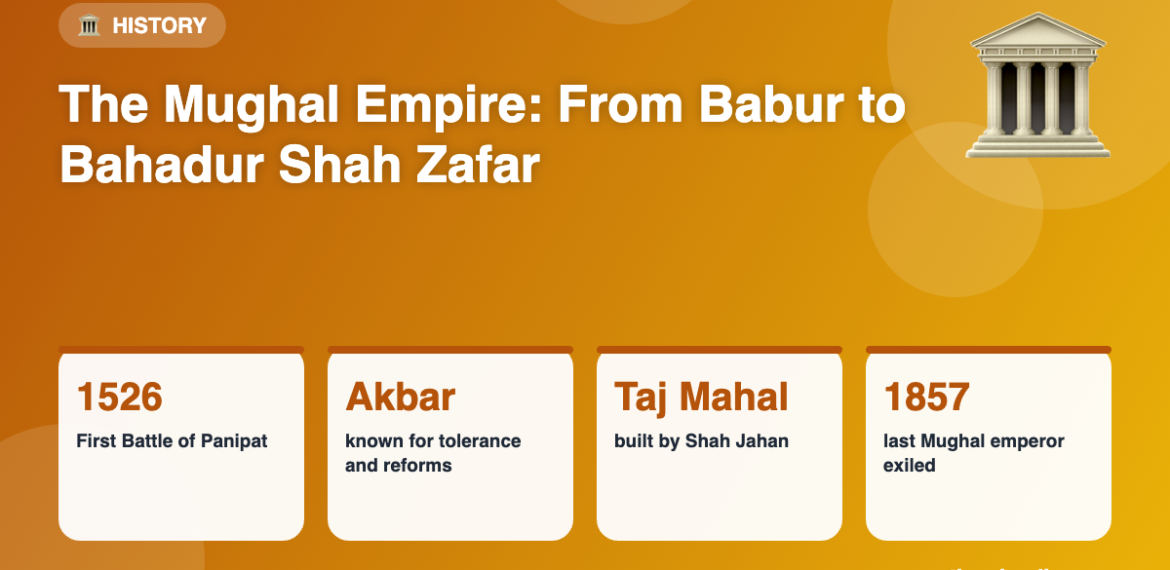
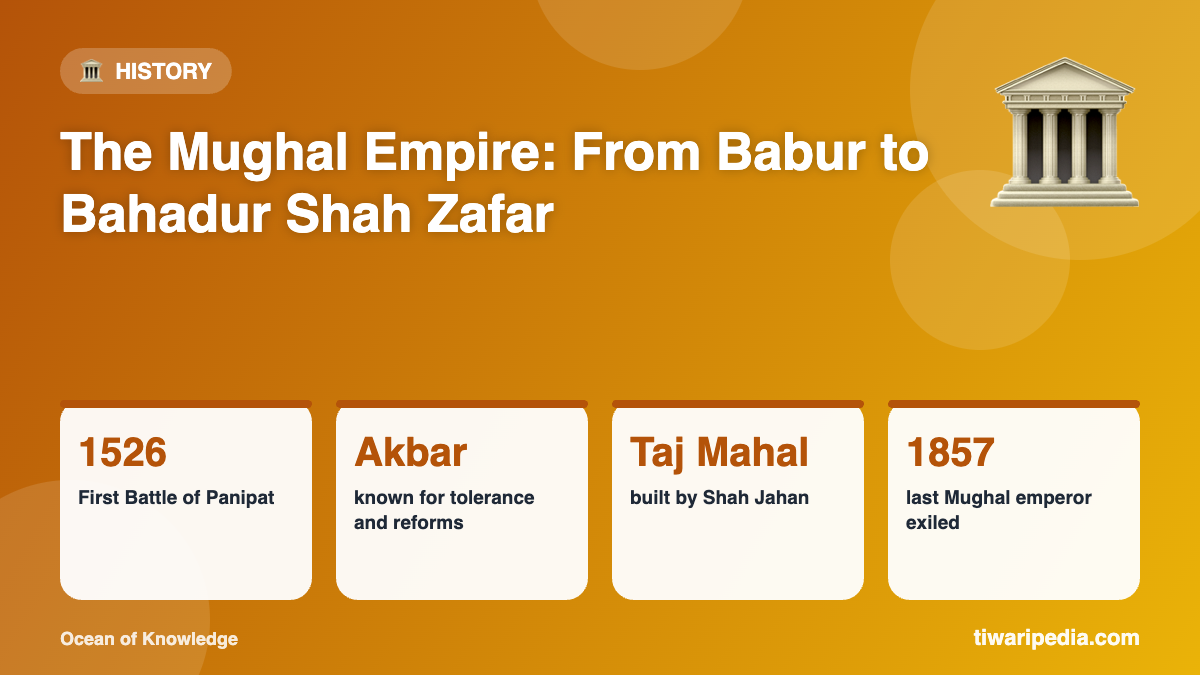
Babur, a descendant of Timur and Genghis Khan, came from Central Asia. In 1526 he defeated Ibrahim Lodi at the First Battle of Panipat, using cannons and clever tactics, and founded the Mughal dynasty.
Humayun
Babur’s son Humayun lost the empire to Sher Shah Suri, who built roads and introduced the silver rupiya. Humayun regained his throne in 1555 shortly before his death. His tomb in Delhi inspired later Mughal architecture.
Akbar the Great (1556–1605)
- Expanded the empire across most of north and central India.
- Known for religious tolerance: he abolished the jizya tax on non-Muslims and held discussions with scholars of many faiths.
- Built an efficient administration with the mansabdari system, and his finance minister Raja Todar Mal reformed land revenue.
- His court included the famous “Navratnas”, such as Birbal and the musician Tansen.
Jahangir and Shah Jahan
- Jahangir was a patron of painting; his wife Nur Jahan was highly influential.
- Shah Jahan was the great builder. He built the Taj Mahal in Agra in memory of his wife Mumtaz Mahal, and the Red Fort and Jama Masjid in Delhi.
Aurangzeb (1658–1707)
The empire reached its greatest size under Aurangzeb, but long wars, especially in the Deccan against the Marathas, strained its resources.
Decline and end
After Aurangzeb’s death in 1707, the empire weakened as regional powers grew and the British East India Company expanded. After the Revolt of 1857, the last emperor, Bahadur Shah Zafar, was exiled to Rangoon, ending Mughal rule.
Legacy
Mughal gardens, miniature paintings, Mughlai cuisine and the Urdu language all reflect this rich blend of Persian, Central Asian and Indian cultures.




