

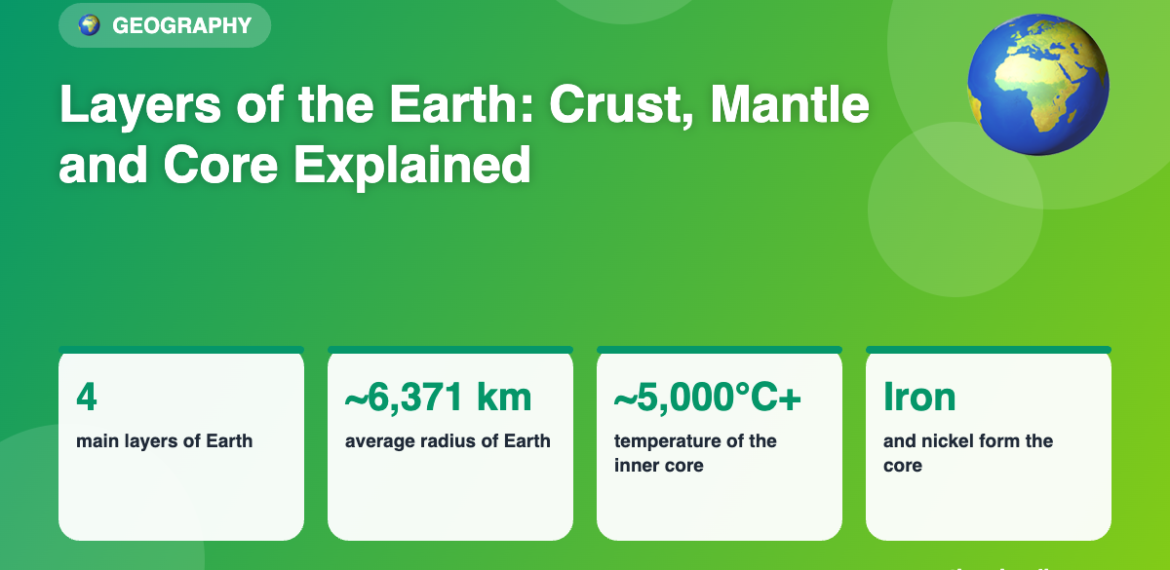
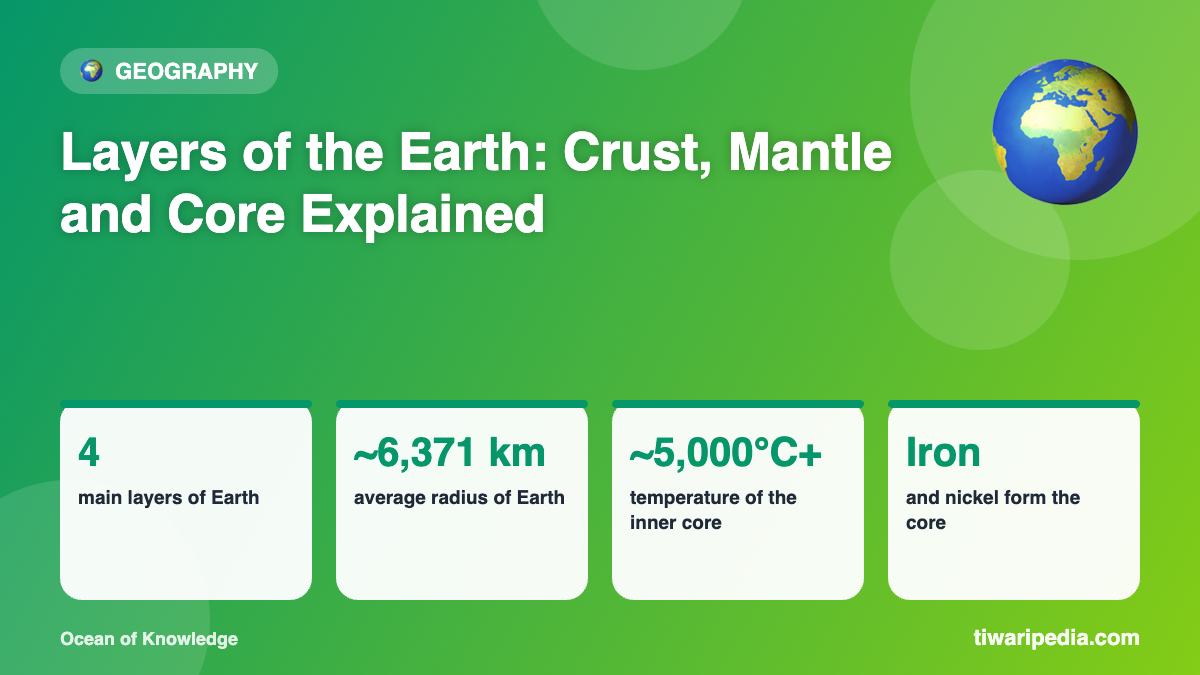
If you could slice Earth in half like a fruit, you would see it is built in layers. Scientists divide Earth into four main layers.
1. The crust
The thin, rocky outer skin we live on. It is only about 5–10 km thick under the oceans (oceanic crust) and around 30–70 km under continents (continental crust). Compared to the whole Earth, the crust is thinner than an apple’s skin.
2. The mantle
The thickest layer, about 2,900 km deep. It is made of hot rock that, over very long periods, flows slowly like extremely thick toffee. Heat from below creates slow currents in the mantle (convection currents) that move the tectonic plates above. Magma from the upper mantle feeds volcanoes.
3. The outer core
A layer of liquid iron and nickel, about 2,200 km thick. The movement of this molten metal generates Earth’s magnetic field, which protects us from harmful solar radiation and makes compasses work.
4. The inner core
A solid ball of iron and nickel at the centre, with a radius of about 1,200 km. Its temperature is thought to be over 5,000°C, comparable to the surface of the Sun. It stays solid because of the enormous pressure.
Lithosphere and asthenosphere
- The lithosphere is the rigid outer shell: the crust plus the uppermost mantle. It is broken into tectonic plates.
- The asthenosphere below it is softer, allowing the plates to move.
How do we know?
No one has drilled through the crust; the deepest hole ever drilled went about 12 km. Scientists study seismic waves from earthquakes. These waves change speed and direction as they pass through different materials, and some cannot travel through liquid. This revealed that the outer core is liquid.




