

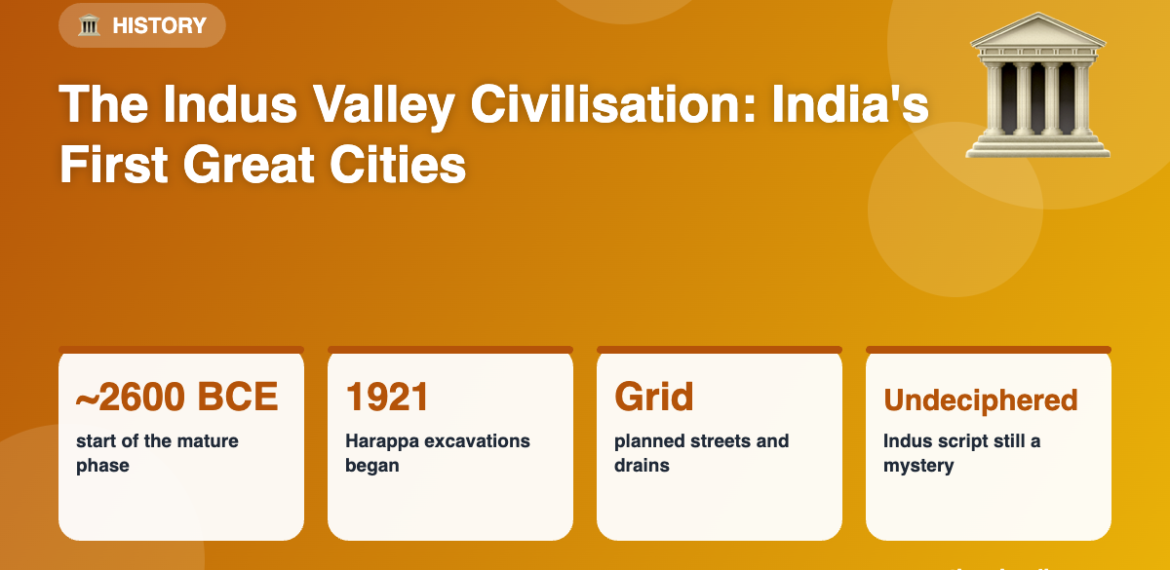
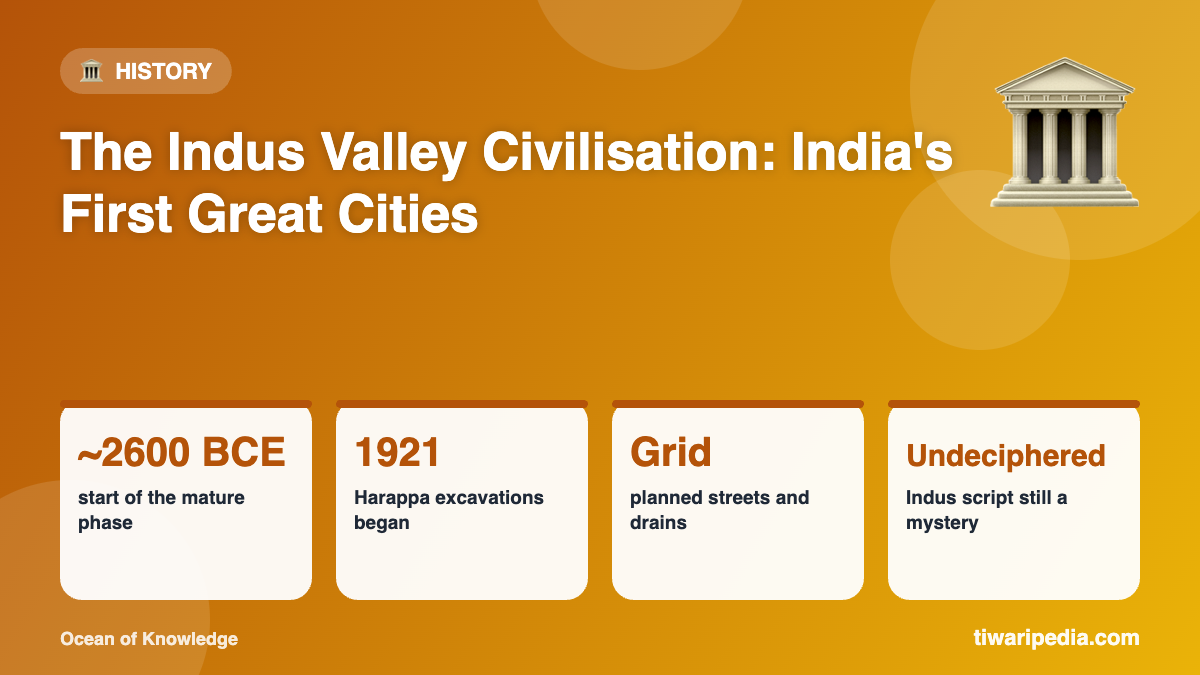
Long before many great civilisations, people in the river valleys of northwest South Asia built some of the world’s earliest planned cities. This is the Indus Valley Civilisation, also called the Harappan Civilisation after its first excavated site.
When and where?
Its mature phase flourished roughly from 2600 to 1900 BCE, around the same time as ancient Egypt and Mesopotamia. It spread across present-day Pakistan and northwest India, including Punjab, Haryana, Rajasthan and Gujarat, making it the largest of the ancient civilisations by area.
Discovery
Excavations began at Harappa in 1921 and at Mohenjo-daro in 1922. Since then, over a thousand sites have been found, including Lothal and Dholavira in Gujarat and Rakhigarhi in Haryana. Dholavira was declared a UNESCO World Heritage Site in 2021.
Amazing city planning
- Streets laid out in a grid pattern, crossing at right angles.
- Covered drainage systems along streets, far ahead of their time.
- Houses built with standard-sized baked bricks, many with private wells and bathrooms.
- A raised “citadel” area and a lower town.
The Great Bath
Mohenjo-daro’s Great Bath is a large watertight pool, probably used for ritual bathing. It shows advanced engineering, with bitumen used to waterproof the bricks.
Trade and economy
- Farmers grew wheat, barley and cotton; the Harappans were among the earliest people to grow cotton.
- Lothal had a dockyard, suggesting sea trade.
- Indus seals have been found in Mesopotamia, showing long-distance trade.
- They used standardised weights and measures.
The mystery script
The Harappans used a script found on thousands of small seals, often with animals such as the “unicorn” bull. The Indus script has not yet been deciphered, so much about their language and beliefs remains a mystery.
Why did it decline?
Historians believe a mix of factors played a role: changes in climate and monsoon patterns, shifting or drying rivers such as the Ghaggar-Hakra, and decline in trade. People gradually moved to smaller villages further east.




