

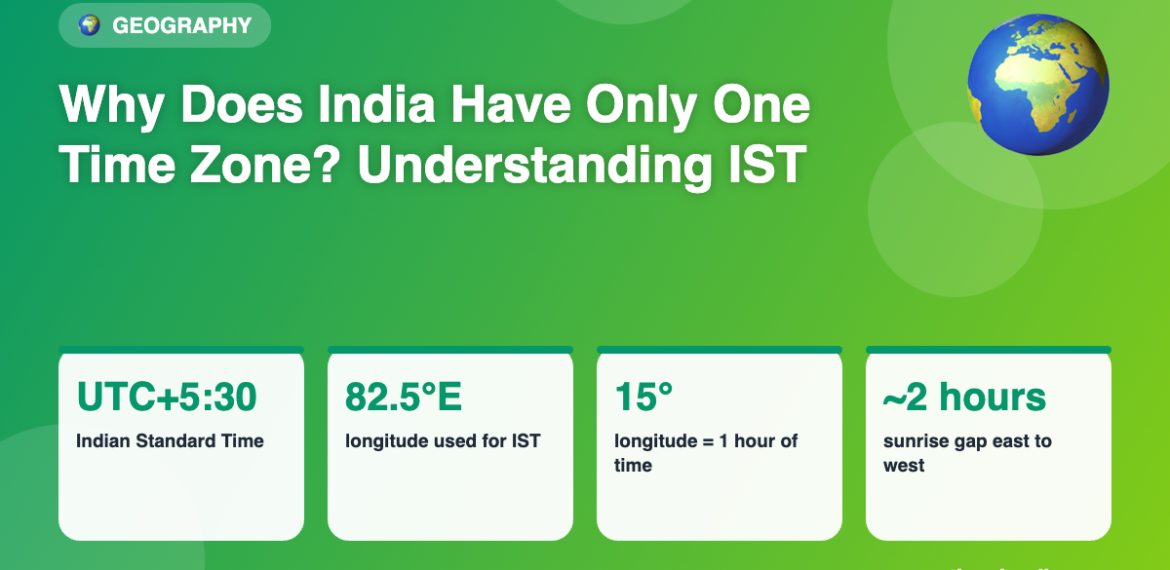
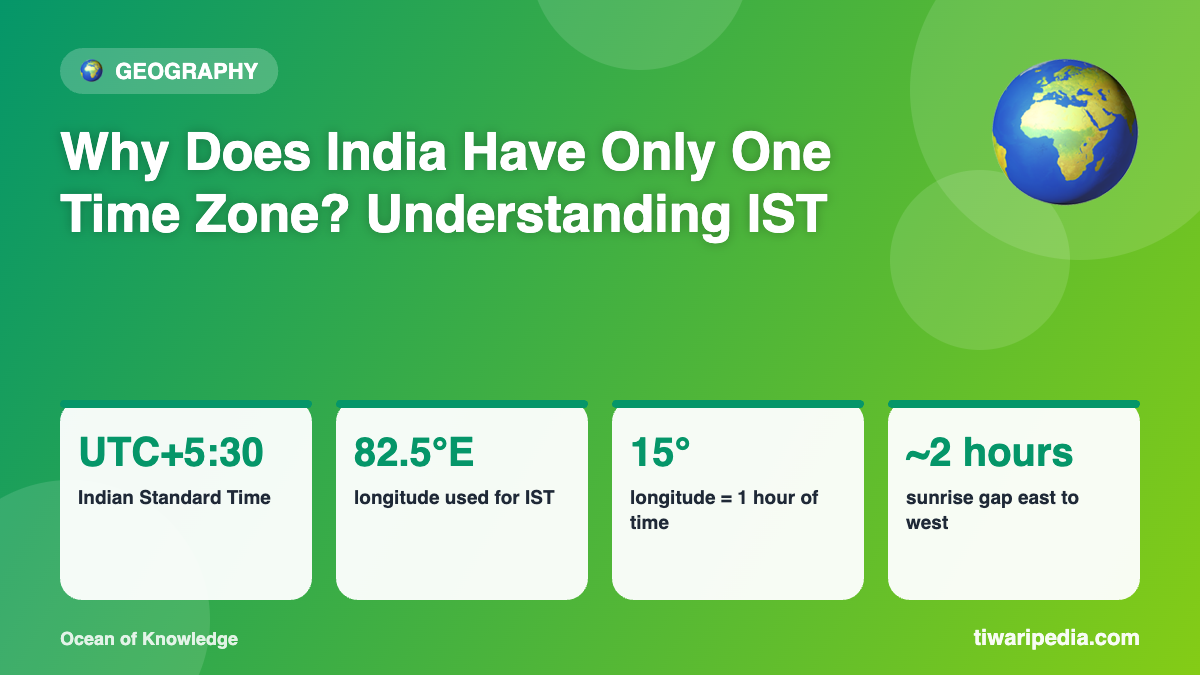
When it is 6:00 am in Delhi, it is also 6:00 am in Kohima and in Bhuj, even though the Sun rises much earlier in the Northeast. That is because India uses a single time zone: Indian Standard Time (IST).
How do time zones work?
Earth rotates 360 degrees in 24 hours, so it turns 15 degrees every hour. The world is therefore divided into time zones roughly 15 degrees of longitude wide, measured from the Prime Meridian (0°) at Greenwich as Coordinated Universal Time (UTC).
How IST is calculated
IST is based on the 82.5°E longitude, which passes near Mirzapur in Uttar Pradesh. Since 82.5 ÷ 15 = 5.5, IST is UTC + 5 hours 30 minutes.
India is wide
India stretches about 30 degrees of longitude from Gujarat to Arunachal Pradesh, about two hours of difference in solar time. In the Northeast, the Sun can rise around 4:30–5:00 am in summer, while in western Gujarat it rises much later.
The case for two time zones
- People in the Northeast lose daylight hours when offices open by IST.
- An earlier time zone could save electricity and improve productivity there.
- Tea gardens in Assam have long followed an informal “chai bagan time”, about an hour ahead of IST.
The case for one time zone
- Simplicity for railways, flights, banking and broadcasting.
- Avoids confusion from switching clocks across state borders.
- Supports a sense of national unity.
Other countries
- China is even wider but also uses one time zone.
- The USA and Russia use several time zones.
- Nepal uses UTC+5:45, one of the few zones offset by 45 minutes.
IST is maintained by the CSIR–National Physical Laboratory in New Delhi using atomic clocks.




