

Before printing, every book had to be copied by hand, which took months and made books rare and expensive. The printing press changed that, and with it, the world.
Early printing in Asia
Printing began in East Asia. The Chinese used carved wooden blocks to print text centuries earlier, and the oldest surviving dated printed book, the Diamond Sutra, dates from 868 CE. Movable type made of clay and later metal was also developed in China and Korea.
Gutenberg’s breakthrough
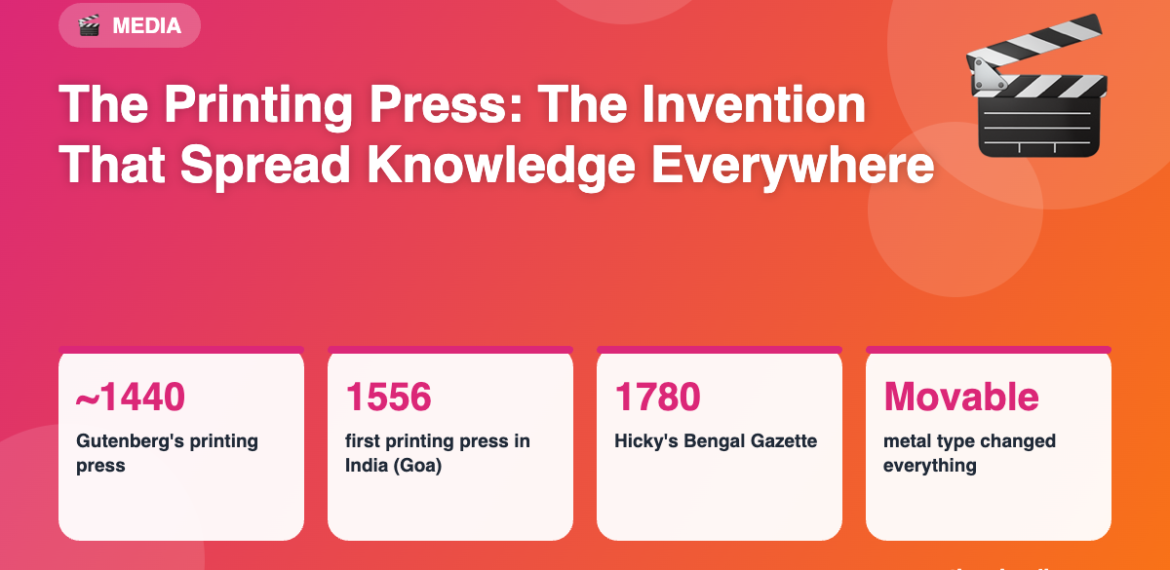
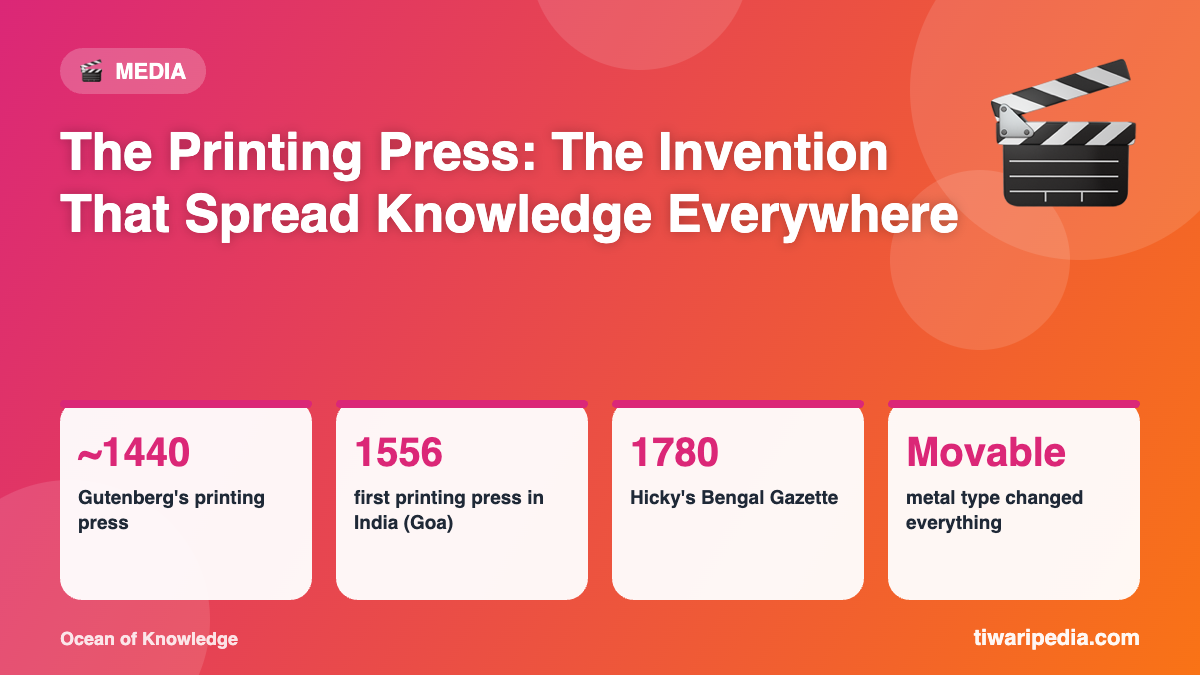
Around 1440, Johannes Gutenberg in Germany developed a printing press using movable metal type, oil-based ink and a press adapted from wine presses. Individual letters could be arranged into pages, inked, printed and then reused. His famous Gutenberg Bible was printed in the 1450s.
A knowledge revolution
- Books became cheaper and more widely available.
- Literacy spread beyond priests and nobles.
- Scientific ideas could be shared accurately and quickly.
- It helped drive the Renaissance, the Reformation and the Scientific Revolution.
Printing comes to India
Portuguese Jesuit missionaries brought the first printing press to Goa in 1556. In the following centuries, printing spread to Tamil Nadu, Bengal and elsewhere. The Serampore Mission Press in Bengal printed books in many Indian languages in the early 1800s.
India’s first newspaper
James Augustus Hicky started Hicky’s Bengal Gazette in Calcutta on 29 January 1780, India’s first newspaper. Indian-language newspapers soon followed, and the press later became a powerful voice of the freedom movement, through papers founded or edited by leaders such as Bal Gangadhar Tilak and Mahatma Gandhi.
From press to pixels
Printing evolved through steam-powered presses, rotary presses and offset printing to today’s digital printing and e-books. Yet the idea Gutenberg spread, of making knowledge available to everyone, lives on in the internet.




