

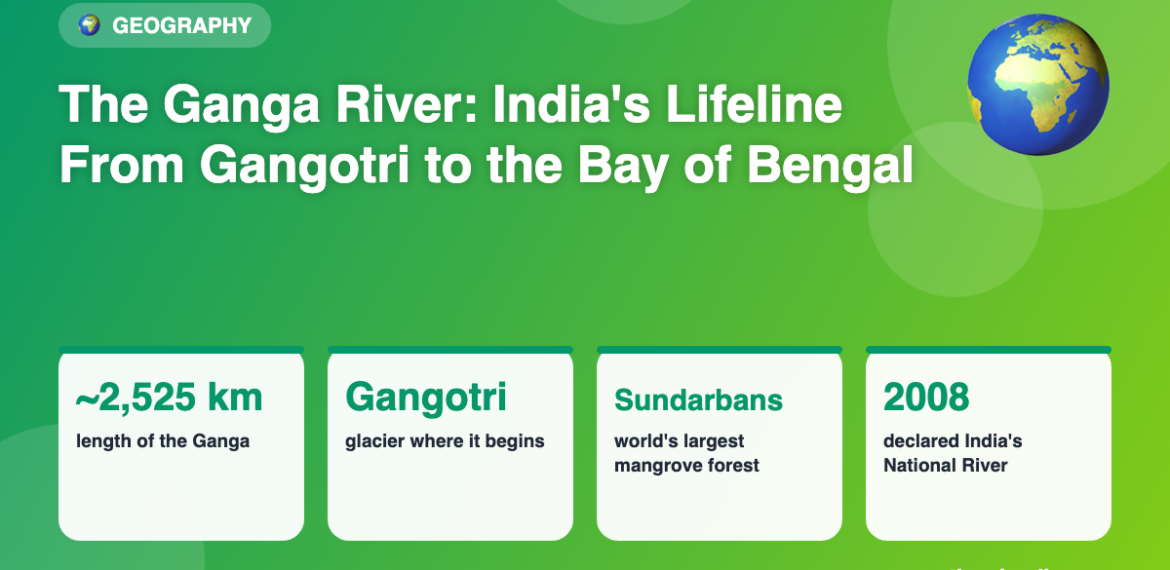
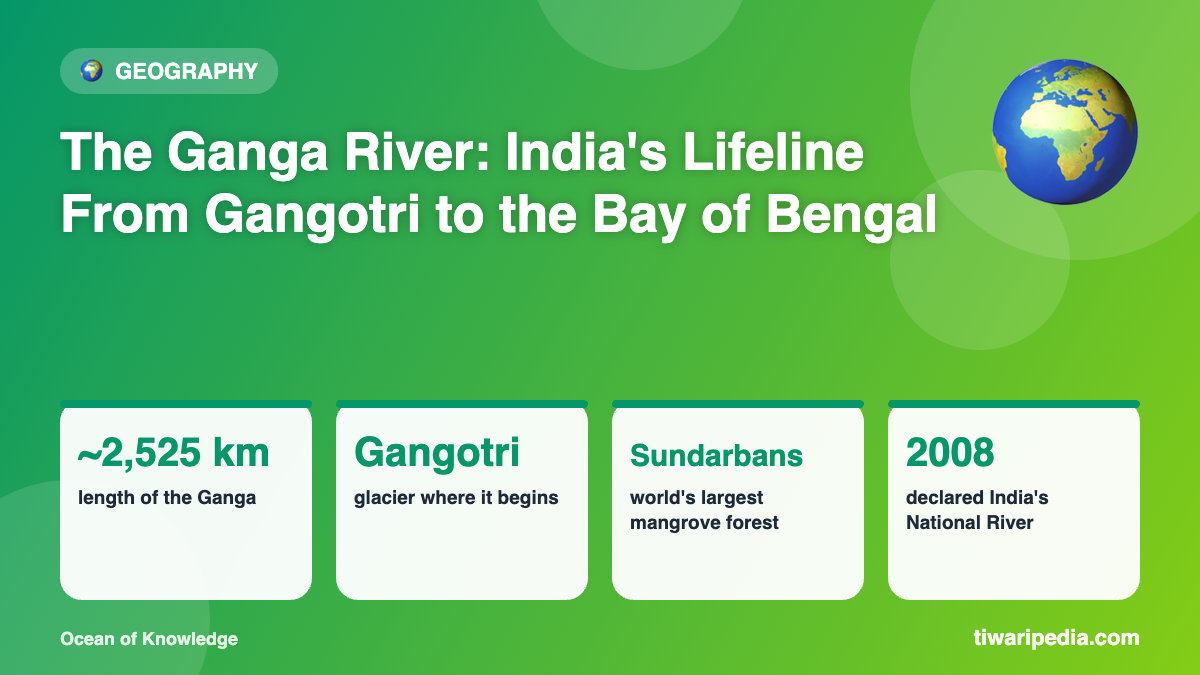
The Ganga (Ganges) is India’s most important river. It supports hundreds of millions of people, irrigates vast farmlands and holds deep religious significance. In 2008 it was declared India’s National River.
Where does it begin?
The Ganga starts as the Bhagirathi from the Gangotri Glacier at Gaumukh in Uttarakhand. At Devprayag, the Bhagirathi meets the Alaknanda, and from there the combined river is called the Ganga.
Its journey
- It leaves the mountains at Rishikesh and enters the plains at Haridwar.
- It flows through Uttar Pradesh, past Kanpur and Prayagraj, where it meets the Yamuna at the Triveni Sangam.
- It passes Varanasi, one of the oldest continuously inhabited cities in the world, and then Patna in Bihar.
- In West Bengal it splits: the main stream enters Bangladesh as the Padma, while the Hooghly branch flows past Kolkata.
- It joins the Brahmaputra and empties into the Bay of Bengal.
Major tributaries
Yamuna, Ghaghara, Gandak, Kosi, Son and Ramganga, among others.
The Sundarbans delta
Where the Ganga and Brahmaputra meet the sea, they form one of the world’s largest river deltas. It hosts the Sundarbans, the largest mangrove forest on Earth and home to the Royal Bengal tiger. It is a UNESCO World Heritage Site.
Why the Ganga matters
- Agriculture: its fertile plains are among the most productive farmlands in the world.
- Population: the Ganga basin is one of the most densely populated regions on Earth.
- Culture and faith: it is worshipped as Goddess Ganga, and the Kumbh Mela at Prayagraj is one of the largest gatherings of people anywhere.
- Wildlife: it is home to the endangered Ganges river dolphin, India’s National Aquatic Animal.
Cleaning the river
Pollution from cities and industries is a serious challenge. The Namami Gange programme, launched in 2014, works on sewage treatment, riverfront development and biodiversity conservation.




