

SAP is the world’s best-known enterprise resource planning (ERP) software. Large and mid-sized companies use it to run finance, sales, purchasing, manufacturing, projects, warehouses and HR on one integrated system. In India, many of the biggest manufacturers, banks, telecom operators, retailers and public sector companies run on SAP.
This guide explains what SAP S/4HANA is, the top 10 modules every learner should know, how AI is changing SAP, and the latest market updates for 2026.
What is SAP?
SAP SE was founded in 1972 in Germany by five former IBM engineers. Its software evolved from R/2 (mainframe) to R/3 (client-server, 1992), then SAP ECC (ERP Central Component), and in 2015 to SAP S/4HANA, its current ERP suite.
The “HANA” in S/4HANA is SAP’s in-memory database, which keeps data in RAM so reports and analysis can run in real time on live transactions. S/4HANA also simplified the data model: for example, finance and controlling postings now land in a single table, the Universal Journal (ACDOCA).
How companies run SAP today
- SAP S/4HANA Cloud, Public Edition: standardised SaaS ERP with regular automatic upgrades, often sold through GROW with SAP to mid-sized and fast-growing companies.
- SAP S/4HANA Cloud, Private Edition: more flexibility and customisation, hosted and managed for the customer, typically through RISE with SAP.
- On-premise S/4HANA: installed in the customer’s own data centre or chosen hyperscaler.
- SAP Business One and SAP Business ByDesign serve smaller businesses.
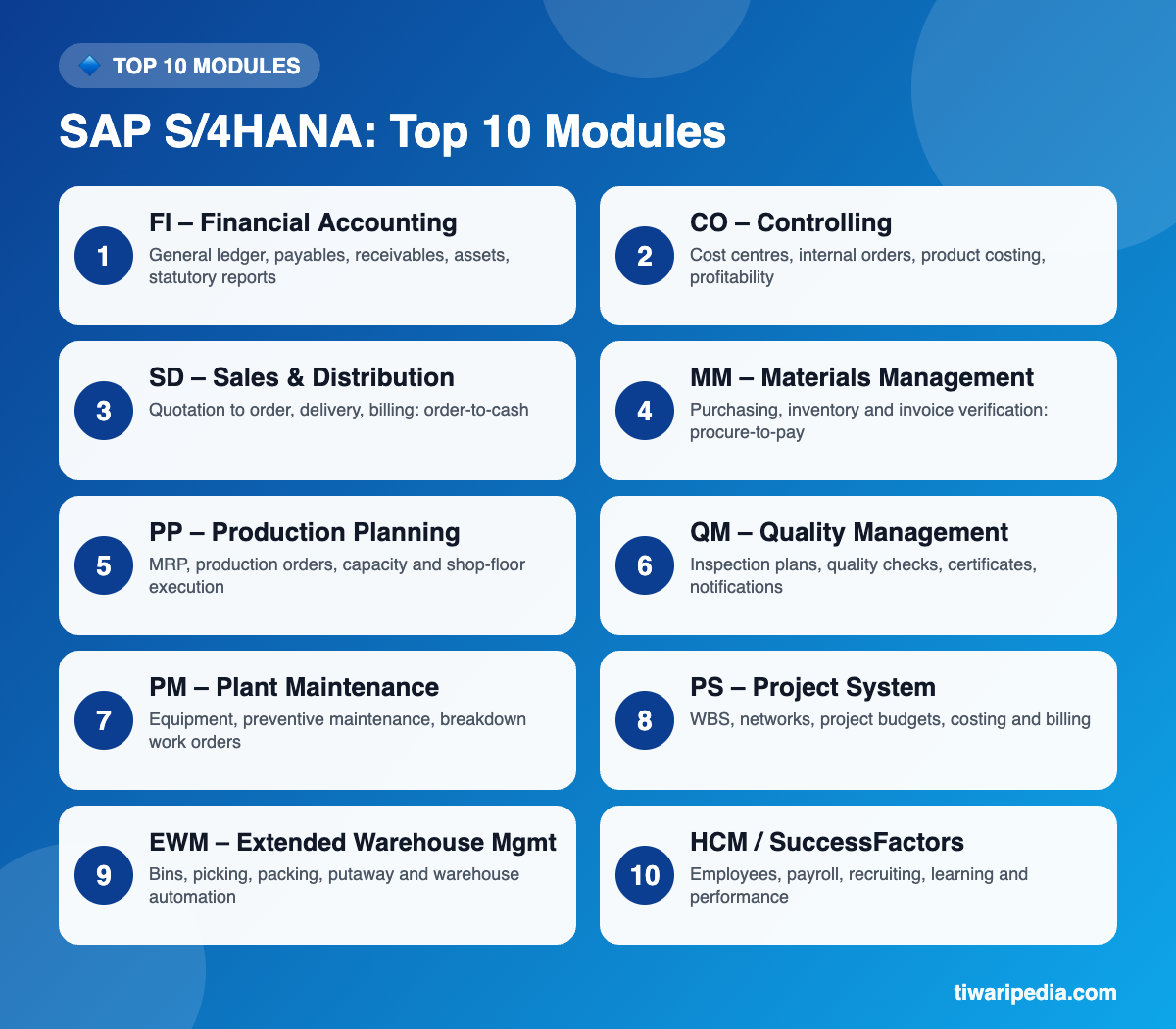
Top 10 SAP S/4HANA modules
1. FI – Financial Accounting
The backbone of SAP. FI records every financial transaction and produces legally required statements: balance sheet and profit and loss. Sub-areas include General Ledger, Accounts Payable, Accounts Receivable, Asset Accounting and Bank Accounting. In India, FI is configured for GST, TDS and statutory reporting.
2. CO – Controlling
Controlling is management accounting. It tracks where costs arise and whether products, customers and departments are profitable, using cost centres, profit centres, internal orders, product costing and profitability analysis (CO-PA). FI and CO are so closely linked that most consultants work on both (“FICO”).
3. SD – Sales and Distribution
SD runs the order-to-cash process: inquiry, quotation, sales order, pricing, credit check, delivery, shipping and billing. Its pricing engine (condition technique) is one of the most powerful parts of SAP.
4. MM – Materials Management
MM handles procure-to-pay: purchase requisitions, purchase orders, goods receipt, inventory management and invoice verification. It keeps track of what a company buys, from whom, and how much stock is in each plant and storage location.
5. PP – Production Planning
PP plans and executes manufacturing using bills of materials, routings, work centres, material requirements planning (MRP) and production orders. S/4HANA’s MRP Live runs much faster on HANA. Advanced scenarios use SAP Digital Manufacturing.
6. QM – Quality Management
QM embeds quality checks into purchasing, production and sales: inspection lots, sampling plans, results recording, usage decisions, quality notifications and certificates. It is critical in pharmaceuticals, food and automotive.
7. PM – Plant Maintenance
PM (now part of SAP’s Enterprise Asset Management) manages equipment and functional locations, preventive maintenance plans, breakdown notifications and maintenance orders, helping factories and utilities reduce downtime.
8. PS – Project System
PS manages large, complex projects such as construction, engineering, defence, power plants and capital investments. It uses Work Breakdown Structures (WBS) and networks to plan budgets, schedules, resources, costs and project billing, and integrates tightly with FI/CO, MM, SD and PP.
9. EWM – Extended Warehouse Management
EWM runs complex warehouses at bin level: inbound and outbound processes, wave picking, packing, putaway strategies, yard management and automation such as conveyors and robots. In S/4HANA it is available as embedded EWM.
10. HCM and SAP SuccessFactors
HR in SAP covers organisational management, personnel administration, time and payroll. Most new HR projects now use SAP SuccessFactors, SAP’s cloud HR suite for core HR, recruiting, onboarding, learning, performance and compensation.
Beyond the core: other important SAP solutions
- SAP BTP (Business Technology Platform): for extensions, integration (Integration Suite/CPI), analytics and AI, supporting a “clean core” ERP.
- SAP Ariba (procurement network), SAP Concur (travel and expenses) and SAP Fieldglass (external workforce).
- SAP Service Management (CS/SM): service orders, contracts, warranties and field service.
- SAP BRIM: subscription and usage-based billing for telecom, utilities and digital businesses.
- SAP Document and Reporting Compliance (DRC): e-invoicing and statutory e-reporting, including India’s GST e-invoice requirements.
- SAP Signavio for process mining, SAP Analytics Cloud for planning and BI, and SAP Business Data Cloud for unifying SAP and non-SAP data for analytics and AI.
Latest SAP market updates (2026)
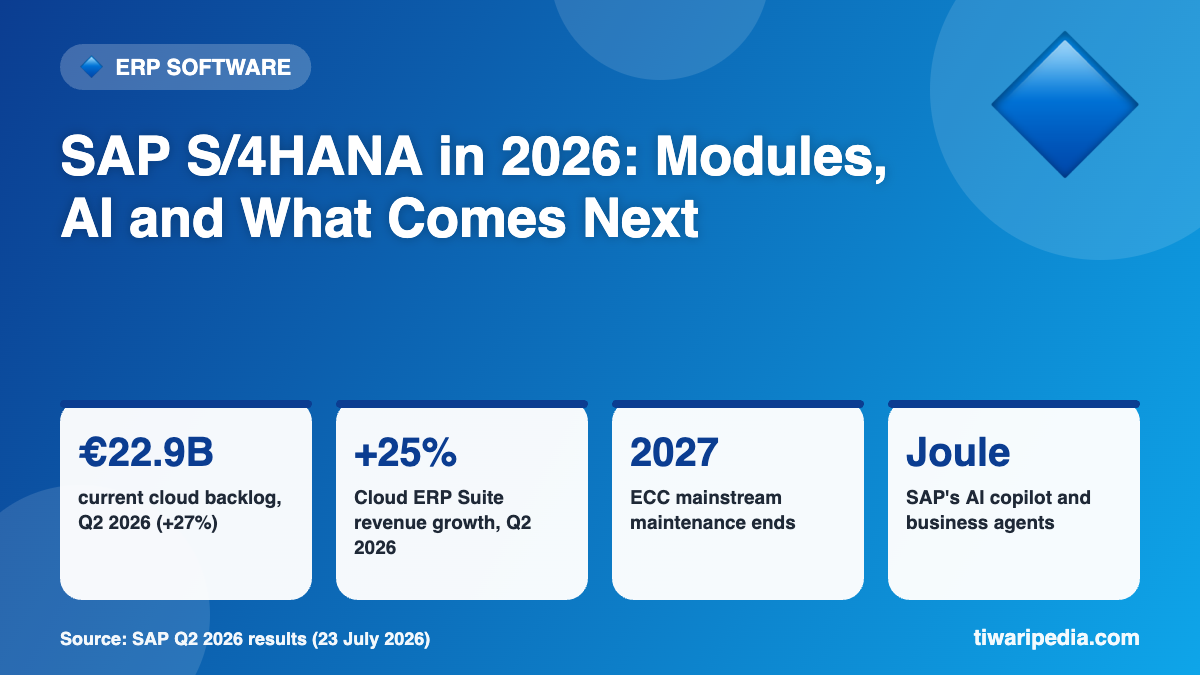
- Strong cloud growth: In its Q2 2026 results (23 July 2026), SAP reported a current cloud backlog of €22.9 billion, up 27%, with cloud revenue up 22% and Cloud ERP Suite revenue up 25%. Total revenue grew 9%.
- The “Autonomous Enterprise”: SAP’s leadership now frames its strategy around AI-driven automation across its suite and its Business AI platform. The company also cited the acquisitions of Dremio and Prior Labs in its 2026 outlook.
- Joule everywhere: SAP’s AI copilot, Joule, is embedded across S/4HANA Cloud and other SAP applications, with task-specific Joule agents for areas such as finance, procurement and supply chain.
- Clean core: SAP is pushing customers to keep the ERP standard and build extensions on BTP, making upgrades faster and AI adoption easier.
- The ECC deadline is close: see the timeline below.
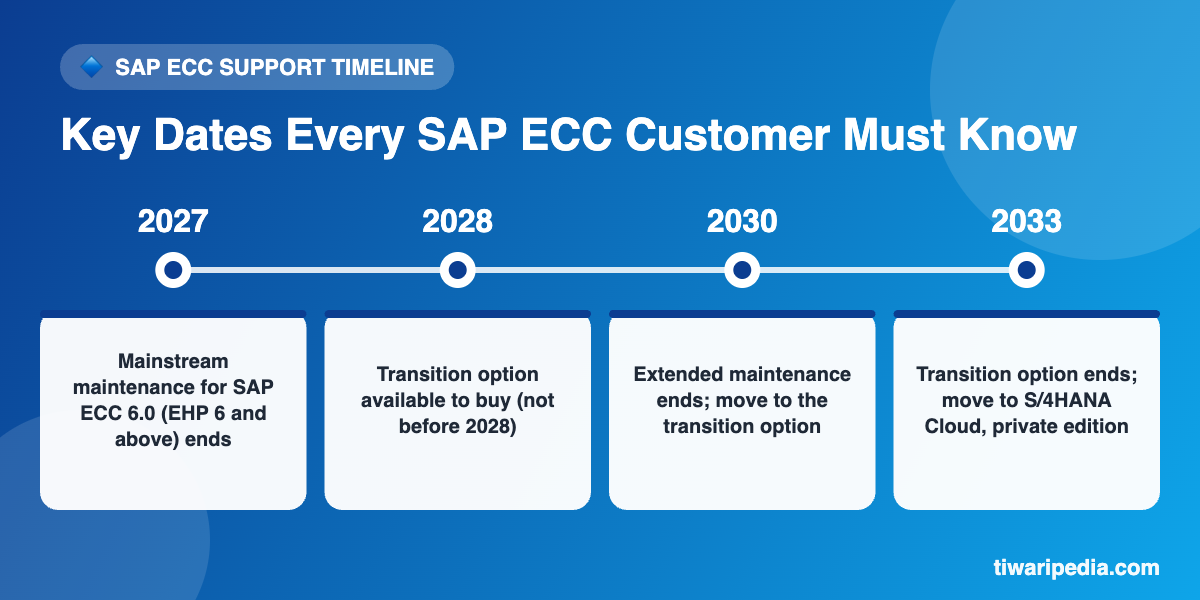
For companies still on ECC, mainstream maintenance ends in 2027. SAP offers extended maintenance until the end of 2030, and a paid SAP ERP, private edition transition option covering 2031–2033 for customers committed to moving to S/4HANA Cloud, private edition. This makes S/4HANA migration one of the biggest IT programmes in the world right now, and a major source of SAP jobs.
Careers in SAP
- Most in-demand skills: S/4HANA FI/CO, SD, MM, EWM, PP/QM, SuccessFactors, ABAP (especially ABAP Cloud/RAP), BTP and integration, and S/4HANA migration.
- Learning path: understand business processes first (order-to-cash, procure-to-pay, record-to-report), then learn configuration on a sandbox system, then earn an SAP certification through SAP Learning.
- Tip: domain experience (finance, supply chain, manufacturing or projects) combined with SAP skills makes a consultant far more valuable.
Frequently asked questions
Is SAP a programming language? No. SAP is a company and its business software. ABAP is SAP’s programming language.
Which SAP module is best to learn? FI/CO is a popular start for commerce and finance graduates; SD and MM suit supply chain backgrounds; PP, QM and PM suit engineers. Choose the module closest to your work experience.
What is the difference between ECC and S/4HANA? S/4HANA runs only on the HANA in-memory database, has a simplified data model, a modern Fiori user interface and built-in AI and analytics, while ECC is the older generation.
About the author: Pravinkumar Tiwari is an SAP consultant with more than 10 years of experience in SAP Service Management, Project System, BRIM, DRC and S/4HANA. Figures above are from SAP’s official Q2 2026 results and SAP’s published ECC maintenance plans; always check SAP’s official announcements for the latest details.
Sources: SAP Q2 2026 results; SAPinsider on the ERP transition option.




