

India’s journey to freedom from British rule was a long struggle involving millions of ordinary people, revolutionaries and great leaders. Here are the key milestones.
1857: The Revolt
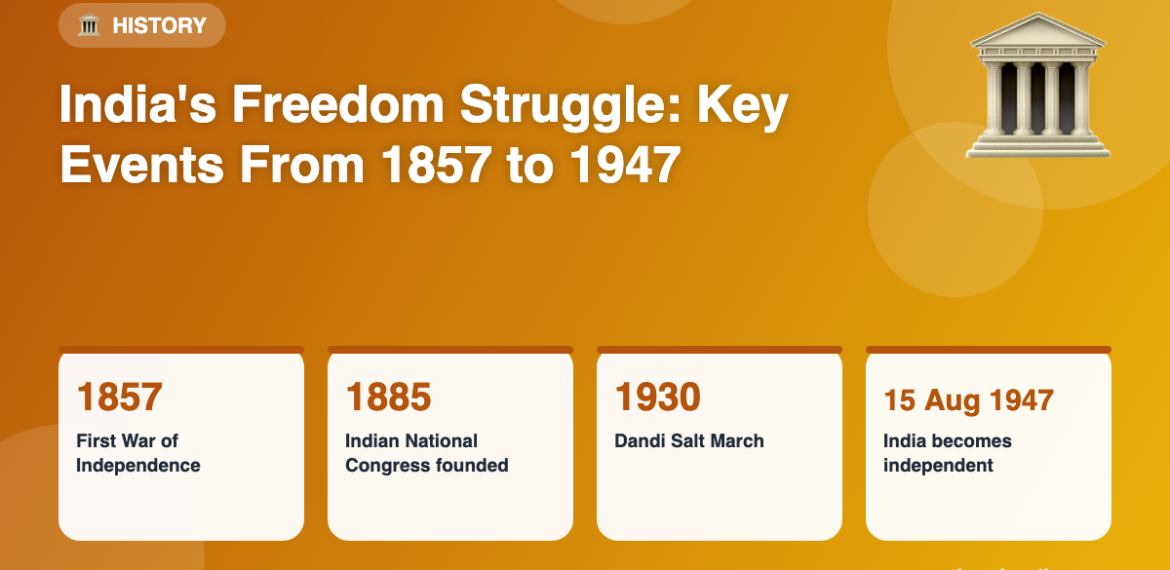
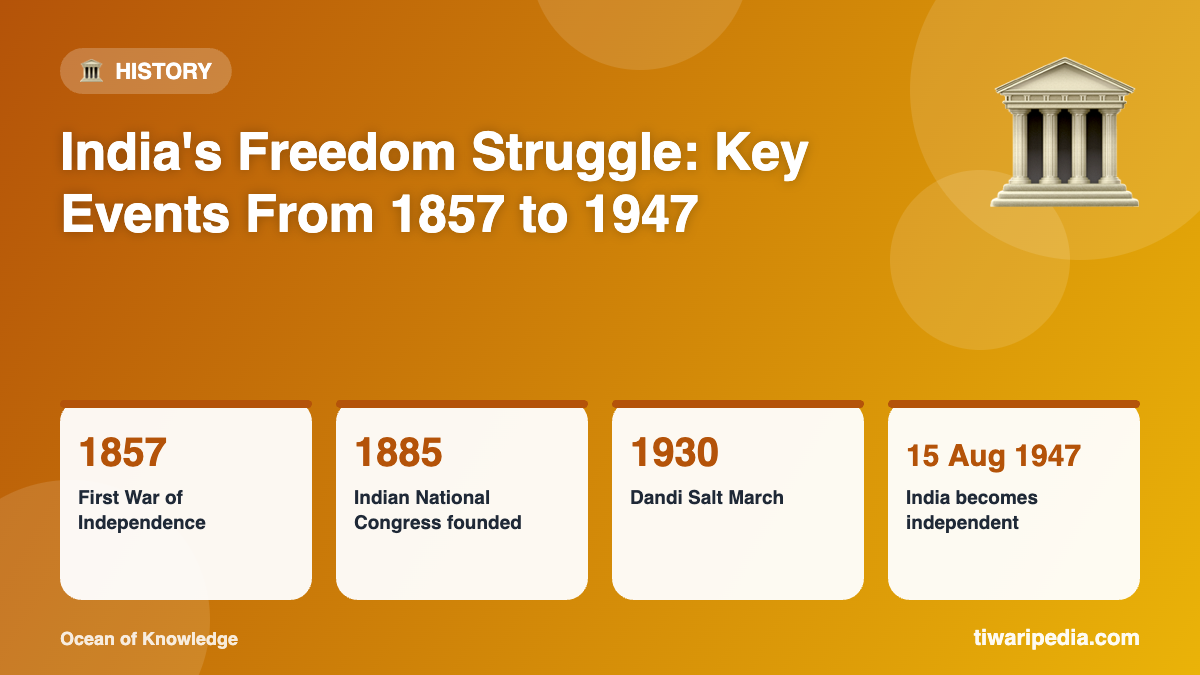
Often called the First War of Independence, it began with sepoys in Meerut and spread across north and central India. Leaders included Rani Lakshmibai of Jhansi, Tantia Tope and Mangal Pandey. After it was crushed, the British Crown took direct control of India from the East India Company in 1858.
1885: Indian National Congress
The Indian National Congress was founded, giving Indians a national platform to demand rights and reforms.
1905: Partition of Bengal and Swadeshi
Lord Curzon divided Bengal, sparking the Swadeshi movement: boycotting British goods and promoting Indian-made products. The partition was reversed in 1911.
1915–1919: Gandhi and Jallianwala Bagh
Mahatma Gandhi returned from South Africa in 1915 and led local movements such as Champaran (1917). In April 1919, British troops fired on a peaceful crowd at Jallianwala Bagh in Amritsar, killing hundreds and shocking the nation.
1920–22: Non-Cooperation Movement
Indians boycotted British schools, courts and goods. Gandhi called it off after violence at Chauri Chaura.
1930: Salt March
Gandhi walked about 385 km from Sabarmati to Dandi to make salt in defiance of the British salt tax, launching the Civil Disobedience Movement.
Revolutionaries
Bhagat Singh, Chandrashekhar Azad, Sukhdev and Rajguru inspired young Indians. Subhas Chandra Bose later led the Indian National Army.
1942: Quit India
Gandhi gave the call “Do or Die”, demanding the British leave India immediately. Leaders were jailed, but the movement showed the people’s determination.
1947: Independence and Partition
India became independent on 15 August 1947, with Jawaharlal Nehru as the first Prime Minister. Independence came with the painful Partition into India and Pakistan, which caused mass migration and violence.




