

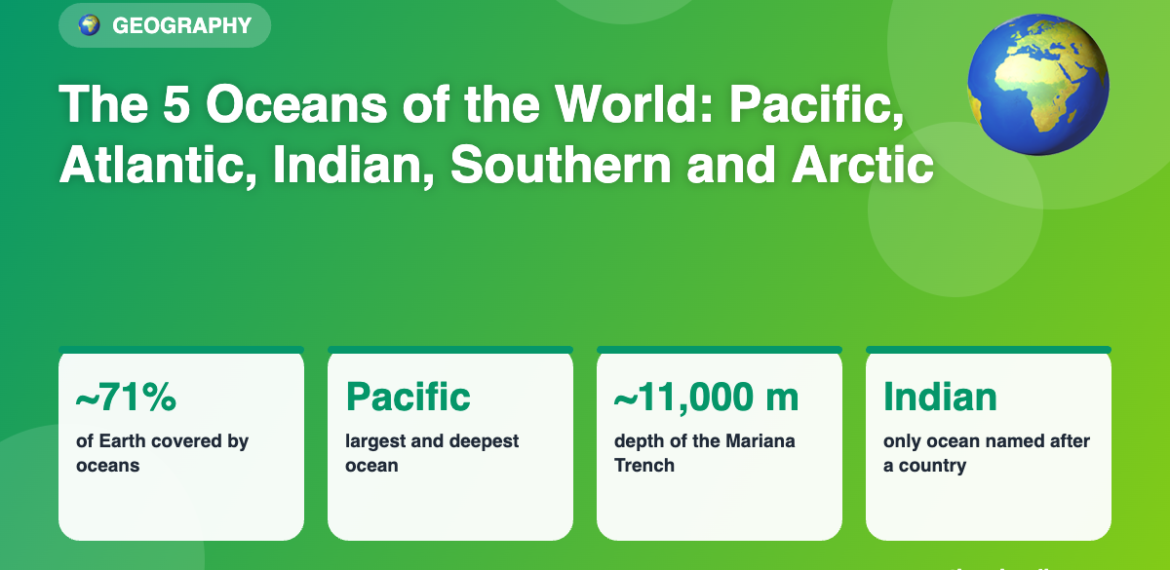
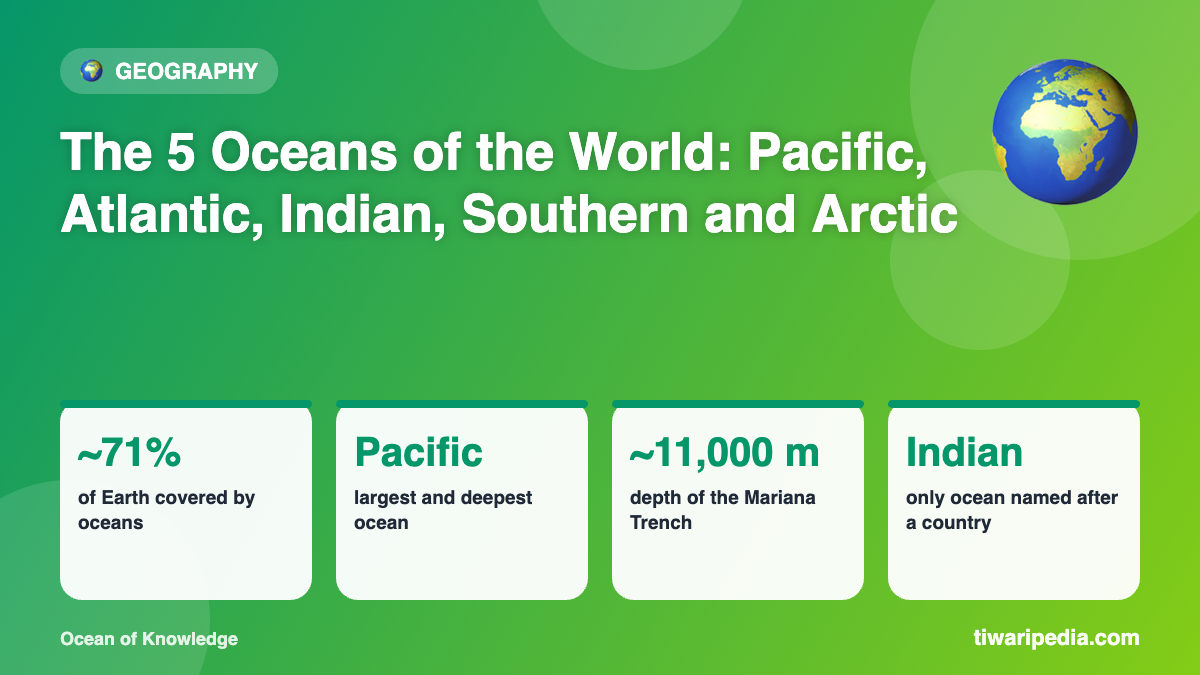
Oceans cover about 71% of Earth’s surface and hold most of its water. Though they are all connected as one global ocean, geographers divide them into five.
1. Pacific Ocean
The largest and deepest ocean, bigger than all of Earth’s land combined. It contains the Mariana Trench, whose deepest point, the Challenger Deep, is about 11,000 metres down. The Pacific is ringed by the “Ring of Fire”, a belt of volcanoes and earthquakes.
2. Atlantic Ocean
The second-largest ocean, separating the Americas from Europe and Africa. It is crossed by the Mid-Atlantic Ridge, an underwater mountain range where new sea floor forms. The warm Gulf Stream keeps Western Europe milder than other places at the same latitude.
3. Indian Ocean
The third-largest and the only ocean named after a country. It is the warmest ocean, drives the Indian monsoon, and carries a large share of the world’s oil and trade shipping. It includes the Arabian Sea and the Bay of Bengal.
4. Southern Ocean
Surrounding Antarctica, it is defined by the powerful Antarctic Circumpolar Current, the strongest ocean current on Earth.
5. Arctic Ocean
The smallest and shallowest ocean, around the North Pole, much of it covered by sea ice. Warming temperatures are shrinking this ice, which affects polar bears and global climate.
Why oceans matter
- Ocean plants and phytoplankton produce a large share of the oxygen we breathe.
- Oceans absorb heat and carbon dioxide, helping regulate climate.
- They provide food, livelihoods and trade routes for billions of people.
Seas vs oceans
A sea is a smaller body of salt water, usually partly enclosed by land, such as the Arabian Sea or the Mediterranean Sea.




