

An earthquake is the sudden shaking of the ground caused by the release of energy inside Earth. Thousands happen every year, but most are too small to feel.
Moving plates
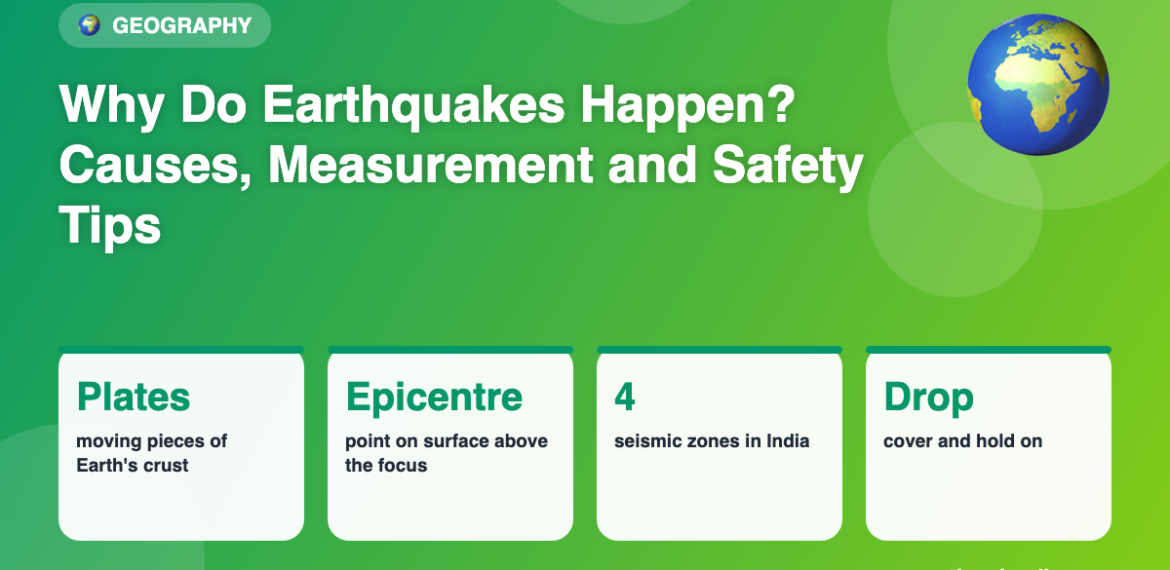
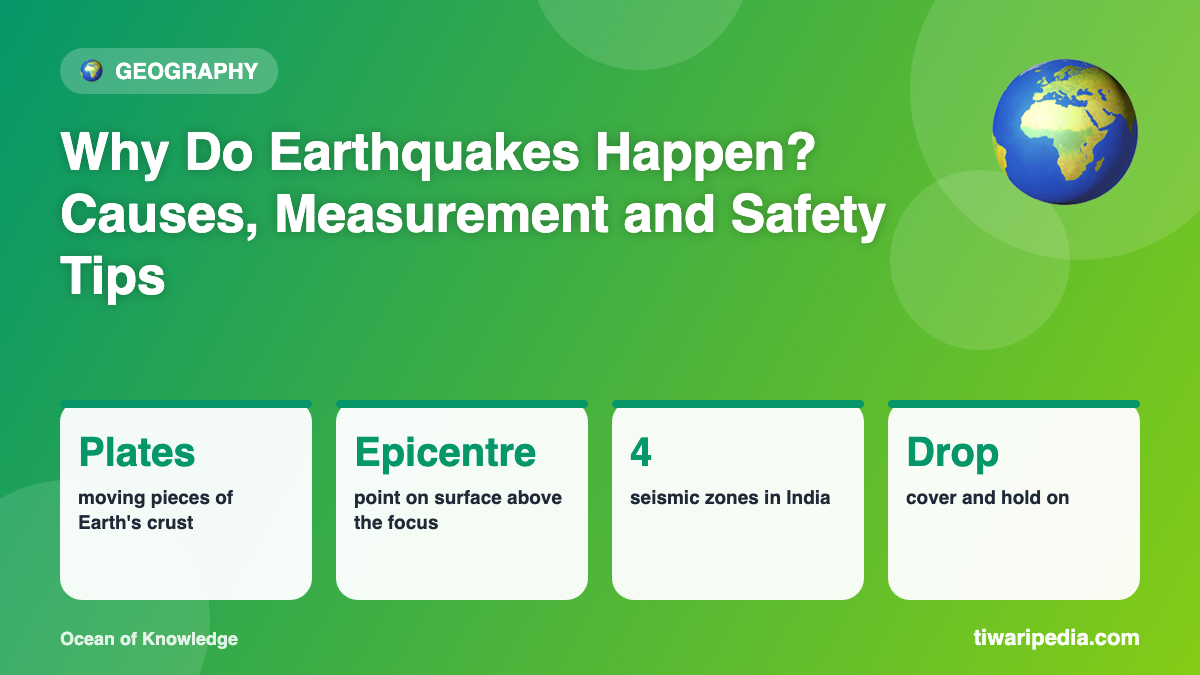
Earth’s outer shell is broken into giant pieces called tectonic plates, which move slowly, a few centimetres a year. Where plates meet, they can push together, pull apart or slide past each other.
Stress and release
Plate edges do not slide smoothly; they get stuck. Stress builds up over years until the rocks suddenly break or slip along a crack called a fault. The stored energy is released as seismic waves that shake the ground.
Key terms
- Focus (hypocentre): the point underground where the rupture begins.
- Epicentre: the point on the surface directly above the focus, usually where shaking is strongest.
- Aftershocks: smaller quakes that follow the main shock.
How are earthquakes measured?
Instruments called seismographs record ground motion. Earthquake size is reported as magnitude, today usually on the moment magnitude scale. Each whole-number step represents about 32 times more energy released.
Earthquakes in India
India is earthquake-prone because the Indian plate keeps pushing into the Eurasian plate. India’s seismic zone map divides the country into four zones (II to V), with Zone V the most at risk, including the Himalayan region, the Northeast and Kutch in Gujarat. A major example is the Bhuj earthquake of 2001.
Tsunamis
Strong undersea earthquakes can push up huge volumes of water, causing tsunamis, like the one that hit India’s coasts in 2004.
Safety: what to do
- Drop, Cover and Hold On: get down, take cover under a sturdy table, and hold on until shaking stops.
- Stay away from windows, glass and heavy furniture that could fall.
- If outdoors, move to an open area away from buildings, trees and power lines.
- Do not use lifts during or immediately after a quake.
- Keep an emergency kit with water, torch, first-aid and important documents.




