

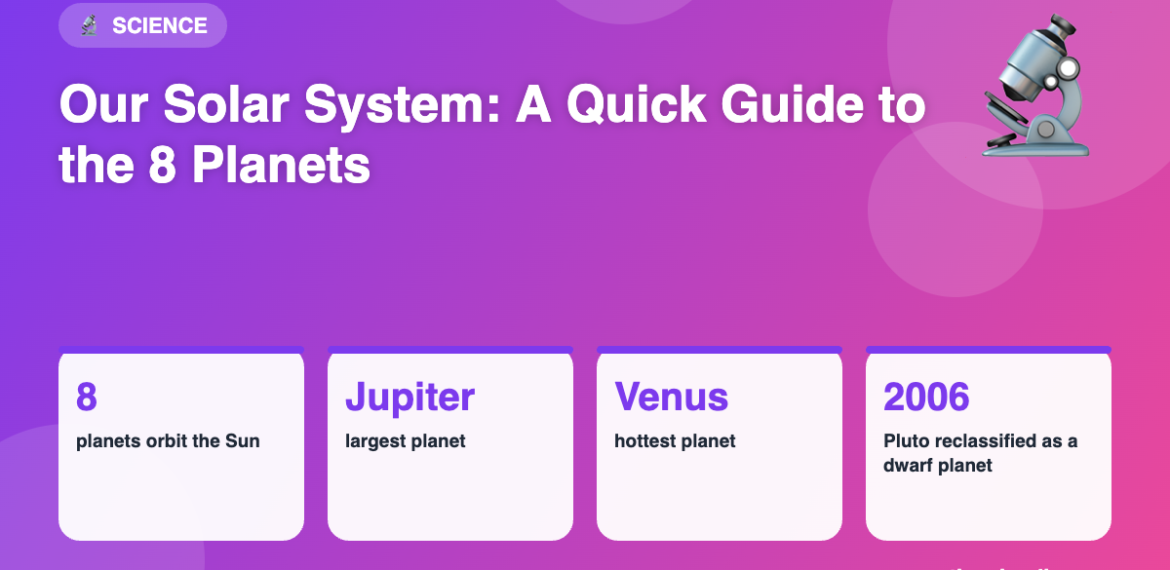
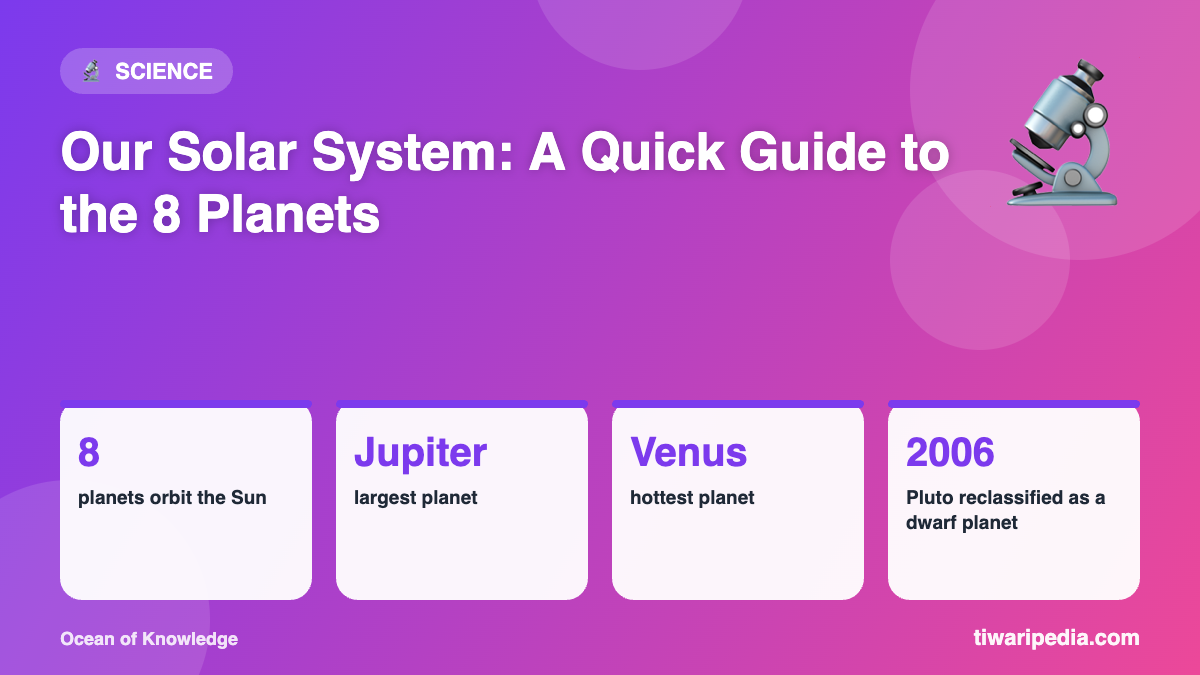
Our solar system formed about 4.6 billion years ago. At its centre is the Sun, a star that holds more than 99% of the solar system’s mass. Around it orbit eight planets, along with dwarf planets, moons, asteroids and comets.
The inner rocky planets
- Mercury: the smallest planet and closest to the Sun. It has almost no atmosphere, so it is scorching by day and freezing at night.
- Venus: similar in size to Earth, but covered in thick clouds of carbon dioxide that trap heat, making it the hottest planet. It spins backwards compared to most planets.
- Earth: the only planet known to support life, with liquid water on its surface and one Moon.
- Mars: the Red Planet, coloured by iron oxide (rust) in its soil. It has the tallest volcano in the solar system, Olympus Mons. India’s Mangalyaan mission reached Mars orbit in 2014 on its first attempt.
The outer giant planets
- Jupiter: the largest planet, a gas giant so big that all the other planets could fit inside it. Its Great Red Spot is a storm larger than Earth.
- Saturn: famous for its spectacular rings made of ice and rock.
- Uranus: an ice giant that rotates on its side, probably after an ancient collision.
- Neptune: the farthest planet, with the strongest winds in the solar system.
What happened to Pluto?
In 2006, the International Astronomical Union created a new definition of a planet. Pluto did not meet all the rules, because it has not cleared other objects from its orbit, so it was reclassified as a dwarf planet.
Easy way to remember the order
“My Very Educated Mother Just Served Us Noodles” = Mercury, Venus, Earth, Mars, Jupiter, Saturn, Uranus, Neptune.
Other members of the solar system
- Asteroid belt: rocky bodies between Mars and Jupiter.
- Kuiper Belt: icy objects beyond Neptune, including Pluto.
- Comets: icy visitors that grow glowing tails when they near the Sun.




