

DNA, short for deoxyribonucleic acid, is the molecule that carries the instructions for building and running every living thing, from bacteria to banyan trees to human beings.
The double helix
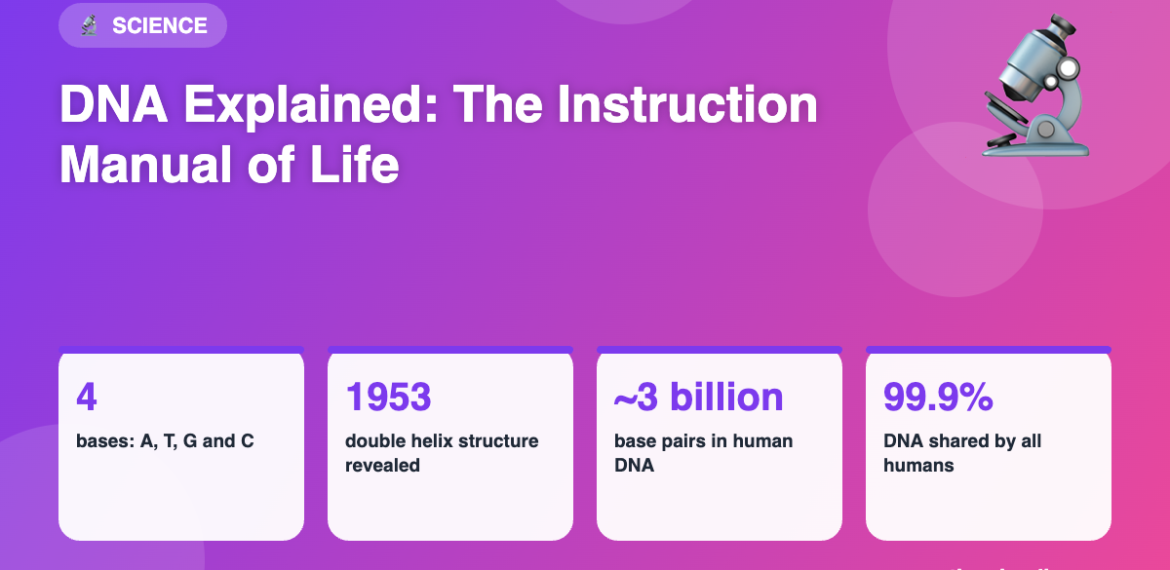
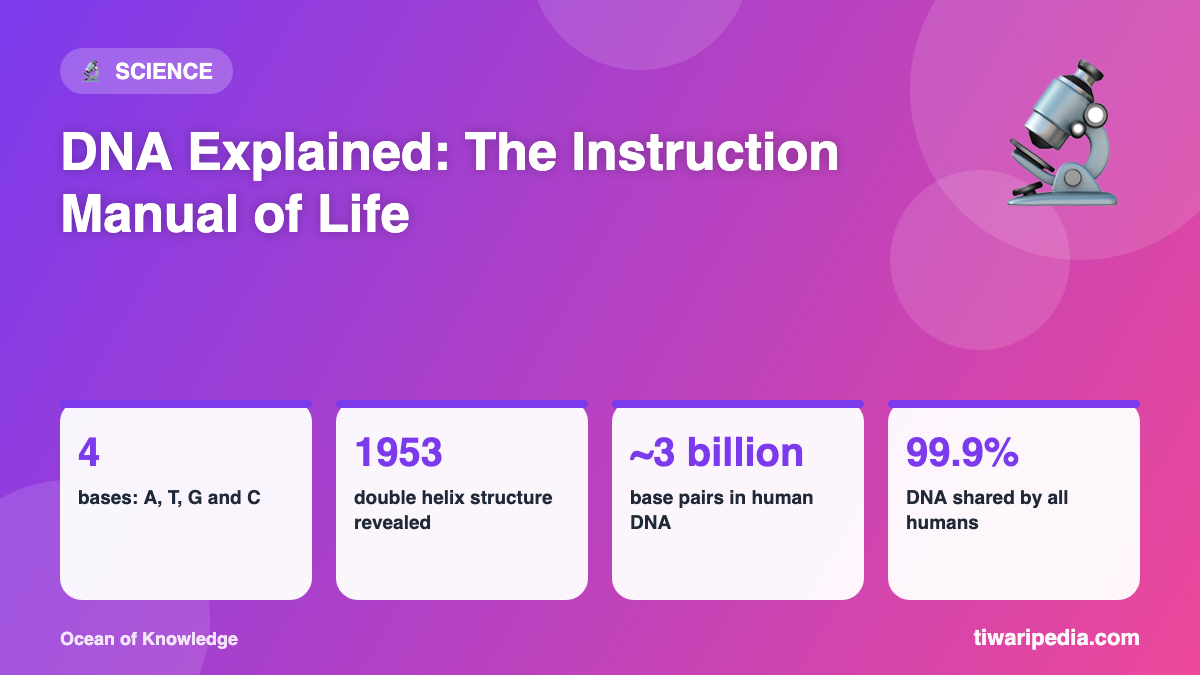
DNA looks like a twisted ladder, a shape called a double helix. The sides of the ladder are made of sugar and phosphate. The rungs are pairs of chemical bases. The structure was described in 1953 by James Watson and Francis Crick, building on X-ray images made by Rosalind Franklin.
The four-letter code
DNA uses just four bases:
- A (adenine), which pairs with T (thymine)
- G (guanine), which pairs with C (cytosine)
The order of these letters spells out instructions, much like letters form words and sentences.
Genes and chromosomes
- A gene is a section of DNA that holds the instructions for making a protein.
- DNA is tightly packed into chromosomes. Humans have 23 pairs: one set from each parent.
- The human genome contains about 3 billion base pairs and around 20,000 protein-coding genes.
How DNA copies itself
Before a cell divides, the DNA ladder “unzips” down the middle. Each half serves as a template to build a new matching half, so each new cell gets a complete copy.
Why are we all different?
All humans share about 99.9% of their DNA. The tiny remaining difference, along with our environment, explains differences in height, eye colour and much more.
DNA in daily life
- Medicine: genetic tests help diagnose inherited diseases.
- Forensics: DNA fingerprinting identifies people from tiny samples, a technique developed by Alec Jeffreys in 1984.
- Agriculture: scientists develop crops that resist pests or drought.
- Ancestry: DNA tests can trace family origins.




