Last updated: October 2026 · 3 min read
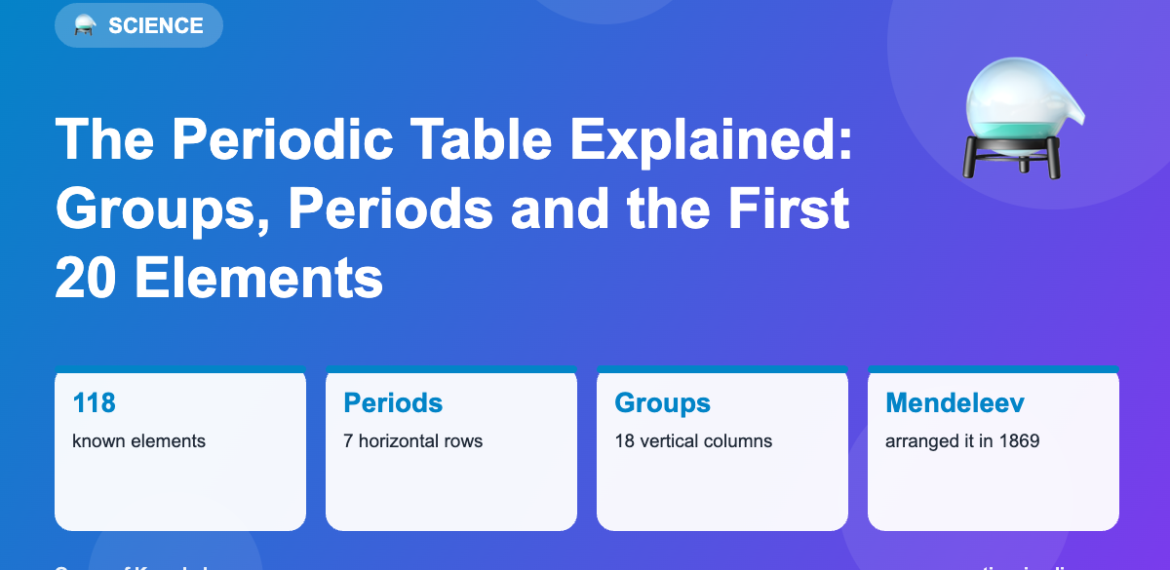
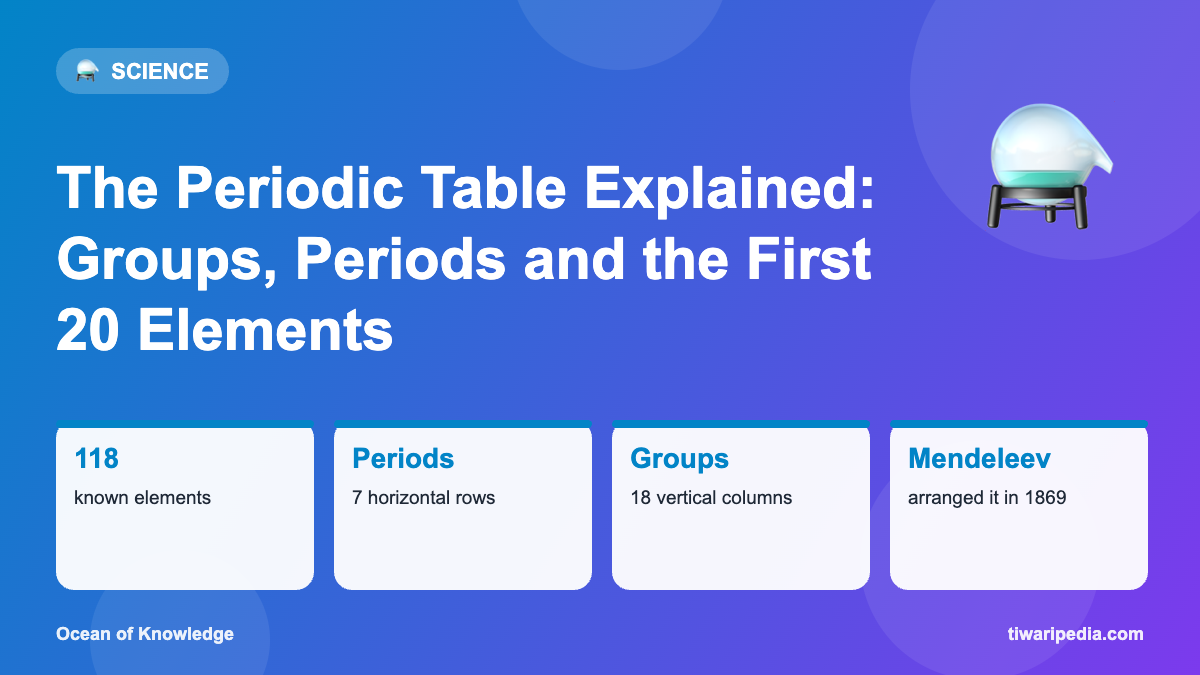
Everything around you, from air to your phone, is made of chemical elements. The periodic table arranges all 118 known elements in a grid so their properties follow clear patterns.
Who created the periodic table?
Russian chemist Dmitri Mendeleev published his table in 1869, arranging elements by atomic mass and leaving gaps for elements not yet discovered. Today the table is ordered by atomic number, the number of protons in an atom.
Periods and groups
- Periods are the 7 horizontal rows. Elements in the same period have the same number of electron shells.
- Groups are the 18 vertical columns. Elements in a group have similar chemical behaviour because they have the same number of outer electrons.
Important groups
| Group | Name | Examples | Key property |
|---|---|---|---|
| 1 | Alkali metals | Sodium, potassium | Very reactive with water |
| 2 | Alkaline earth metals | Calcium, magnesium | Reactive, found in bones and rocks |
| 17 | Halogens | Chlorine, fluorine | Reactive non-metals used in disinfectants |
| 18 | Noble gases | Helium, neon, argon | Very unreactive |
| 3-12 | Transition metals | Iron, copper, gold | Strong, conduct electricity |
The first 20 elements
| No. | Element | Symbol | No. | Element | Symbol |
|---|---|---|---|---|---|
| 1 | Hydrogen | H | 11 | Sodium | Na |
| 2 | Helium | He | 12 | Magnesium | Mg |
| 3 | Lithium | Li | 13 | Aluminium | Al |
| 4 | Beryllium | Be | 14 | Silicon | Si |
| 5 | Boron | B | 15 | Phosphorus | P |
| 6 | Carbon | C | 16 | Sulphur | S |
| 7 | Nitrogen | N | 17 | Chlorine | Cl |
| 8 | Oxygen | O | 18 | Argon | Ar |
| 9 | Fluorine | F | 19 | Potassium | K |
| 10 | Neon | Ne | 20 | Calcium | Ca |
Memory trick: “Hi Hello Little Beautiful Baby, Can Not Open Fridge Now. Nana Maggi Always Sees People Sitting Clean And Kind Ca(lm).”
Metals, non-metals and metalloids
Metals sit on the left and centre, are shiny and conduct electricity. Non-metals are on the right. A zig-zag line separates them, with metalloids such as silicon and germanium, used in computer chips, along the border.
Frequently asked questions
How many elements are there?
118 confirmed elements. The latest four, including nihonium and oganesson, were officially named in 2016.
Why are some symbols different from names?
They come from Latin names: Na from natrium (sodium), K from kalium (potassium), Fe from ferrum (iron).
Which is the most abundant element?
Hydrogen in the universe; oxygen in Earth’s crust and in the human body by mass.
Keep exploring
Facts are based on widely accepted official, scientific and historical sources at the time of writing. Spotted something that needs updating? Let us know.