Last updated: October 2026 · 3 min read
The Amazon is the largest tropical rainforest on Earth, a vast green world of rivers, wildlife and Indigenous cultures. Here are 10 incredible facts about this natural wonder.
10 incredible facts about the Amazon rainforest
1. It is enormous
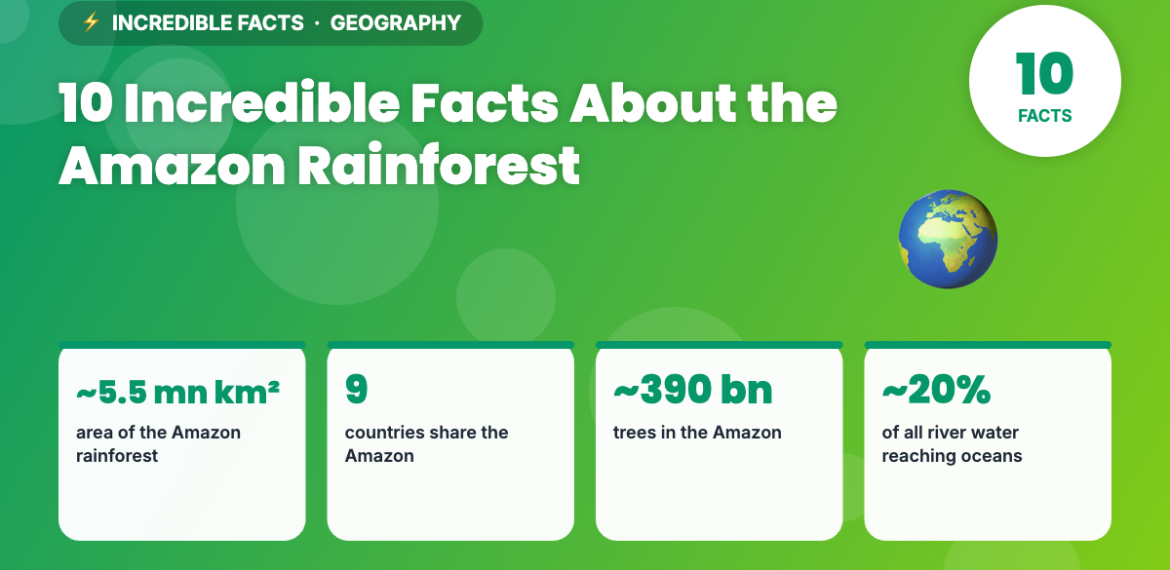
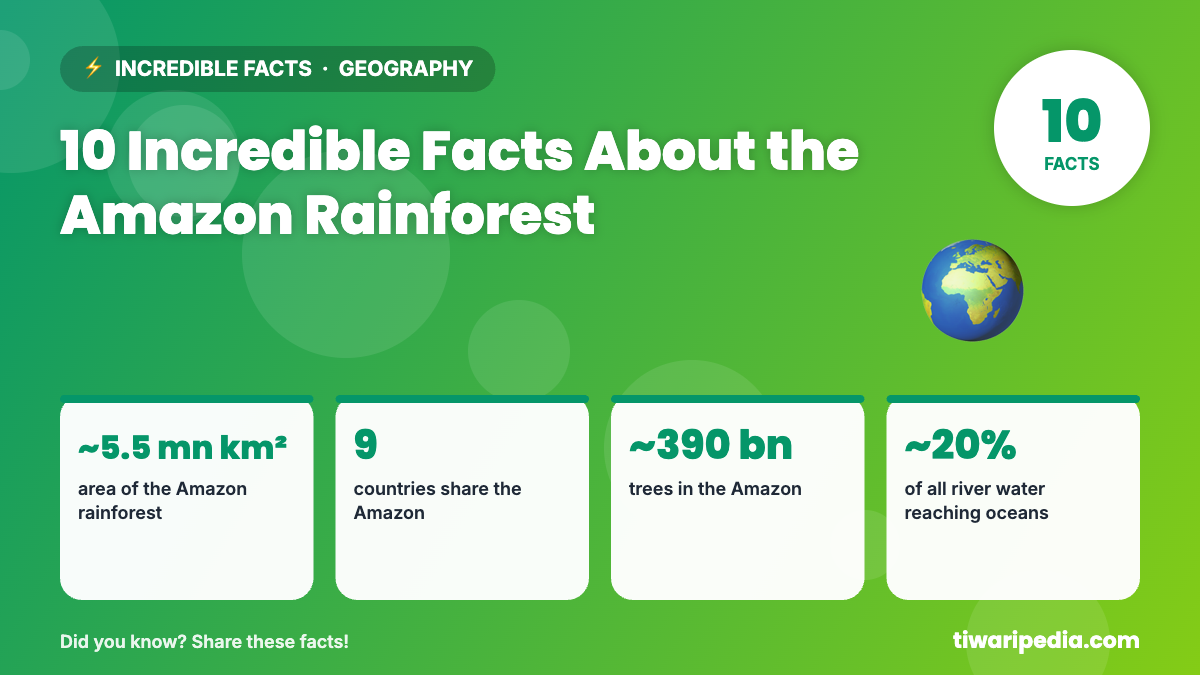
The Amazon rainforest covers about 5.5 million square kilometres, an area well over one and a half times the size of India.
2. It spreads across nine countries
The rainforest spans Brazil, Peru, Colombia, Venezuela, Ecuador, Bolivia, Guyana, Suriname and French Guiana. About 60% lies in Brazil.
3. It has around 390 billion trees
Scientists estimate the Amazon contains about 390 billion individual trees belonging to roughly 16,000 species.
4. It is home to countless species
The Amazon hosts a large share of the world’s known species of plants and animals, and new ones are still being discovered.
5. The Amazon River carries the most water
The Amazon River discharges more water than any other river, about a fifth of all the fresh water that rivers deliver to the oceans.
6. No bridge crosses the main Amazon River
Along its main course there is no bridge, because the river is so wide, the banks are soft and much of the region is sparsely populated.
7. It makes its own rain
Trees release huge amounts of water vapour that forms clouds and rain over the forest. These moving streams of moisture are called “flying rivers”.
8. It is fertilised by Sahara dust
NASA satellites show that winds carry millions of tonnes of dust from the Sahara across the Atlantic every year, bringing phosphorus that helps nourish the rainforest.
9. Pink dolphins live there
The Amazon river dolphin, or boto, is famous for its pink colour, which often becomes brighter with age.
10. It is home to Indigenous peoples
Hundreds of Indigenous groups live in the Amazon, including some that have little or no contact with the outside world.
Frequently asked questions
Why is the Amazon called the “lungs of the Earth”?
Because its plants produce oxygen and absorb huge amounts of carbon dioxide. However, the forest also uses much of the oxygen it makes, so its main global role is storing carbon and shaping climate.
Is the Amazon River longer than the Nile?
Scientists still debate this. The answer depends on where you measure the source and mouth; the Nile is traditionally listed as longest.
What threatens the Amazon?
Deforestation for farming, ranching, logging and mining, as well as fires and climate change.
Keep exploring
- Photosynthesis explained
- The 7 continents of the world
- More Geography explainers on Tiwaripedia
- Browse all incredible facts
Facts are based on widely accepted scientific, historical and official sources at the time of writing. Spotted something that needs updating? Let us know.