

Last updated: October 2026 · 3 min read
Artificial intelligence has moved from science fiction into our phones, offices and hospitals. Its history is full of surprises. Here are 10 incredible facts about AI.
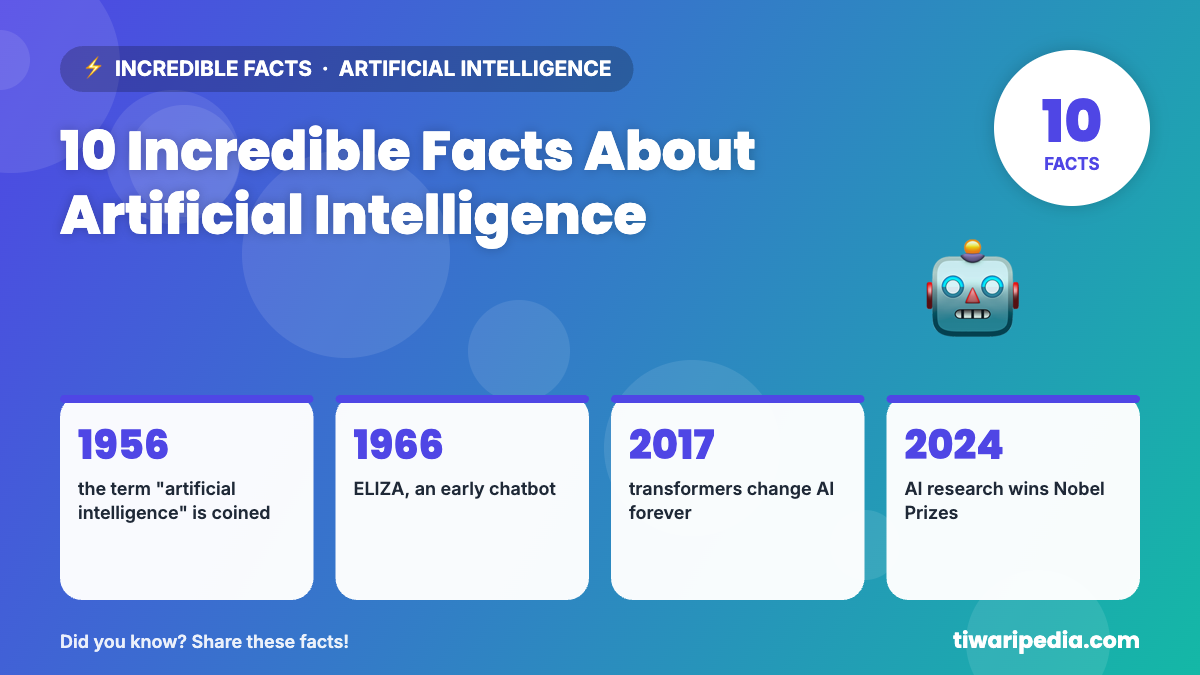
10 incredible facts about artificial intelligence
1. It was named at a 1956 workshop
The term “artificial intelligence” was used for a 1956 summer research workshop at Dartmouth College, organised by John McCarthy and colleagues.
2. Alan Turing asked the big question
In 1950, Alan Turing asked “Can machines think?” and proposed what became known as the Turing Test.
3. An early chatbot amazed people
ELIZA, created at MIT in 1966, imitated a therapist using simple patterns. Some users were surprised how human it felt.
4. AI went through “winters”
When early promises were not met, funding dried up in periods known as AI winters, notably in the 1970s and late 1980s.
5. Computers beat world champions
IBM’s Deep Blue beat chess champion Garry Kasparov in 1997, and DeepMind’s AlphaGo beat Go champion Lee Sedol in 2016.
6. A 2017 paper changed everything
Google researchers introduced the “transformer” architecture in 2017, the foundation of today’s large language models.
7. AI learns from data
Most modern AI systems learn patterns from huge amounts of data rather than following hand-written rules for every situation.
8. You use AI every day
Maps, spam filters, face unlock, recommendations, translation and voice assistants all rely on AI.
9. AI won Nobel Prizes in 2024
The 2024 Nobel Prize in Physics honoured foundational work on neural networks, and the Chemistry prize included AI-based protein structure prediction.
10. AI can be confidently wrong
AI chatbots can produce fluent but incorrect answers, sometimes called hallucinations, so important facts should always be checked.
Frequently asked questions
Is AI the same as robots?
No. AI is software that can learn and decide; robots are physical machines. Some robots use AI, but many AI systems have no body at all.
Can AI think like humans?
Today’s AI can perform many tasks impressively, but it works very differently from the human mind, and scientists debate what “thinking” means for machines.
Is AI dangerous?
AI brings big benefits but also risks, such as misinformation, bias and misuse, which is why responsible development and rules matter.
Keep exploring
- What is artificial intelligence?
- A short history of AI
- More Artificial Intelligence explainers on Tiwaripedia
- Browse all incredible facts
Facts are based on widely accepted scientific, historical and official sources at the time of writing. Spotted something that needs updating? Let us know.




