Last updated: October 2026 · 3 min read
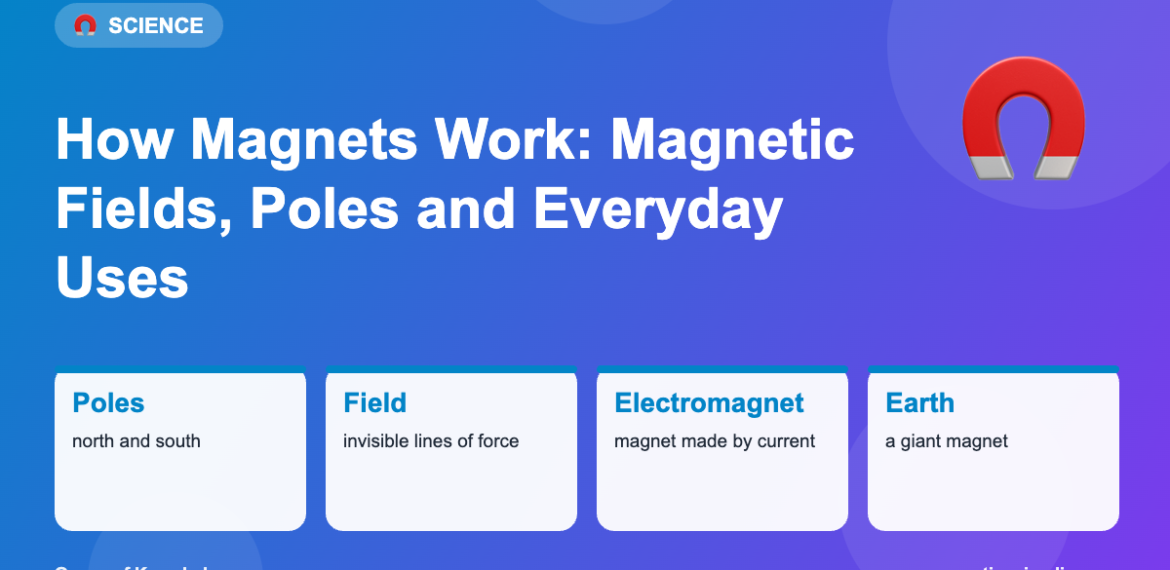
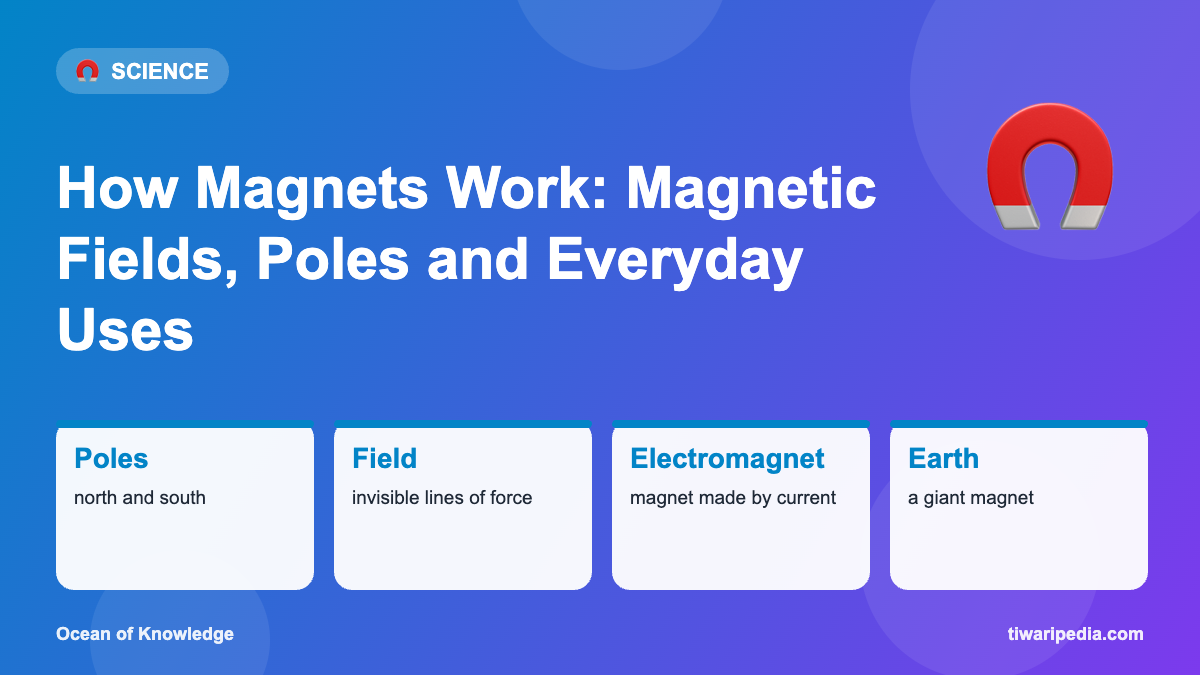
Magnets hold notes on your fridge, spin motors in your mixer and help doctors see inside the body. All of it comes from the way tiny particles called electrons behave inside materials.
Poles and the basic rule
Every magnet has a north and a south pole. Like poles repel, unlike poles attract. Cut a magnet in half and you get two smaller magnets, each with its own north and south pole.
Where magnetism comes from
Electrons spin and move around atoms, which makes each atom a tiny magnet. In most materials these tiny magnets point in random directions and cancel out. In iron, nickel and cobalt, groups of atoms called domains can line up together, creating a strong magnet.
Magnetic field
The space around a magnet where its force acts is the magnetic field. Iron filings sprinkled near a bar magnet show the field lines running from north to south.
Types of magnets
| Type | How it works | Example |
|---|---|---|
| Permanent | Stays magnetic | Fridge magnets, speaker magnets |
| Temporary | Magnetic only near another magnet | A pin near a magnet |
| Electromagnet | Current through a coil around iron; switch on/off | Scrapyard cranes, electric bells, motors |
Earth is a giant magnet
Molten iron moving in Earth’s outer core creates a magnetic field. A compass needle points roughly north because it lines up with this field. The field also shields us from harmful solar particles and creates the auroras near the poles.
Everyday uses
- Electric motors and generators in fans, cars and power plants.
- MRI scanners in hospitals.
- Speakers and earphones.
- Credit card strips and old hard disks.
- Maglev trains that float above tracks.
Frequently asked questions
Why doesn’t a magnet attract aluminium or gold?
Their atoms do not form aligned domains, so they are only very weakly magnetic.
Can a magnet lose its magnetism?
Yes, through heating, strong impacts or exposure to opposing magnetic fields.
Who discovered electromagnetism?
Hans Christian Ørsted showed in 1820 that electric current deflects a compass; Michael Faraday later discovered electromagnetic induction.
Keep exploring
Facts are based on widely accepted official, scientific and historical sources at the time of writing. Spotted something that needs updating? Let us know.