
Last updated: October 2026 · 3 min read
Electricity powers fans, phones and trains, yet the basic ideas are simple. Think of electricity in a wire like water in a pipe: voltage is the pressure, current is the flow and resistance is how narrow the pipe is.
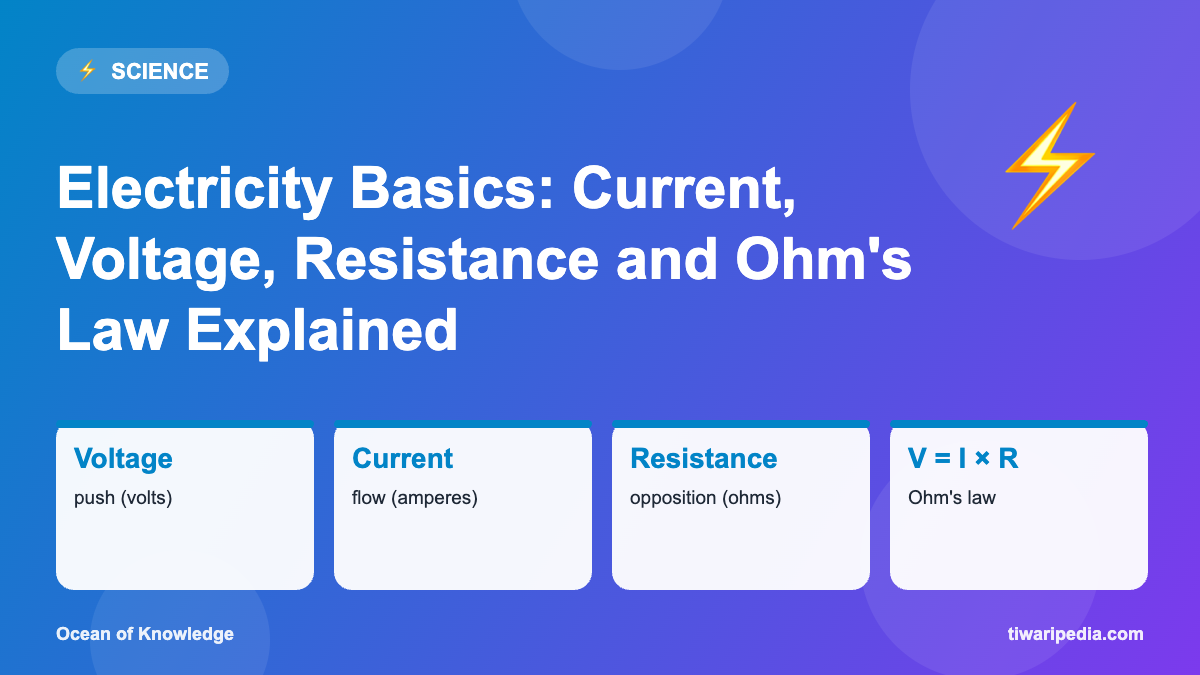
The three key quantities
| Quantity | Meaning | Unit | Symbol |
|---|---|---|---|
| Voltage | Electrical “push” between two points | Volt (V) | V |
| Current | Rate of flow of electric charge | Ampere (A) | I |
| Resistance | Opposition to current | Ohm (Ω) | R |
Ohm’s law
V = I × R, discovered by Georg Ohm in 1827. If a 230 V supply is connected across a 46 Ω heater coil, current I = V ÷ R = 230 ÷ 46 = 5 A.Power and your electricity bill
Power (watts) = Voltage × Current. Your bill counts energy in units, where 1 unit = 1 kilowatt-hour (kWh). A 1,000 W geyser running for one hour uses 1 unit; a 50 W ceiling fan running for 20 hours also uses 1 unit.AC vs DC
| AC (alternating current) | DC (direct current) | |
|---|---|---|
| Direction | Changes back and forth | Flows one way |
| Where | Home sockets: 230 V, 50 Hz in India | Batteries, phones, solar panels |
| Why | Easy to transmit over long distances | Electronics need steady DC |
Conductors and insulators
Copper and aluminium conduct electricity well and are used in wires. Rubber, plastic and dry wood are insulators that protect us. Water with impurities conducts electricity, which is why wet hands and switches are dangerous.
Electrical safety tips
- Never touch switches with wet hands.
- Use an MCB and an RCCB/ELCB at home to cut power during faults.
- Do not overload one socket with many adaptors.
- Use ISI-marked wires and appliances.
- Switch off the mains before any repair.
Frequently asked questions
Why are birds safe on power lines?
Both feet are on the same wire at the same voltage, so no current flows through them.
What is the voltage in Indian homes?
The standard supply is 230 V single-phase at 50 Hz.
Which consumes more units, AC or fan?
An air conditioner uses far more: often 1-1.5 units per hour, versus about 0.05-0.08 for a ceiling fan.
Keep exploring
Facts are based on widely accepted official, scientific and historical sources at the time of writing. Spotted something that needs updating? Let us know.