

Last updated: October 2026 · 3 min read
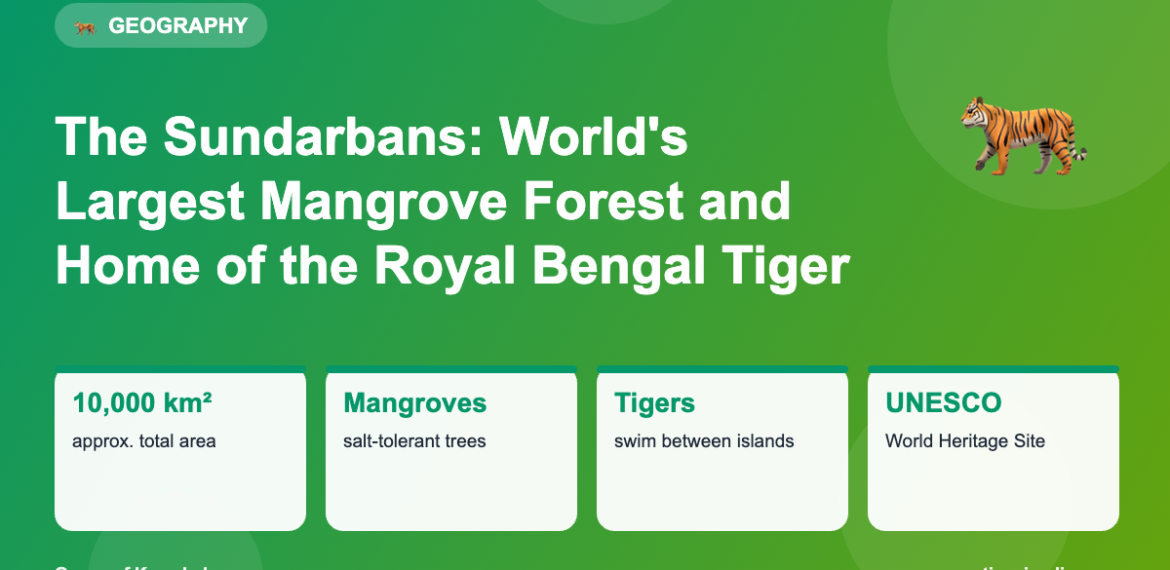
Where the Ganga, Brahmaputra and Meghna rivers meet the Bay of Bengal lies the Sundarbans, the largest mangrove forest on Earth, shared between India (West Bengal) and Bangladesh. Its name is often explained as “beautiful forest”, after the sundari tree.
Quick facts
| Feature | Detail |
|---|---|
| Location | Ganga-Brahmaputra-Meghna delta, West Bengal and Bangladesh |
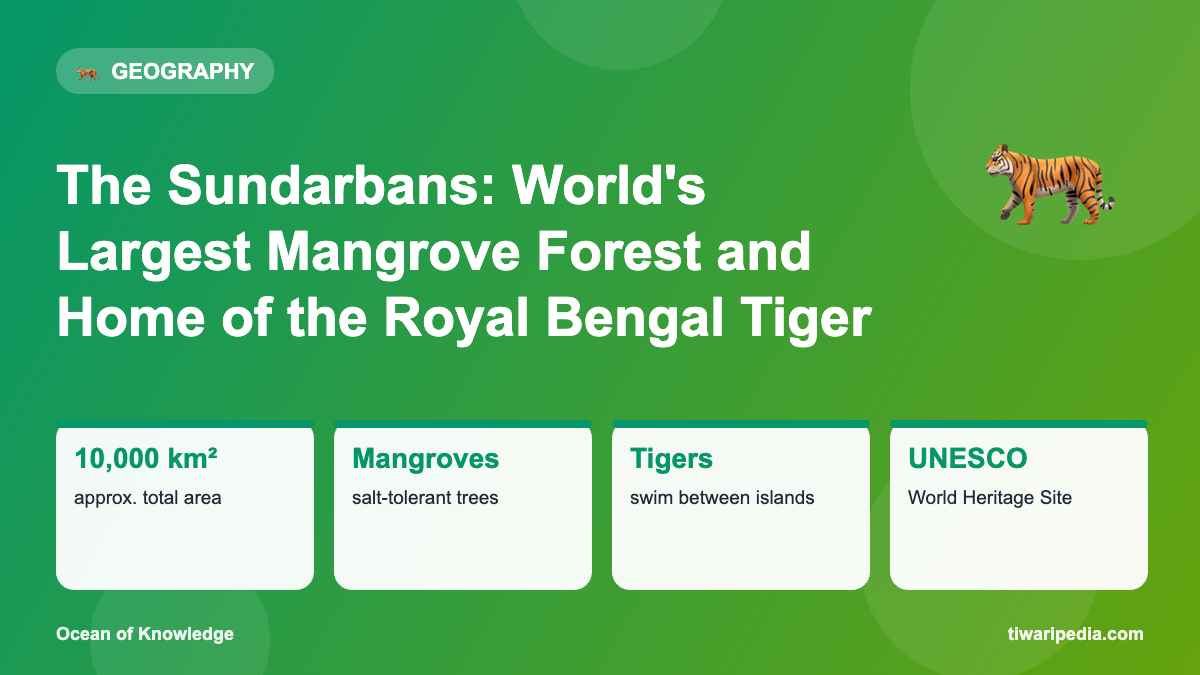
| Total area | About 10,000 km² (around 40% in India) |
| Famous animal | Royal Bengal tiger |
| Indian protected areas | Sundarban National Park, Tiger Reserve and Biosphere Reserve |
| UNESCO | Indian Sundarbans National Park inscribed in 1987 |
| Ramsar site | Indian Sundarbans designated in 2019 |
What are mangroves?
Mangroves are trees and shrubs that grow in salty, muddy coastal water. They have special breathing roots called pneumatophores that poke up from the mud, and many have seeds that sprout while still on the tree. Mangroves protect coasts from cyclones, store large amounts of carbon and serve as nurseries for fish and crabs.
Wildlife
- Royal Bengal tigers adapted to swim between islands and drink brackish water.
- Saltwater crocodiles, Gangetic dolphins and Irrawaddy dolphins.
- Spotted deer, wild boar and fishing cats.
- Hundreds of bird species, including kingfishers and herons.
Life with the tides
Twice a day, tides flood and drain the islands, changing the landscape. Local communities depend on fishing, crab collecting and honey gathering, and many honour Bonbibi, the forest goddess believed to protect people from tigers.
Threats
Rising sea levels, stronger cyclones such as Aila (2009) and Amphan (2020), increasing salinity and land erosion are shrinking islands and threatening livelihoods. Mangrove planting and embankment repair are key conservation efforts.
Frequently asked questions
Why are the Sundarbans important?
They protect millions of people from storms, support fisheries, store carbon and host rare wildlife like the Royal Bengal tiger.
How many tigers live in the Indian Sundarbans?
Recent counts put the number at around 100, though surveys in mangroves are difficult and figures change.
What is the best time to visit?
From November to February, when the weather is cool and dry. Visits are by boat from places like Godkhali.
Keep exploring
- The Ganga river guide
- Major rivers of India
- Climate change explained
- More Geography articles on Tiwaripedia
Facts are based on widely accepted official, scientific and historical sources at the time of writing. Spotted something that needs updating? Let us know.




