

Last updated: October 2026 · 3 min read
Rising on the banks of the Yamuna in Agra, the Taj Mahal is one of the most beautiful buildings ever made and a symbol of India around the world. Here are 12 incredible facts about it.
12 incredible facts about the Taj Mahal
1. It was built as a memorial of love
Mughal emperor Shah Jahan built the Taj Mahal in memory of his wife Mumtaz Mahal, who died in 1631 while giving birth to their 14th child.
2. It took about two decades
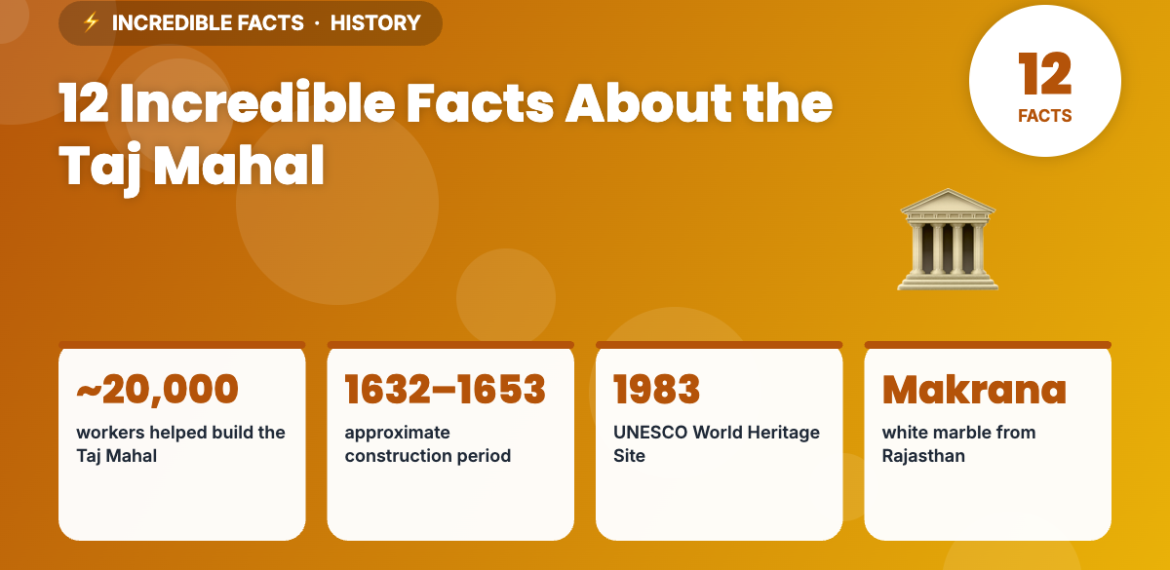
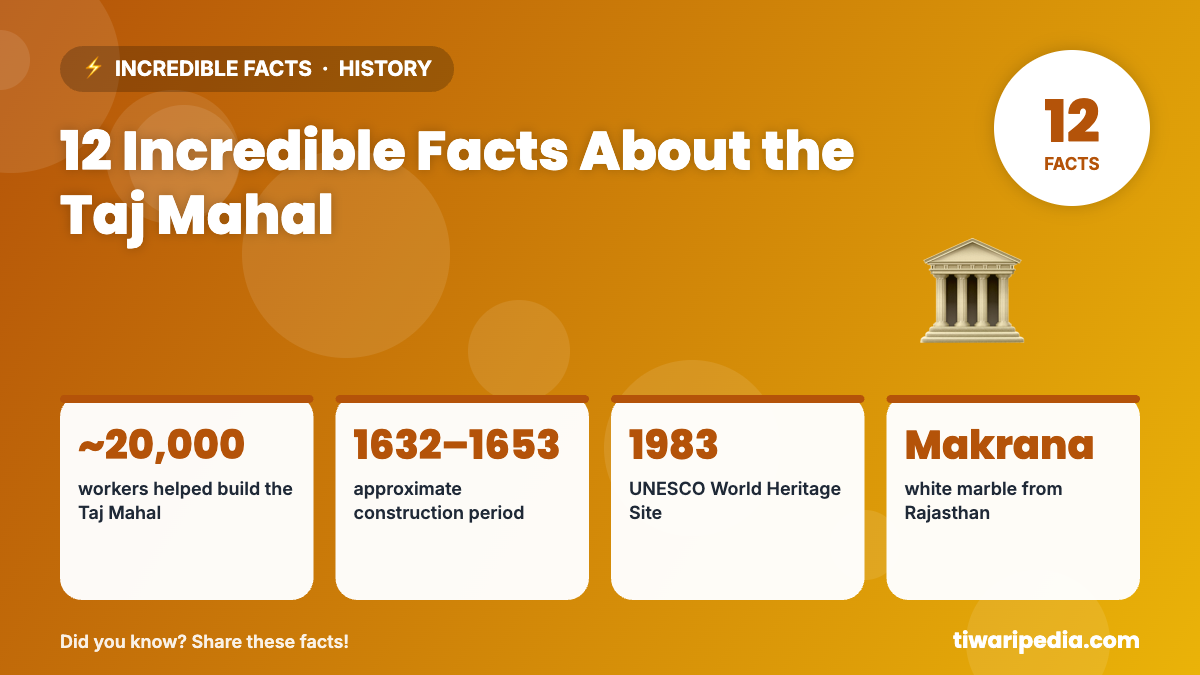
Work began around 1632. The main mausoleum was finished first, and the whole complex, with gardens, mosque and gateway, was completed around 1653.
3. About 20,000 workers built it
Masons, stone-cutters, inlay artists, calligraphers and labourers from across the Mughal empire and beyond worked on the project.
4. Its chief architect is believed to be Ustad Ahmad Lahauri
Historians generally credit Ustad Ahmad Lahauri as the principal designer.
5. Its marble came from Rajasthan
The gleaming white marble was brought from Makrana in Rajasthan, and elephants and bullock carts were used to transport materials.
6. It changes colour through the day
The marble looks pinkish at dawn, dazzling white at midday and golden at sunset, and appears silvery under moonlight.
7. Its minarets lean outward on purpose
The four minarets tilt very slightly outward, so that if they ever fell they would fall away from the main tomb.
8. It is decorated with precious stones
Flowers and patterns were made with pietra dura, an inlay technique using semi-precious stones such as jade, lapis lazuli and carnelian set into marble.
9. Its symmetry has one exception
Almost everything is perfectly symmetrical. The exception is Shah Jahan’s own cenotaph, added beside Mumtaz Mahal’s after his death in 1666.
10. It was disguised during wars
During World War II and the India–Pakistan wars of 1965 and 1971, the monument was covered to protect it from possible air attacks.
11. It is a UNESCO and “New Seven Wonders” site
The Taj Mahal became a UNESCO World Heritage Site in 1983 and was named one of the New Seven Wonders of the World in 2007.
12. Pollution rules protect it
To protect the marble from yellowing, India’s Supreme Court created the Taj Trapezium Zone with strict pollution controls around Agra.
Frequently asked questions
Where is the Taj Mahal?
In Agra, Uttar Pradesh, on the southern bank of the Yamuna River.
When is the Taj Mahal closed?
It is closed to general visitors on Fridays, when the mosque is used for prayers.
Who is buried in the Taj Mahal?
Mumtaz Mahal and Shah Jahan. Their actual graves are in a lower chamber beneath the cenotaphs.
Keep exploring
- The Mughal Empire: from Babur to Bahadur Shah Zafar
- The Gupta Empire: India’s golden age
- More History explainers on Tiwaripedia
- Browse all incredible facts
Facts are based on widely accepted scientific, historical and official sources at the time of writing. Spotted something that needs updating? Let us know.




