

📦 SAP MM (Materials Management) interview guide
Procure-to-Pay from requirement to vendor payment, plus inventory, valuation, account determination and the S/4HANA changes interviewers test today.
SAP Materials Management (MM) handles everything a company buys and stores: purchasing, inventory management, valuation and invoice verification. Its core process is Procure-to-Pay (P2P). MM integrates tightly with FI, CO, SD, PP, PM and PS, so strong MM consultants are always in demand.
What is SAP MM?
Key MM areas:
- Purchasing: purchase requisitions, RFQs and quotations, purchase orders, contracts, scheduling agreements and source determination.
- Inventory management: goods receipts, goods issues, transfer postings, reservations and physical inventory, all controlled by movement types.
- Valuation & account determination: standard (S) or moving average (V) price, valuation classes and automatic G/L postings (OBYC).
- Logistics Invoice Verification: 3-way match of PO, goods receipt and invoice (MIRO).
- MRP / consumption-based planning: reorder point and forecast-based planning that generate requirements.
Special procurement types you must know: subcontracting, consignment, stock transport orders, third-party and pipeline.
End-to-end process: Procure-to-Pay (P2P)
“Explain P2P” is the classic MM opener. Mention the document, the T-code and the accounting entry at each step.
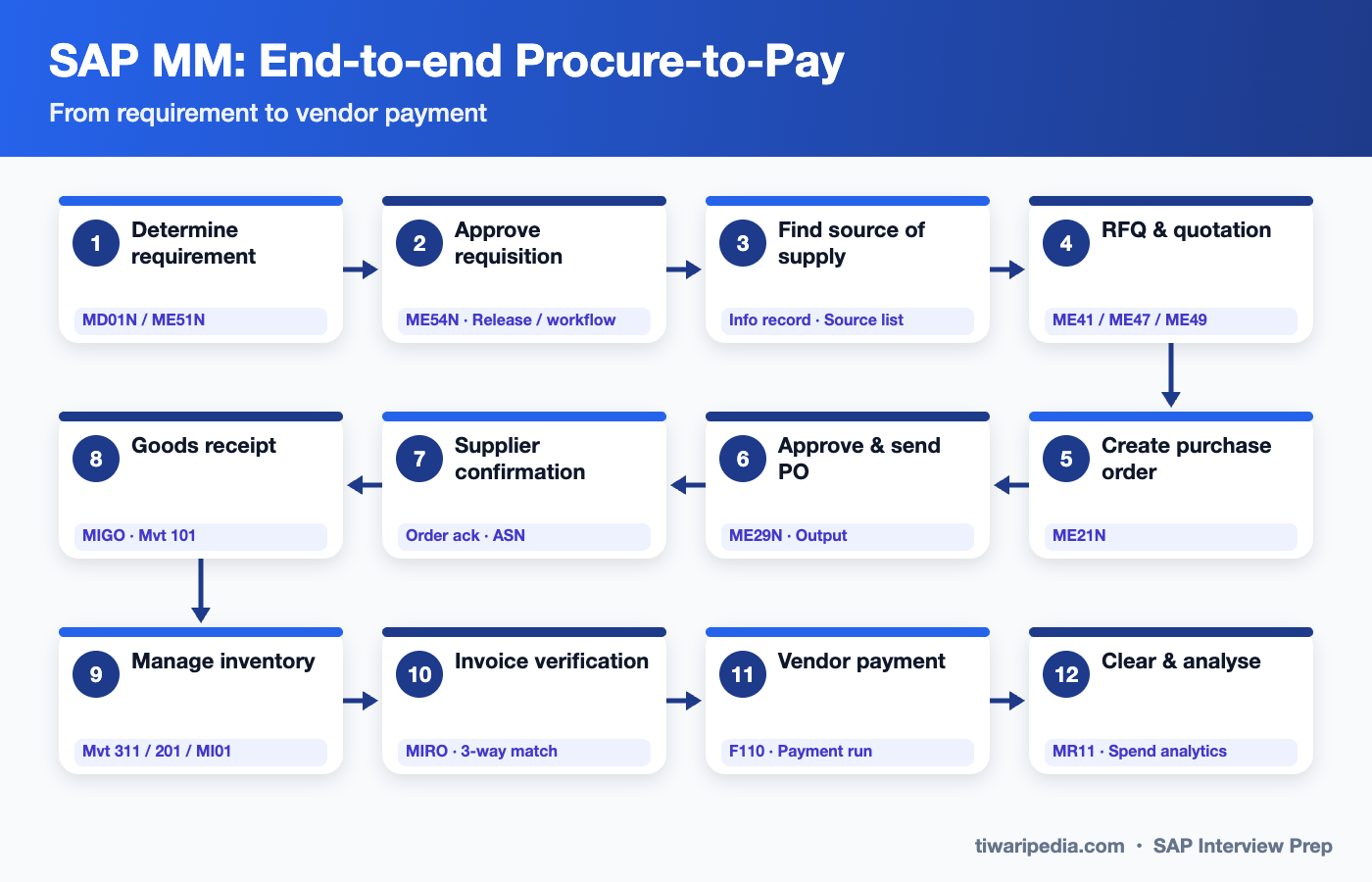
- Determine requirement
MD01N / ME51N
MRP or a user creates a purchase requisition for materials or services, with account assignment if consumed directly (K, F, P, A). - Approve requisition
ME54N · Release / workflow
Release strategy (classification-based) or flexible workflow in S/4HANA approves the PR by value, plant or material group. - Find source of supply
Info record · Source list
Source determination uses purchasing info records, source lists, quota arrangements, contracts and scheduling agreements. - RFQ & quotation
ME41 / ME47 / ME49
Request quotations from suppliers, enter the prices and compare them (price comparison) to select the best supplier. - Create purchase order
ME21N
The PO is the legal document with supplier, prices, delivery dates, terms and account assignment. Pricing comes from conditions. - Approve & send PO
ME29N · Output
PO release strategy or workflow, then output to the supplier via print, email, EDI or SAP Ariba. - Supplier confirmation
Order ack · ASN
Order acknowledgements and inbound deliveries (ASN) update expected dates and quantities. - Goods receipt
MIGO · Mvt 101
GR increases stock and posts Inventory Dr / GR-IR Cr. Quality inspection may be triggered through QM. - Manage inventory
Mvt 311 / 201 / MI01
Transfer postings, issues to cost centres or orders, reservations and physical inventory counts keep stock accurate. - Invoice verification
MIRO · 3-way match
The invoice is matched with the PO and GR. It posts GR-IR Dr / Vendor Cr, and variances post to price difference or are blocked. - Vendor payment
F110 · Payment run
The automatic payment program pays due invoices according to payment terms and clears the open items. - Clear & analyse
MR11 · Spend analytics
Maintain the GR/IR clearing account and analyse spend, supplier performance and purchasing KPIs.
Organizational structure & master data
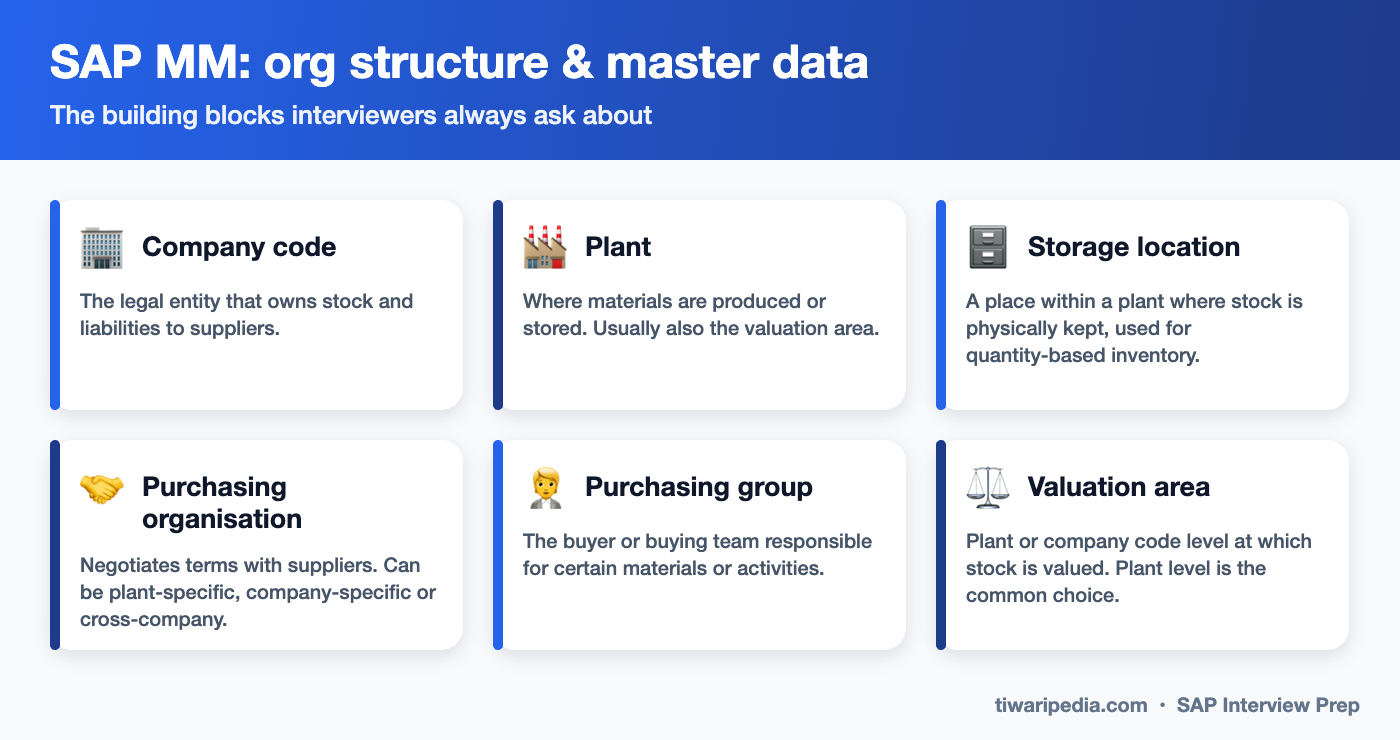
Organizational structure
Client & company code
Client is the top level. The company code is the independent legal entity.
Plant & storage location
Plants are assigned to one company code. Storage locations sit below plants.
Purchasing organisation
Centralised (assigned to many company codes / plants), company-code specific or plant specific. A reference purchasing org allows contracts to be shared.
Purchasing group
Not assigned to any org unit. It represents buyers and is used for reporting and release.
Valuation level
Set at plant or company code level and cannot easily be changed later. Plant level is mandatory for PP and recommended.
Master data
Material master (MM01)
- Views: Basic, Purchasing, MRP, Accounting, Costing, Plant/Storage
- Material type controls views, number range and valuation
- Price control S (standard) or V (moving average)
Business Partner supplier
Created through BP with supplier roles (FLVN00 for FI, FLVN01 for purchasing) and synchronised by CVI.
Purchasing info record (ME11)
Supplier-material relationship with prices, conditions, planned delivery time and tolerances.
Source list (ME01)
Allowed or fixed suppliers for a material and plant over a validity period.
Outline agreements
- Value or quantity contracts (ME31K)
- Scheduling agreements (ME31L)
Quota arrangement (MEQ1)
Splits requirements between suppliers by percentage.
Key T-codes & Fiori apps
Interviewers often ask you to name the transaction or app for a step. You do not need to memorise hundreds, but you should know these confidently.
| T-code / App | What it does |
|---|---|
| ME51N / ME52N / ME53N | Create / change / display purchase requisition |
| ME54N / ME55 | Release PR individually / collectively |
| ME21N / ME22N / ME23N | Create / change / display purchase order |
| ME29N / ME28 | Release PO individually / collectively |
| ME41 / ME47 / ME49 | Create RFQ / maintain quotation / price comparison |
| ME31K / ME31L | Create contract / scheduling agreement |
| ME11 / ME01 / MEQ1 | Info record / source list / quota arrangement |
| MIGO | Goods movements (GR, GI, transfer posting) |
| MIRO / MIR4 / MRBR | Enter invoice / display / release blocked invoices |
| MMBE / MB52 | Stock overview / warehouse stock |
| MI01 / MI04 / MI07 | Create physical inventory doc / enter count / post differences |
| OBYC / OMWB | Automatic account determination |
| MD01N | MRP Live (S/4HANA) |
| Fiori: Manage Purchase Requisitions, Manage Purchase Orders, Monitor Material Coverage | Modern procurement and inventory apps |
What changed in S/4HANA
- Business Partner replaces separate vendor master transactions (XK01, MK01).
- MATDOC becomes the single table for material documents, replacing MKPF/MSEG and the stock aggregate tables. Stock is computed on the fly, which allows much higher throughput.
- Material Ledger is mandatory for inventory valuation in parallel currencies. Actual costing stays optional.
- MRP Live (MD01N) runs MRP in HANA, with Fiori apps for material coverage and predictive MRP.
- Flexible workflow for PR, PO and other documents is available as a modern alternative to classification-based release strategies.
- The material number is extended to 40 characters, and Central Procurement and SAP Ariba integration support hub procurement scenarios.
- Situation handling and analytics (spend, supplier evaluation) come with embedded CDS views and Fiori.
Integration points
| With | How it integrates |
|---|---|
| FI | GR posts Inventory / GR-IR, MIRO posts GR-IR / Vendor, and F110 pays. Account determination is in OBYC by valuation class and transaction key. |
| CO | Consumption to cost centres, internal orders, WBS or maintenance orders via account assignment categories. Standard cost estimates set the S price. |
| SD | Third-party orders, stock transport orders, availability check, and consignment stock. |
| PP | MRP creates planned orders and PRs. Goods issues to production orders (261) and GR from production (101). |
| QM | Inspection lots at GR, quality info records and supplier evaluation. |
| PM / PS | Spare parts reservations and service procurement for maintenance orders and project activities. |
| WM / EWM | Putaway and picking for goods receipts and issues. |
Interview questions & answers
Tap a question to see a model answer. They are grouped from fundamentals to scenario-based questions that senior panels love.
🟢 Fundamentals
Explain the Procure-to-Pay cycle. Beginner
What is the difference between standard price and moving average price? Beginner
What are movement types? Give examples. Beginner
What is a purchasing info record? Beginner
What are account assignment categories? Beginner
What is the purpose of the GR/IR account? Beginner
🟡 Intermediate
Explain automatic account determination in MM. Intermediate
What is a release strategy? Intermediate
Explain the subcontracting process. Intermediate
Explain the vendor consignment process. Intermediate
What is a stock transport order (STO)? Intermediate
How does 3-way matching work in MIRO? Intermediate
🔴 Scenario & design
A GR posts to the wrong G/L account. How do you investigate? Scenario
The business wants POs above 5 lakh to be approved by the plant head and above 25 lakh by the CFO. How do you design it? Scenario
How would you migrate open POs and stock to S/4HANA? Scenario
Users complain that the MRP run is slow and creating too many requisitions. What do you check? Scenario
How do you handle service procurement? Scenario
What would you propose to integrate SAP Ariba with S/4HANA? Scenario
What KPIs would you build for a procurement head? Scenario
Solution architect view
Key MM design decisions:
- Procurement model: centralised, decentralised or hybrid purchasing organisations, plus Central Procurement for multi-system landscapes.
- Valuation: plant-level valuation, price control by material type, material ledger and actual costing decisions with Controlling.
- Approval design: release strategy vs flexible workflow, aligned with the delegation-of-authority matrix.
- Inventory: IM only, WM, or EWM (embedded or decentralised) based on warehouse complexity.
- Supplier collaboration: SAP Ariba, EDI or a supplier portal.
- Planning: MRP Live, MRP areas and replenishment strategies with PP.
- Account determination: valuation classes and OBYC designed with Finance for clean reporting.
Typical deliverables: P2P process design, enterprise structure design, release and workflow matrix, account determination workbook, and migration plan for suppliers, materials, info records, open POs and stock.
Test yourself: scored MM quiz
Interview tips
- Narrate P2P with T-codes and the accounting entry at GR, invoice and payment.
- Memorise core movement types (101, 122, 201, 261, 311, 541, 561, 601) and OBYC keys (BSX, WRX, PRD, GBB).
- Be ready to explain subcontracting, consignment and STO step by step.
- Mention S/4HANA: MATDOC, BP, MRP Live, flexible workflow and Ariba.
- For senior roles, explain how you designed approvals and valuation with Finance.
Keep preparing: 🎯 SAP Interview Prep hub & combined mock test · All SAP interview guides · ERP Software




