

👥 SAP HR / HCM & SuccessFactors interview guide
Org management, personnel administration, time and payroll, and the cloud move to SuccessFactors. Everything HCM panels ask, with a scored test at the end.
SAP Human Capital Management (HCM), still called SAP HR, manages the employee lifecycle: Hire-to-Retire. Today most projects combine on-premise HCM (especially payroll and time) with SAP SuccessFactors in the cloud, so interviewers test both the classic infotype world and the cloud integration story.
What is SAP HCM?
Core SAP HCM components:
- Organizational Management (OM): org units, positions, jobs and reporting lines (objects O, S, C, P with relationships).
- Personnel Administration (PA): employee master data stored in infotypes, maintained through personnel actions.
- Time Management: work schedules, absences, attendances, quotas and time evaluation.
- Payroll: gross-to-net calculation with schemas, rules and wage types, including country-specific statutory deductions.
- Talent (now SuccessFactors): recruiting, onboarding, performance and goals, learning, compensation and succession.
SAP SuccessFactors Employee Central (EC) is the cloud core HR system of record. Employee Central Payroll (ECP) is SAP’s payroll engine, run by SAP in the cloud.
End-to-end process: Hire-to-Retire
Explain the employee lifecycle step by step and point out which system (on-premise HCM or SuccessFactors) owns each step in a hybrid landscape.
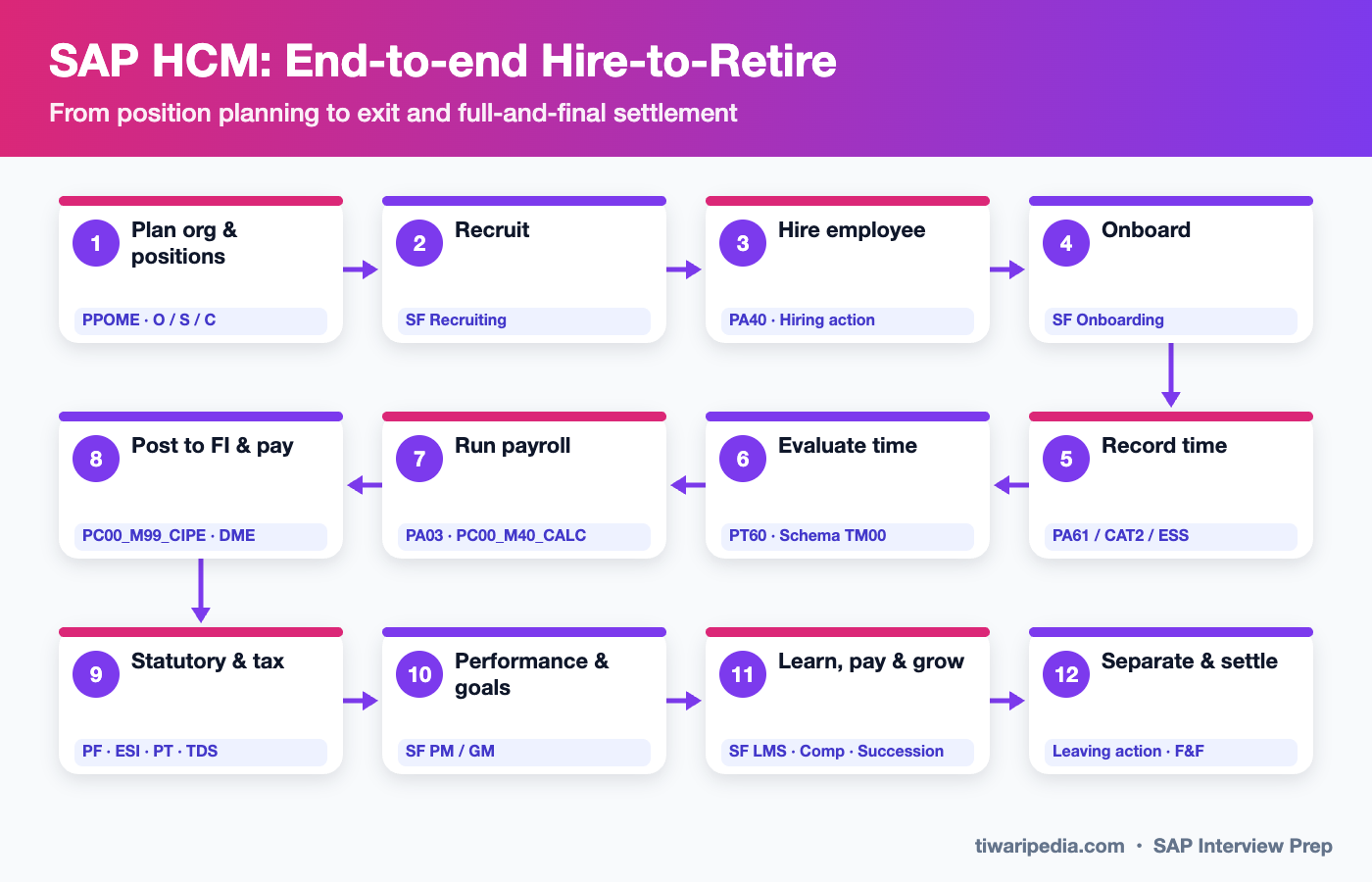
- Plan org & positions
PPOME · O / S / C
Create org units, positions and jobs with reporting relationships. Vacant positions trigger hiring demand. - Recruit
SF Recruiting
A job requisition is approved and posted. Candidates apply, are screened and interviewed, and an offer is made. - Hire employee
PA40 · Hiring action
The hiring action creates infotypes 0000, 0001, 0002, 0006, 0007, 0008 and 0009. In EC, the hire wizard creates the employee record. - Onboard
SF Onboarding
New hire paperwork, equipment, buddy and compliance tasks. Data is replicated to payroll and IT systems. - Record time
PA61 / CAT2 / ESS
Absences, attendances and timesheets are recorded through infotypes, CATS or self-service apps with approval workflow. - Evaluate time
PT60 · Schema TM00
Time evaluation compares actual and planned time, generates overtime and time wage types, and updates quotas. - Run payroll
PA03 · PC00_M40_CALC
Release the control record, simulate, run the live payroll, check results, then exit the control record. - Post to FI & pay
PC00_M99_CIPE · DME
Payroll results post to G/L accounts by symbolic account. Bank transfer files pay employees. - Statutory & tax
PF · ESI · PT · TDS
Country legal reporting. For India this covers PF, ESI, professional tax, TDS, Form 16 and Form 24Q. - Performance & goals
SF PM / GM
Goal setting, continuous feedback, appraisals and calibration feed compensation decisions. - Learn, pay & grow
SF LMS · Comp · Succession
Learning plans, merit and bonus cycles, promotions and succession planning are handled as personnel actions. - Separate & settle
Leaving action · F&F
The termination action delimits records. Final payroll computes full-and-final settlement, leave encashment and gratuity.
Organizational structure & master data
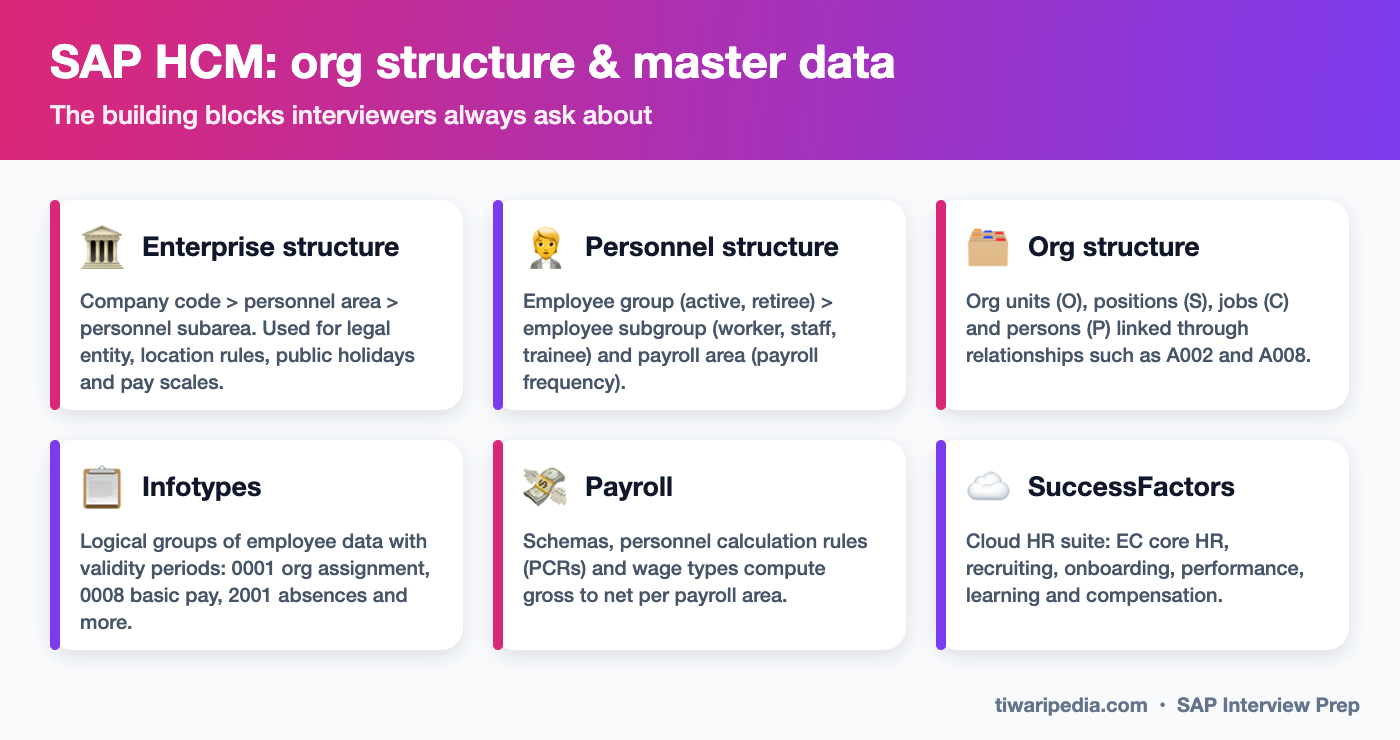
Organizational structure
Company code
The legal entity, from FI.
Personnel area
A location or business unit within a company code, used for reporting and authorisations.
Personnel subarea
Controls public holiday calendar, work schedule groupings, pay scale area and type, and statutory groupings (for example PF and ESI groupings in India).
Employee group and subgroup
Control payroll rules, time quotas, pay scale and wage type permissibility through groupings.
Payroll area
Groups employees paid on the same frequency and date. It has its own control record (PA03).
Organizational plan
Org units, positions, jobs and cost centre assignments maintained in PPOME / PPOCE.
Master data
Key infotypes
- 0000 Actions, 0001 Org Assignment
- 0002 Personal Data, 0006 Addresses
- 0007 Planned Working Time, 0008 Basic Pay
- 0009 Bank Details, 0014/0015 Recurring/Additional Payments
Time infotypes
- 2001 Absences, 2002 Attendances
- 2006 Absence Quotas, 2010 Employee Remuneration
India statutory infotypes
- 0580–0586 Tax declarations (previous employer, HRA, exemptions, 80C)
- 0587 Provident Fund, 0588 Other statutory deductions
Personnel actions
Hiring, org reassignment, promotion and leaving are configured as action types that run a sequence of infotypes (infogroup).
Wage types
Primary (entered) and secondary (calculated) wage types with processing classes, cumulation and evaluation classes.
Schemas & PCRs
Payroll schema (such as IN00 for India) calls functions and rules that process wage types.
Key T-codes & Fiori apps
Interviewers often ask you to name the transaction or app for a step. You do not need to memorise hundreds, but you should know these confidently.
| T-code / App | What it does |
|---|---|
| PA20 / PA30 / PA40 | Display / maintain HR master data / run personnel actions |
| PPOME / PPOCE | Change / create organisation and staffing |
| PA61 / PA62 | Maintain / list time data |
| PT60 / PT_CLSTB2 | Time evaluation / display time results |
| CAT2 | Record working time (CATS) |
| PA03 | Maintain payroll control record |
| PC00_M40_CALC | Payroll run for India |
| PC00_M99_CIPE | Post payroll results to accounting |
| PE01 / PE02 | Maintain schemas / personnel calculation rules |
| PC_PAYRESULT | Display payroll results |
| SPRO → Personnel Management | HCM configuration (IMG) |
| SF: Admin Center, Manage Business Configuration, Integration Center | SuccessFactors configuration and integrations |
What changed in S/4HANA
- On S/4HANA you can keep classic HCM only under the compatibility pack (with limited use rights) or move to SAP HCM for S/4HANA (H4S4), an on-premise successor with a long support horizon. Check the current SAP roadmap for exact dates.
- The strategic cloud direction is SAP SuccessFactors Employee Central, often with Employee Central Payroll.
- Hybrid models are common: EC as the system of record with employee data replicated to S/4HANA (as Business Partner) and to payroll through point-to-point replication or SAP Integration Suite.
- Employees must exist as Business Partners in S/4HANA for travel, procurement and finance processes. The BP synchronisation (employee role) handles this.
- Fiori apps and SAP Work Zone replace ESS/MSS on Portal.
Integration points
| With | How it integrates |
|---|---|
| FI | Payroll posts expenses and liabilities by symbolic account and wage type through posting runs (PC00_M99_CIPE). |
| CO | Cost centres on IT0001 / IT0027 drive cost distribution. Activity allocation through CATS. |
| PS / PM | CATS timesheets transfer hours to WBS elements, network activities and maintenance orders. |
| SuccessFactors | EC to ECP or on-premise payroll replication, org data sync, and talent data into the master record. |
| Travel Management | Employee master and bank details for expense reimbursement. |
| Identity & IT | Hire and leave events drive user provisioning through Identity Authentication and Identity Provisioning. |
Interview questions & answers
Tap a question to see a model answer. They are grouped from fundamentals to scenario-based questions that senior panels love.
🟢 Fundamentals
What is an infotype? Give examples. Beginner
Explain the enterprise structure and personnel structure in HCM. Beginner
What are the OM objects and relationships? Beginner
What is a personnel action? Beginner
What is a payroll control record? Beginner
Difference between primary and secondary wage types? Beginner
🟡 Intermediate
Explain the steps of a payroll run. Intermediate
What is retro accounting? Intermediate
What are schemas and PCRs? Intermediate
Explain time evaluation. Intermediate
What are the main India statutory components in SAP payroll? Intermediate
What is Employee Central and how is it different from SAP HCM PA? Intermediate
🔴 Scenario & design
How would you design a hybrid EC + on-premise payroll landscape? Scenario
An employee did not receive a backdated increment. How do you investigate? Scenario
Payroll posting to FI fails. What do you check? Scenario
How do you handle full-and-final settlement for a resigning employee in India? Scenario
A client on ECC HCM asks what to do in an S/4HANA move. What do you advise? Scenario
How would you set up leave quota generation? Scenario
How would you secure HR data? Scenario
Solution architect view
Key HCM architecture decisions:
- Target model: SuccessFactors cloud, SAP HCM for S/4HANA on-premise, or hybrid. Decide system of record, payroll location and the support horizon.
- Global template: a single global data model with country extensions for legal fields and statutory processes.
- Structures: personnel areas and subareas, employee groups and subgroups, and payroll areas, designed for reporting and authorisation needs.
- Integration: EC to payroll, EC to S/4HANA (BP and cost centres), identity provisioning, time systems and benefits vendors through SAP Integration Suite.
- Payroll: country coverage, retro strategy, posting design and parallel runs before go-live.
- Privacy: GDPR and India DPDP Act compliance, data residency, masking and retention.
Typical deliverables: HR solution blueprint, data model and picklist workbook, integration catalogue, payroll configuration and parallel-run reconciliation plan, and the role and permission design.
Test yourself: scored HCM quiz
Interview tips
- Learn the main infotype numbers by heart. HCM panels almost always ask.
- Explain a payroll run end to end, including the control record states.
- Know your country statutory rules (for India: PF, ESI, PT, TDS, Form 16).
- Show cloud awareness: Employee Central, ECP, replication and the S/4HANA HCM options.
- For senior roles, describe a hybrid architecture and the data privacy design.
Keep preparing: 🎯 SAP Interview Prep hub & combined mock test · All SAP interview guides · ERP Software




