

🛠️ SAP EAM (Plant Maintenance) interview guide
Everything a PM/EAM consultant is asked in interviews, from the basic notification-to-settlement cycle to preventive maintenance design and S/4HANA Asset Management, with a scored test at the end.
SAP Enterprise Asset Management (EAM), still widely called Plant Maintenance (PM), keeps machines, vehicles, buildings and networks running. It is one of the most in-demand SAP skills in manufacturing, utilities, oil & gas, mining and pharma. This guide walks you through the full process with an infographic, the master data you must know, and the questions interview panels actually ask.
📝 Jump to the scored EAM (PM) test
What is SAP EAM (PM)?
SAP EAM manages the complete lifecycle of physical assets: recording technical objects, planning and executing maintenance work, capturing costs and history, and analysing reliability. In S/4HANA it is delivered as Asset Management, and it works with SAP Intelligent Asset Management, SAP Asset Performance Management and the SAP Service and Asset Manager mobile app.
Maintenance falls into three types that you should be able to explain:
- Corrective (breakdown) maintenance: something fails, a notification is raised and an order repairs it.
- Preventive maintenance: time-based or performance (counter)-based plans automatically generate orders, such as an inspection every 3 months or every 500 operating hours.
- Predictive / condition-based maintenance: measurement readings or IoT signals trigger work when a threshold is crossed.
End-to-end process: Plan-to-Maintain (notification to settlement)
Almost every EAM interview starts with “walk me through the maintenance cycle”. Use this flow and name the T-codes as you go.
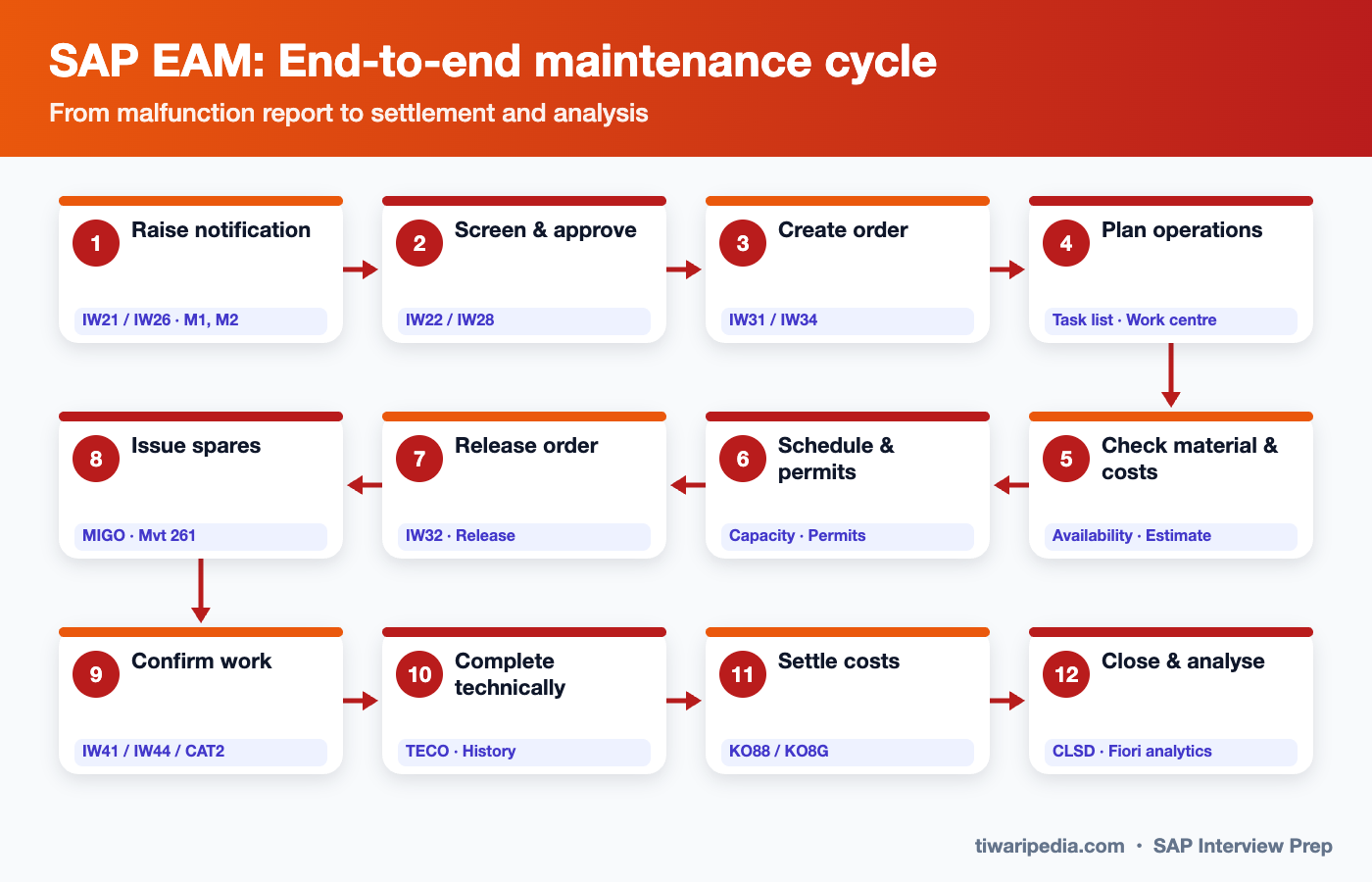
- Raise notification
IW21 / IW26 · M1, M2
A user reports a malfunction (M2) or requests work (M1) against a functional location or equipment, with damage and cause codes from catalogs. - Screen & approve
IW22 / IW28
The maintenance planner reviews the request, sets priority and decides whether an order is needed. - Create order
IW31 / IW34
A maintenance order is created directly or from the notification. The order type (such as PM01) controls numbering, settlement and costing. - Plan operations
Task list · Work centre
Operations, work centres, durations, spare parts (components), tools and external services are planned. A task list can be copied in. - Check material & costs
Availability · Estimate
Stock items create reservations; non-stock items and services create purchase requisitions automatically. Planned costs are calculated. - Schedule & permits
Capacity · Permits
Work is scheduled against work-centre capacity. Permits and work clearance (lock-out/tag-out) are obtained for safety. - Release order
IW32 · Release
Release makes the order executable: reservations become relevant for goods issue and shop papers can be printed. - Issue spares
MIGO · Mvt 261
Spare parts are issued from the store to the order, and the actual material cost is posted to the order. - Confirm work
IW41 / IW44 / CAT2
Technicians confirm actual hours, which posts labour cost via the activity type rate. Measurement readings are recorded. - Complete technically
TECO · History
The order is technically completed. Damage, cause and activity codes are recorded on the notification for history. - Settle costs
KO88 / KO8G
Order costs are settled to the receiver in the settlement rule, such as a cost centre, asset (capitalisation) or WBS element. - Close & analyse
CLSD · Fiori analytics
Business completion closes the order. MTBF, MTTR, planned-vs-actual cost and PM compliance are analysed.
Organizational structure & master data
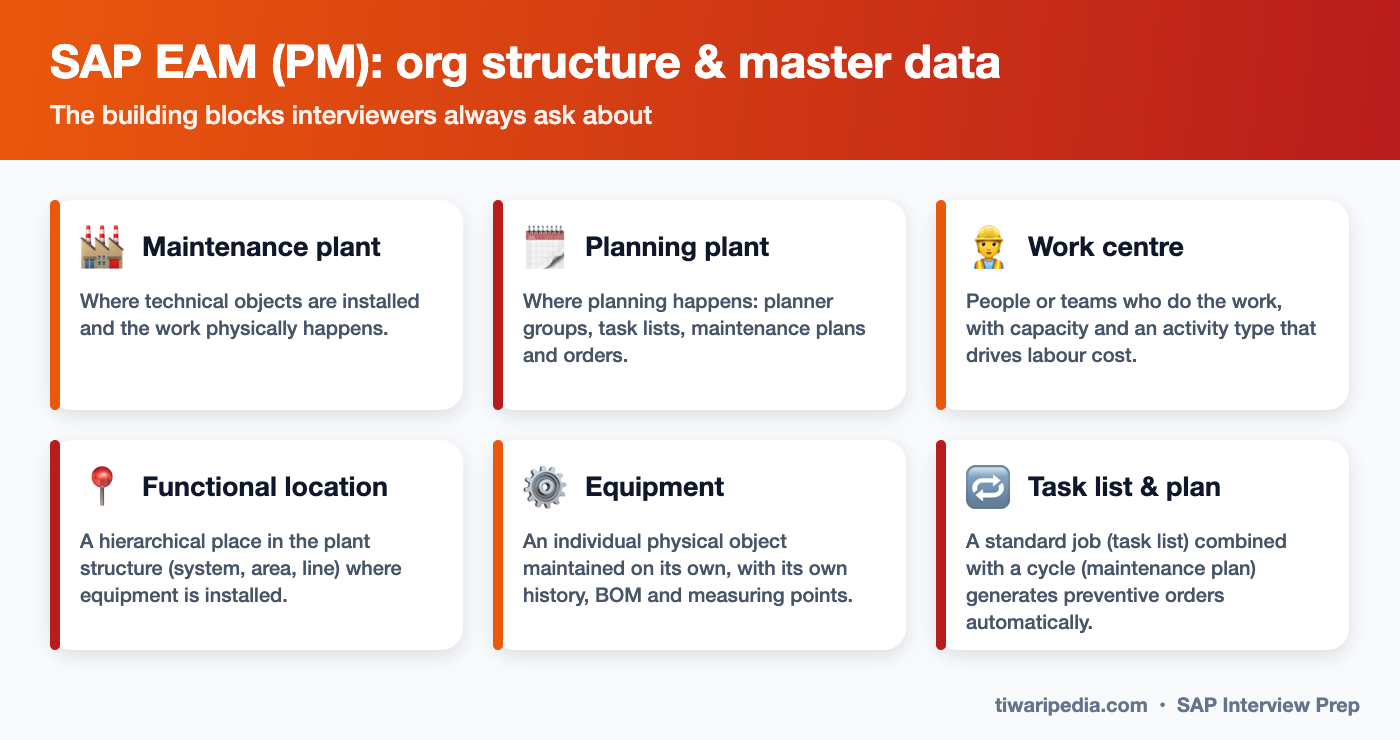
Organizational structure
Maintenance plant
The plant where technical objects are located.
Maintenance planning plant
The plant where maintenance is planned. It can be centralised (one planning plant serving many maintenance plants) or decentralised.
Planner group
The group of planners responsible for a set of objects or orders.
Main work centre
The default responsible work centre on the notification and order.
Plant section / location
Used for responsibility and reporting within a plant.
Company code, controlling area, business area
Determine where maintenance costs land in FI/CO.
Master data
Functional location (IL01)
A hierarchy defined by a structure indicator (edit mask). It represents where work is done.
Equipment (IE01)
Installed at or dismantled from a functional location, with full usage history. Can be serialised material.
Bill of material
- Equipment BOM (IB01)
- Functional location BOM (IB11)
- Material BOM used as an assembly
Task lists (IA05 / IA01 / IA11)
- General task list (A)
- Equipment task list (E)
- Functional location task list (T)
Maintenance plans
- Single cycle (IP41)
- Strategy plan (IP42, strategy in IP11)
- Multiple counter (IP43)
Measuring points & counters (IK01 / IK11)
Capture readings and operating hours that drive counter-based and condition-based maintenance.
Catalogs & catalog profile
Coded damage, cause, object part and activity codes that make history analysable.
Work centre (IR01)
Capacity, formulas, cost centre and activity type for labour costing.
Key T-codes & Fiori apps
Interviewers often ask you to name the transaction or app for a step. You do not need to memorise hundreds, but you should know these confidently.
| T-code / App | What it does |
|---|---|
| IW21 / IW22 / IW23 | Create / change / display notification |
| IW28 / IW29 | Notification list change / display |
| IW31 / IW32 / IW33 | Create / change / display maintenance order |
| IW38 / IW39 | Order list change / display |
| IW41 / IW44 / IW42 | Individual / collective / overall completion confirmation |
| IL01 / IE01 | Create functional location / equipment |
| IA05 / IA01 / IA11 | General / equipment / functional location task list |
| IP41 / IP42 / IP43 | Create maintenance plans (single cycle, strategy, multiple counter) |
| IP10 / IP30 | Schedule a plan / deadline monitoring (batch scheduling) |
| IK01 / IK11 | Create measuring point / enter measurement document |
| KO88 / KO8G | Individual / collective order settlement |
| Fiori: Request Maintenance, Find Maintenance Notification, Manage Maintenance Planning Buckets, Perform Maintenance Jobs | Modern UX for requesters, planners and technicians |
What changed in S/4HANA
- Plant Maintenance is positioned as S/4HANA Asset Management, with role-based Fiori apps for requesters, planners, supervisors and technicians.
- Newer releases add an optional phase model for notifications and orders (initiation, screening, planning, approval, preparation, scheduling, execution, post-execution, completion), giving a clear status-driven process.
- Maintenance planning buckets and a scheduling board support capacity-aware weekly scheduling.
- The Universal Journal (ACDOCA) means order costs are visible in real time without reconciliation between FI and CO.
- Business Partner replaces separate customer and vendor masters, and the material number field is extended to 40 characters.
- Mobile execution moves to SAP Service and Asset Manager, and predictive use cases move to SAP Asset Performance Management on BTP.
Integration points
| With | How it integrates |
|---|---|
| MM | Reservations for stock spares, purchase requisitions for non-stock items and external services, goods issue with movement type 261. |
| CO | Orders collect planned and actual costs, which are settled to cost centres, internal orders or WBS elements. Labour uses activity-type rates. |
| FI-AA | Capital work can be settled to an asset or asset under construction. Equipment can be linked to a fixed asset. |
| PS | Shutdowns and turnarounds are planned with WBS elements, and maintenance orders are assigned to them. |
| QM | Quality notifications, calibration of test equipment and inspection lots for calibration orders. |
| HCM / CATS | Technician time is recorded in CATS and transferred to order confirmations. |
| EHS | Work clearance management and permits for safe isolation. |
Interview questions & answers
Tap a question to see a model answer. They are grouped from fundamentals to scenario-based questions that senior panels love.
🟢 Fundamentals
What is the difference between a functional location and an equipment? Beginner
Explain the standard notification types. Beginner
What is the difference between a notification and an order? Beginner
What is TECO and how is it different from business completion (CLSD)? Beginner
Which movement type issues spare parts to a maintenance order? Beginner
What is a work centre used for in PM? Beginner
What are catalogs in PM? Beginner
🟡 Intermediate
Explain the different maintenance plan types. Intermediate
What scheduling parameters matter in a maintenance plan? Intermediate
How is a settlement rule determined for a maintenance order? Intermediate
What is the difference between an internal and an external operation? Intermediate
What is a refurbishment order? Intermediate
How do measuring points support condition-based maintenance? Intermediate
🔴 Scenario & design
A plant wants orders created automatically every 500 running hours or every 3 months, whichever is first. How do you design it? Scenario
Breakdown costs are landing on the wrong cost centre. How do you investigate? Scenario
How would you plan an annual plant shutdown in SAP? Scenario
The business wants technicians to work on mobile devices offline. What would you propose? Scenario
How do you migrate technical objects to S/4HANA? Scenario
Which KPIs would you build for a maintenance manager? Scenario
When would you choose a functional location hierarchy over equipment only? Scenario
Solution architect view
Key design decisions a solution architect owns in EAM:
- Technical object structure: the functional location mask and depth, the equipment categories, and which objects need their own history and cost tracking. This is the hardest thing to change later.
- Planning model: centralised or decentralised planning plants, planner groups and work-centre granularity.
- Order and notification types: keep a small, clear set (breakdown, preventive, project-related, refurbishment) with clean settlement profiles.
- Costing: activity types and rates, cost element planning and settlement receivers, agreed with Finance early.
- Preventive strategy: time, counter or condition-based plans, call horizons and batch scheduling.
- Mobility and IoT: SAP Service and Asset Manager, APM and sensor integration through BTP.
- Data migration: functional location and equipment hierarchy cleansing is usually the critical path.
Typical deliverables: asset hierarchy design document, business process design (BPD) for corrective, preventive and refurbishment processes, configuration rationale, integration design, and a KPI and reporting catalogue.
Test yourself: scored EAM (PM) quiz
Interview tips
- Always narrate the cycle with T-codes: notification, order, planning, release, goods issue, confirmation, TECO, settlement.
- Know the difference between corrective, preventive and predictive maintenance, with one real example of each.
- Be ready to draw the functional location hierarchy from a plant you know.
- Mention S/4HANA items (Fiori apps, phase model, Service and Asset Manager) to show you are current.
- For senior roles, talk about KPIs (MTBF, MTTR, PM compliance) and how you designed the reporting.
Keep preparing: 🎯 SAP Interview Prep hub & combined mock test · All SAP interview guides · ERP Software




