

Last updated: October 2026 · 3 min read
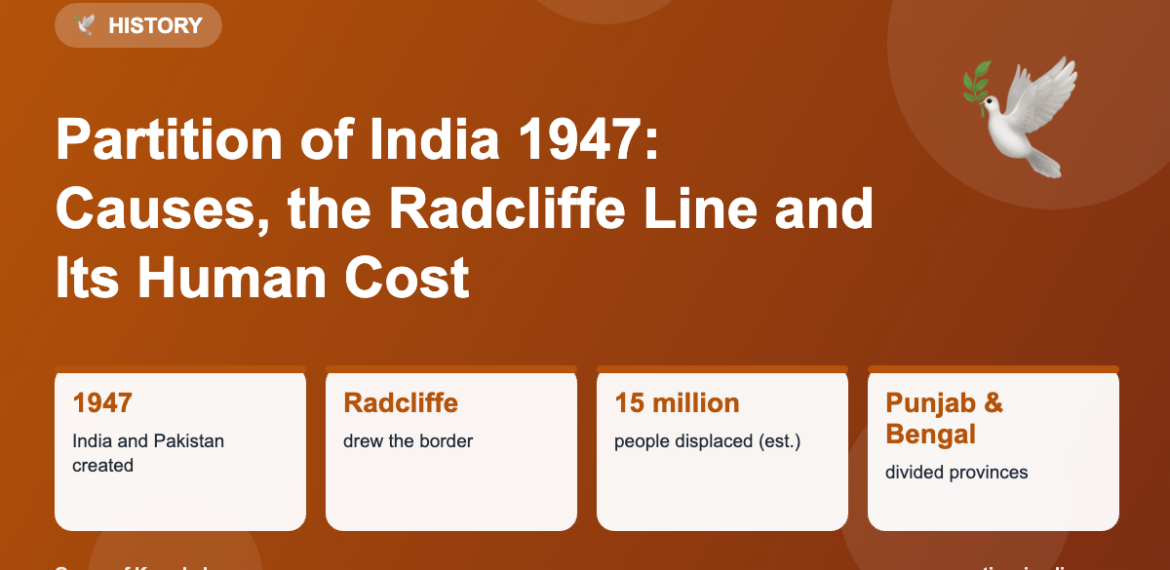
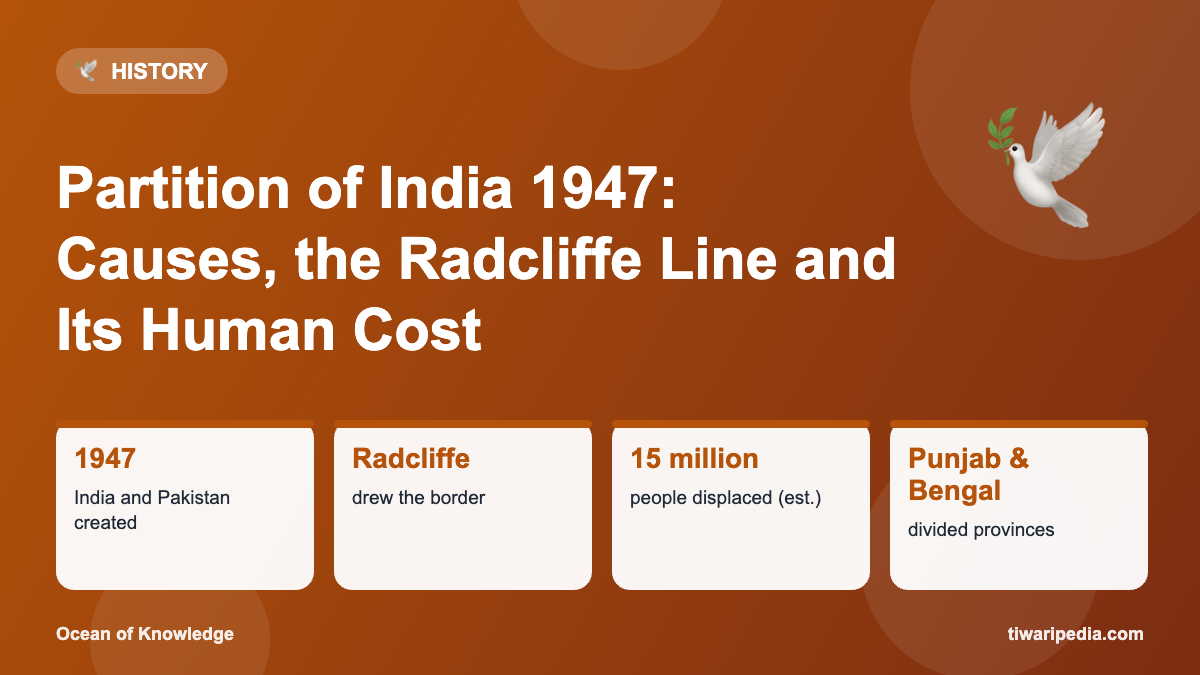
In August 1947, British India gained independence and was divided into two dominions, India and Pakistan. The Partition caused one of the largest and most painful migrations in human history.
Causes of Partition
- Growing political divide between the Indian National Congress and the Muslim League.
- The Muslim League’s Lahore Resolution of 1940 demanding separate states for Muslim-majority areas.
- Failure of the Cabinet Mission Plan (1946) to agree on a united India.
- Communal violence, including the 1946 Direct Action Day riots in Calcutta.
- Britain’s decision to leave quickly after World War II.
Key steps
| Date | Event |
|---|---|
| 3 June 1947 | Mountbatten Plan announces partition |
| 18 July 1947 | Indian Independence Act receives royal assent |
| 14 August 1947 | Pakistan becomes independent |
| 15 August 1947 | India becomes independent |
| 17 August 1947 | Radcliffe Line boundaries made public |
The Radcliffe Line
British lawyer Cyril Radcliffe, who had never been to India before, was given about five weeks to draw borders dividing Punjab and Bengal. The boundaries were announced two days after independence, leaving millions unsure which country they were in.
Migration and violence
An estimated 10 to 20 million people crossed the new borders, and estimates of deaths range from several hundred thousand to around two million. Trains of refugees, attacks on villages and abductions of women left deep scars in Punjab, Bengal, Sindh and Delhi.
Princely states
More than 560 princely states had to choose India or Pakistan. Sardar Vallabhbhai Patel and V.P. Menon persuaded most to join India; Hyderabad, Junagadh and Jammu and Kashmir took longer.
Legacy
Partition shaped India-Pakistan relations, the Kashmir dispute and, in 1971, the creation of Bangladesh from East Pakistan. India observes 14 August as Partition Horrors Remembrance Day, and museums such as the Partition Museum in Amritsar preserve survivors’ stories.
Frequently asked questions
Who drew the India-Pakistan border?
Sir Cyril Radcliffe, chairman of the boundary commissions for Punjab and Bengal.
Which provinces were partitioned?
Punjab and Bengal were divided; Sindh, Balochistan and the North-West Frontier Province went to Pakistan.
Who was the last Viceroy of India?
Lord Louis Mountbatten, who also became independent India’s first Governor-General.
Keep exploring
- India’s freedom struggle
- Facts about Mahatma Gandhi
- How India’s Constitution was made
- More History articles on Tiwaripedia
Facts are based on widely accepted official, scientific and historical sources at the time of writing. Spotted something that needs updating? Let us know.




