

Last updated: October 2026 · 3 min read
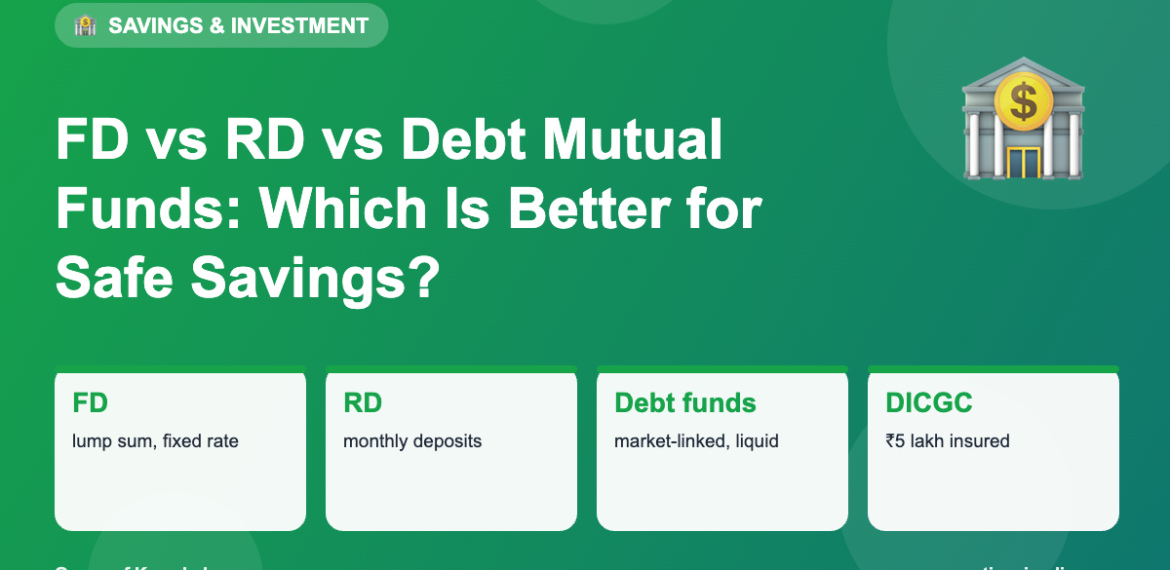
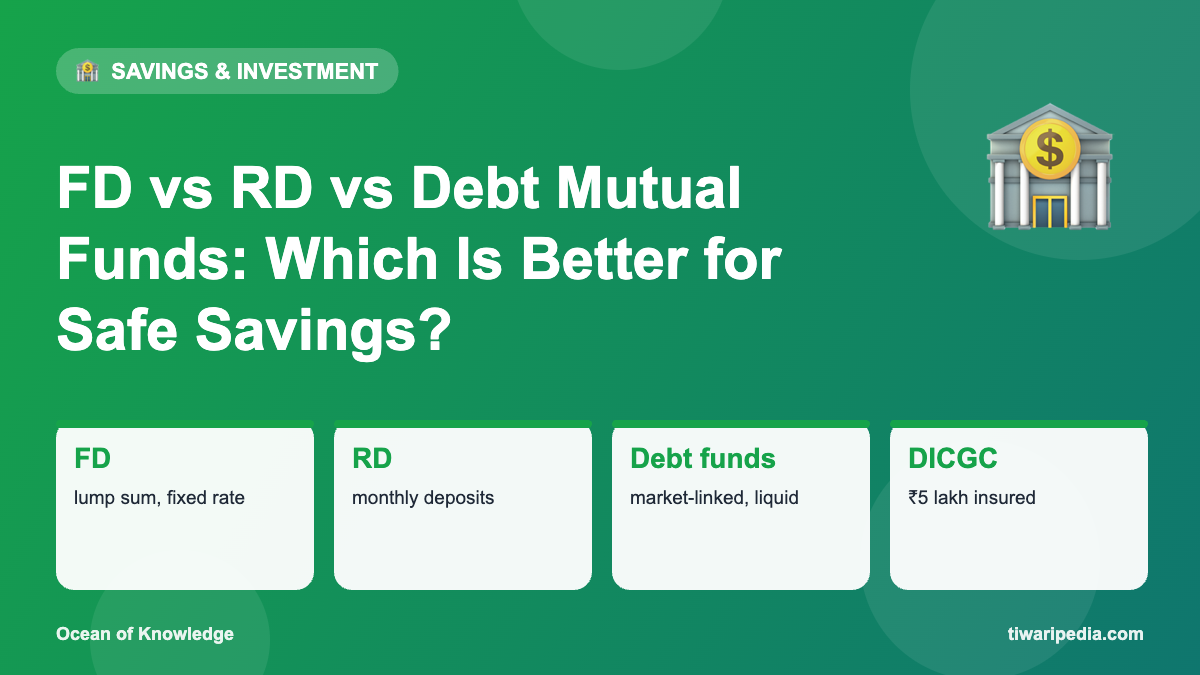
For money you cannot afford to lose, such as an emergency fund or savings for a goal in 1-3 years, safety matters more than high returns. The three most common choices are fixed deposits, recurring deposits and debt mutual funds.
Side-by-side comparison
| Feature | Fixed deposit (FD) | Recurring deposit (RD) | Debt mutual funds |
|---|---|---|---|
| How you invest | One lump sum | Fixed amount every month | Lump sum or SIP |
| Returns | Fixed at booking | Fixed at booking | Market-linked, not guaranteed |
| Safety | High; bank deposits insured up to ₹5 lakh per bank by DICGC | Same as FD | Depends on fund quality; no insurance |
| Liquidity | Premature withdrawal with penalty | Premature closure with penalty | Redeem anytime (some exit loads) |
| Tax | Interest taxed at slab | Interest taxed at slab | Gains taxed at slab (for units bought from April 2023) |
| TDS | Yes, above thresholds | Yes, above thresholds | No TDS for residents |
When to choose an FD
When you have a lump sum and want certainty, for example a planned expense in two years. Senior citizens usually get 0.25-0.50% extra interest. Laddering FDs with different maturities improves liquidity.
When to choose an RD
When you want to save a fixed amount every month for a goal like a vacation, festival shopping or a down payment. Post office 5-year RD offers 6.7% (October-December 2026 quarter).
When to choose debt funds
For flexibility and parking money with easy withdrawal: liquid and overnight funds suit emergency money; short-duration or target maturity funds suit goals of 1-3 years. Check credit quality and expense ratio.
Interest rates are changing
After the RBI raised the repo rate to 5.50% in October 2026, banks may revise FD and loan rates. Compare current rates on bank websites before booking, and remember small finance banks may offer higher rates with similar DICGC cover.
Frequently asked questions
Is FD money safe?
Bank deposits are insured by DICGC up to ₹5 lakh per depositor per bank, covering principal and interest.
Are debt funds riskier than FDs?
They can be, because of interest-rate and credit risk, but high-quality liquid funds have historically been very stable.
Which gives higher returns, FD or RD?
At the same rate, an FD earns more because the full amount is invested from day one; RD money is invested gradually.
Keep exploring
- Emergency fund guide
- Power of compounding
- Sukanya Samriddhi Yojana
- More Savings & Investment articles on Tiwaripedia
This article is for general information, not financial, tax or legal advice. Rates, limits and rules change; always confirm on the official website or with a qualified advisor before you act. Spotted something that needs updating? Let us know.




