

Last updated: October 2026 · 3 min read
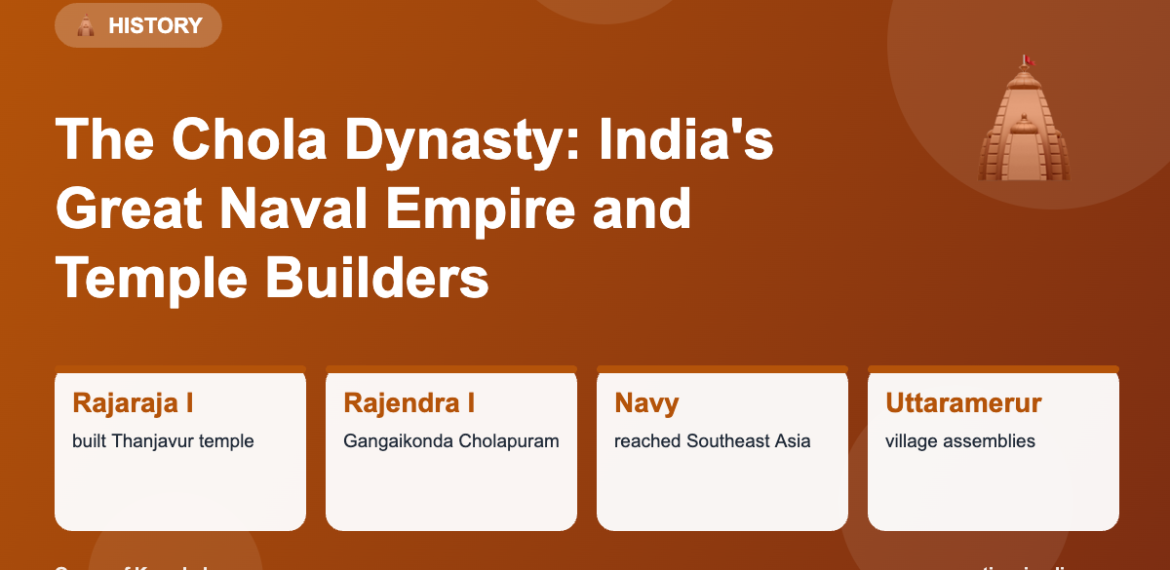
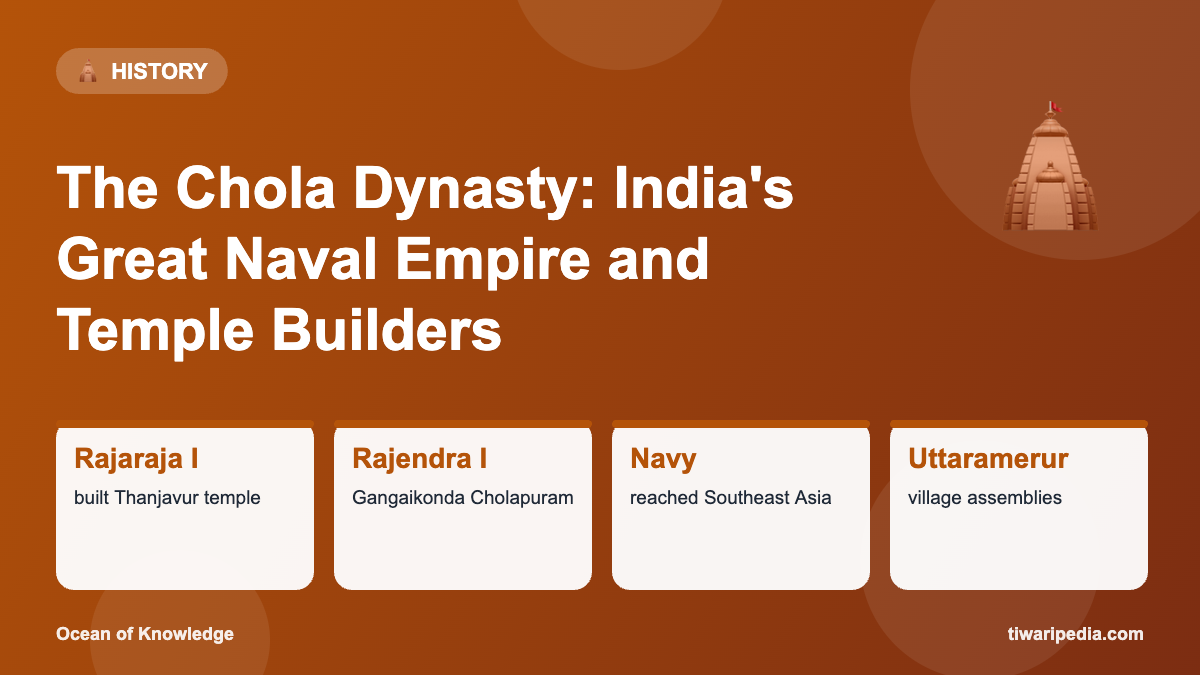
The Cholas ruled from the Kaveri delta in Tamil Nadu and, at their height in the 11th century, controlled much of South India, Sri Lanka and the Maldives, with naval expeditions reaching Southeast Asia. They are remembered for magnificent temples, bronze sculpture and efficient administration.
Timeline at a glance
| Period | Event |
|---|---|
| Sangam age (c. 300 BCE-300 CE) | Early Cholas mentioned in Tamil literature; Karikala Chola builds the Kallanai (Grand Anicut) on the Kaveri |
| c. 850 CE | Vijayalaya Chola captures Thanjavur, starting the imperial Chola line |
| 985-1014 CE | Rajaraja Chola I expands the empire and builds the Brihadeeswara temple |
| 1014-1044 CE | Rajendra Chola I campaigns to the Ganga and to Srivijaya in Southeast Asia |
| 1070-1120 CE | Kulottunga I unites Chola and Eastern Chalukya lines |
| 1279 CE | Last Chola ruler; Pandyas take over |
Rajaraja Chola I
Rajaraja I conquered the Cheras, Pandyas and northern Sri Lanka, organised a strong army and navy, and ordered a detailed land survey for taxation. His greatest monument, the Brihadeeswara (Big) Temple at Thanjavur, completed around 1010 CE, has a vimana about 66 metres tall and is part of the UNESCO “Great Living Chola Temples”.
Rajendra Chola I and the navy
His son Rajendra I marched north to the Ganga and took the title Gangaikonda Chola, building a new capital, Gangaikonda Cholapuram. Around 1025 CE his navy attacked the Srivijaya kingdom in present-day Indonesia and Malaysia, a rare overseas campaign that protected Chola trade routes.
Administration and local self-government
Chola inscriptions at Uttaramerur describe village assemblies (sabha and ur) whose members were chosen by lot (kudavolai) from eligible candidates. Committees managed tanks, gardens, temples and justice, making it an early example of local self-government.
Art, culture and economy
- Chola bronzes, especially Nataraja (dancing Shiva), are world-famous for their grace.
- Temples were centres of music, dance, education and banking.
- The Kaveri delta’s irrigation made it a rich rice-growing region.
- Merchant guilds traded with China, Southeast Asia and Arabia.
The Great Living Chola Temples
UNESCO lists three: the Brihadeeswara Temple at Thanjavur, the Brihadeeswara Temple at Gangaikonda Cholapuram and the Airavatesvara Temple at Darasuram.
Frequently asked questions
Who was the greatest Chola king?
Rajaraja Chola I and his son Rajendra Chola I are considered the greatest for their conquests, administration and temple building.
What was the Chola capital?
Early capitals included Uraiyur; imperial capitals were Thanjavur and later Gangaikonda Cholapuram.
Why is the Chola navy famous?
It carried out overseas expeditions to Sri Lanka, the Maldives and Southeast Asia, unusual for Indian kingdoms of the time.
Keep exploring
Facts are based on widely accepted official, scientific and historical sources at the time of writing. Spotted something that needs updating? Let us know.




