Last updated: October 2026 · 3 min read
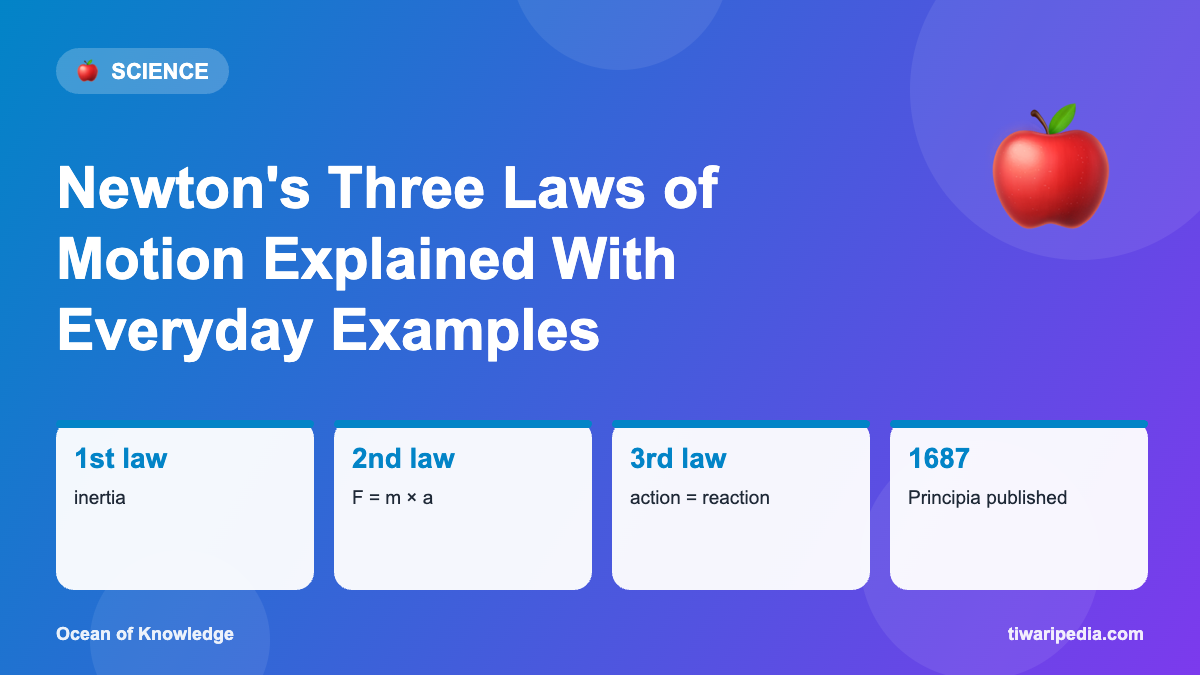
In 1687, Sir Isaac Newton published three laws that explain how things move, from a cricket ball to a rocket leaving Sriharikota. They remain the foundation of physics and engineering.
First law: the law of inertia
An object stays at rest or keeps moving in a straight line at constant speed unless a force acts on it.
- When a bus brakes suddenly, passengers lurch forward because their bodies tend to keep moving.
- Dust leaves a carpet when you beat it, because the carpet moves and the dust stays.
- A ball rolling on grass stops because friction acts on it.
Second law: F = m × a
The force on an object equals its mass multiplied by its acceleration. A bigger force gives a bigger acceleration; a heavier object needs more force to accelerate the same amount.
Example: To accelerate a 1,000 kg car at 2 m/s², you need F = 1,000 × 2 = 2,000 newtons.
- A loaded truck takes longer to speed up than an empty one.
- A fielder pulls hands back while catching to increase the stopping time and reduce the force.
Third law: action and reaction
For every action there is an equal and opposite reaction.
- A rocket pushes hot gas down; the gas pushes the rocket up.
- When you walk, your foot pushes the ground backwards and the ground pushes you forwards.
- A gun recoils when a bullet is fired.
Summary table
| Law | In one line | Everyday example |
|---|---|---|
| First | Things resist change in motion | Seat belts in a sudden stop |
| Second | F = m × a | Pushing a full vs empty trolley |
| Third | Equal and opposite reactions | Boat moves back as you step off |
Where Newton’s laws fall short
At speeds close to light or at atomic sizes, Einstein’s relativity and quantum mechanics give more accurate answers. For everyday life and most engineering, Newton’s laws work extremely well.
Frequently asked questions
What is the SI unit of force?
The newton (N). One newton accelerates a 1 kg mass at 1 m/s².
Is inertia a force?
No. Inertia is the property of matter to resist changes in motion.
Did an apple really fall on Newton’s head?
Newton said watching an apple fall made him think about gravity; the “hit on the head” detail is a later embellishment.
Keep exploring
Facts are based on widely accepted official, scientific and historical sources at the time of writing. Spotted something that needs updating? Let us know.