

Last updated: October 2026 · 3 min read
The rupee is in every Indian’s pocket, but few know its fascinating history. Here are 12 incredible facts about India’s currency.
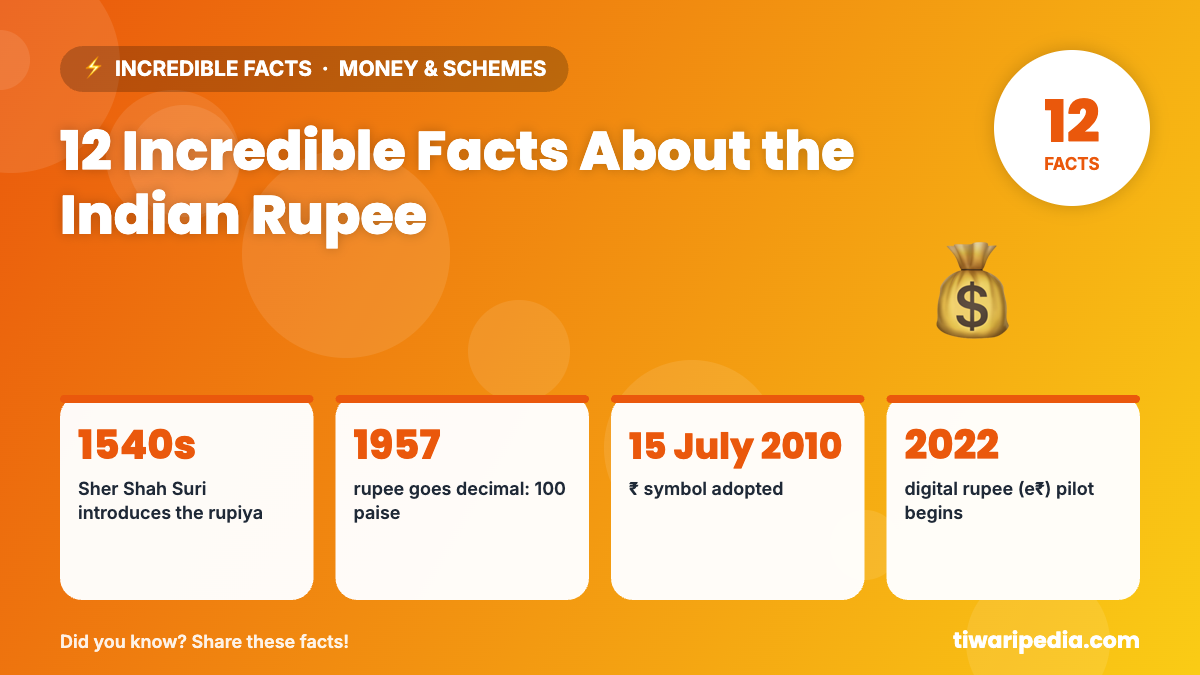
12 incredible facts about the Indian rupee
1. Its name means silver
“Rupee” comes from the Sanskrit “rupya”, meaning shaped or stamped silver.
2. Sher Shah Suri created the “rupiya”
In the 1540s, ruler Sher Shah Suri introduced a silver coin called the rupiya, the ancestor of today’s rupee.
3. One rupee used to be 16 annas
Before 1957, one rupee was divided into 16 annas, 64 paise or 192 pies.
4. It went decimal in 1957
In 1957, India decimalised its currency so that one rupee equals 100 naye paise. “Naye” (new) was later dropped.
5. The ₹ symbol was chosen in 2010
The government adopted the rupee symbol on 15 July 2010. Designed by D. Udaya Kumar, it blends the Devanagari “र” and the Roman letter “R”.
6. Other countries use rupees too
Pakistan, Nepal, Sri Lanka, Mauritius and Seychelles also call their currencies “rupee”.
7. The Gulf once used Indian rupees
The Indian rupee was widely used in Gulf countries, and the RBI issued a special “Gulf rupee” in 1959 until those countries launched their own currencies.
8. RBI issues notes, the government issues coins
The Reserve Bank of India issues banknotes, while the Government of India issues coins and the ₹1 note.
9. The ₹1 note is signed differently
The ₹1 note carries the signature of the Finance Secretary, while all other notes carry the RBI Governor’s signature.
10. India once had a ₹10,000 note
₹10,000 notes were printed in 1938 and again in 1954, and demonetised in 1946 and 1978.
11. Notes speak 17 languages
Indian banknotes show the denomination in Hindi and English on the front and in 15 other Indian languages on the language panel.
12. There is a digital rupee
The RBI began pilots of the e-rupee (e₹), India’s central bank digital currency, in 2022.
Frequently asked questions
Who designed the rupee symbol?
D. Udaya Kumar, who was a design scholar at IIT Bombay when his entry was selected.
What is the difference between UPI and the e-rupee?
UPI moves money between bank accounts. The e-rupee is a digital form of currency issued directly by the RBI.
Are 25 paise coins still valid?
No. Coins below 50 paise stopped being legal tender in 2011.
Keep exploring
- How UPI works
- PPF account explained
- More Money & Schemes explainers on Tiwaripedia
- Browse all incredible facts
Facts are based on widely accepted scientific, historical and official sources at the time of writing. Spotted something that needs updating? Let us know.




