Every leaf is a tiny food factory. Through photosynthesis, green plants, algae and some bacteria turn sunlight into chemical energy, and in the process they produce the oxygen we breathe.
The simple equation
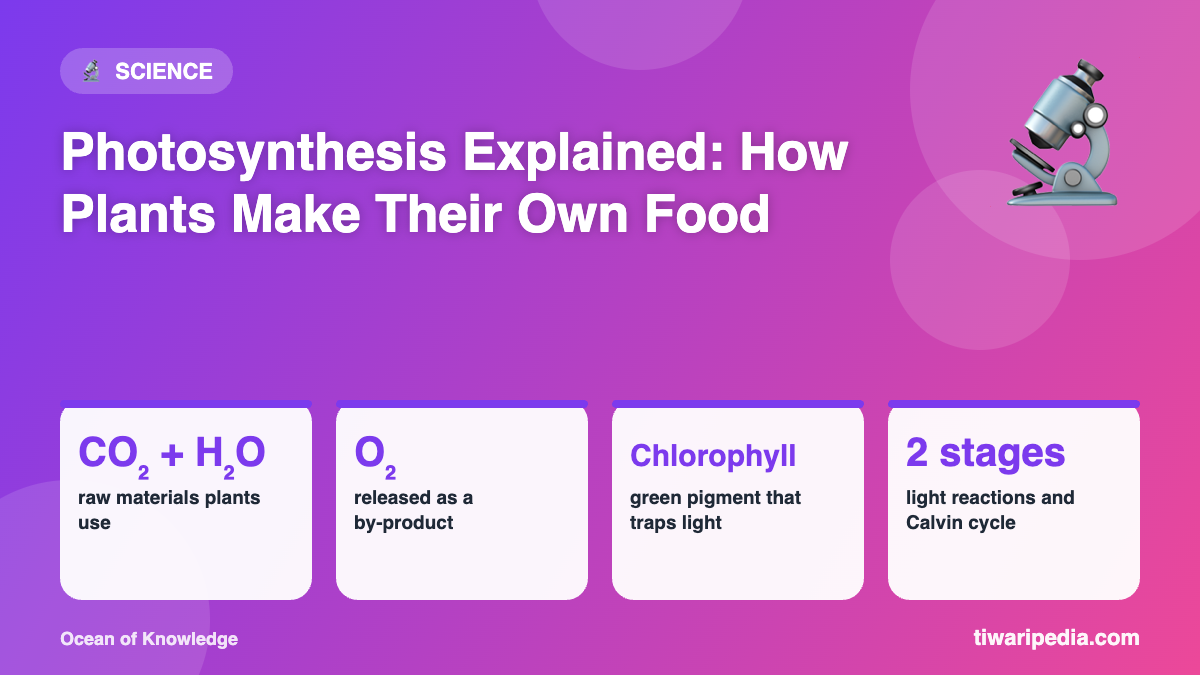
Carbon dioxide + Water + Sunlight → Glucose + Oxygen
Or, in chemical terms: 6CO₂ + 6H₂O + light energy → C₆H₁₂O₆ + 6O₂.
Where does it happen?
Photosynthesis takes place in chloroplasts, tiny structures inside leaf cells. They contain chlorophyll, a green pigment that absorbs red and blue light and reflects green light, which is why leaves look green.
What does the plant need?
- Sunlight for energy.
- Water absorbed by the roots.
- Carbon dioxide taken in from the air through tiny pores on leaves called stomata.
The two stages
- Light-dependent reactions: chlorophyll captures light energy and uses it to split water molecules. This releases oxygen and produces energy carriers (ATP and NADPH).
- Calvin cycle (light-independent reactions): the plant uses that stored energy to convert carbon dioxide into glucose.
Why it matters
- It produces most of the oxygen in our atmosphere.
- It is the base of almost every food chain: animals eat plants, or eat animals that eat plants.
- It removes carbon dioxide from the air, which helps regulate Earth’s climate.
- Fossil fuels such as coal are the remains of ancient plants that stored the Sun’s energy.
Fun fact
Tiny ocean organisms called phytoplankton carry out a large share of the world’s photosynthesis, so the ocean is as important as forests for the oxygen we breathe.