Few sights in nature are as cheerful as a rainbow after rain. But a rainbow is not an object in the sky. It is an optical effect created when sunlight meets millions of tiny water drops.
Step 1: Light bends as it enters a drop
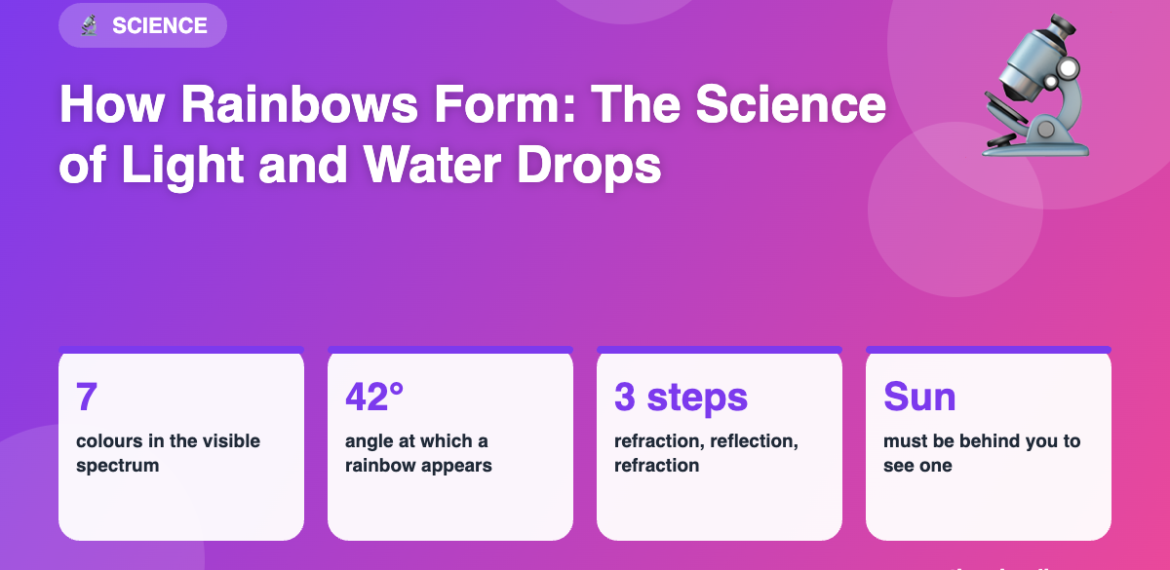
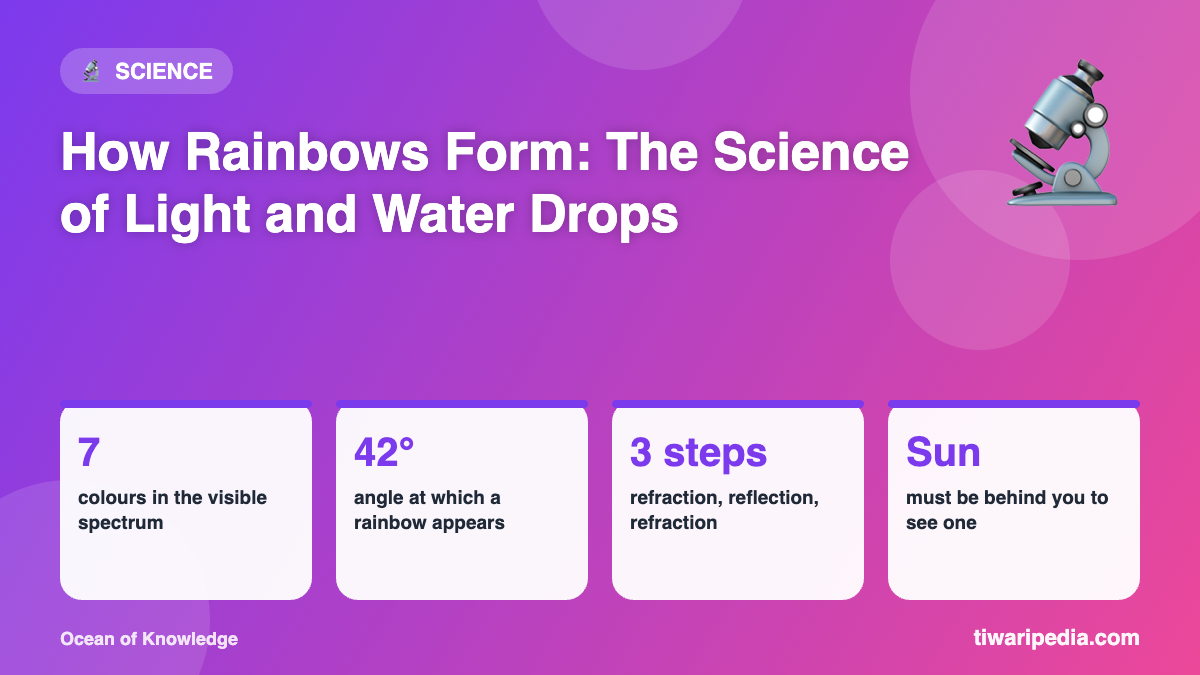
White sunlight is a mix of all colours. When it enters a raindrop, it slows down and bends. This bending is called refraction. Each colour bends by a slightly different amount: violet bends the most and red the least, so the colours begin to separate.
Step 2: Light reflects off the back of the drop
The light travels to the back of the drop and bounces off its inner surface, like a mirror.
Step 3: Light bends again as it leaves
As the light exits the front of the drop, it refracts a second time and the colours spread out further. Each drop sends one colour to your eye, and together millions of drops paint the full arc.
Why is a rainbow curved?
Light leaves the drops at an angle of about 40–42 degrees from the point directly opposite the Sun (called the antisolar point). All drops at that angle form a circle around that point. We usually see only an arc because the ground cuts off the bottom half. From an aeroplane, you can sometimes see a complete circular rainbow.
The order of colours
Red is always on the outside and violet on the inside: Red, Orange, Yellow, Green, Blue, Indigo, Violet (remembered as VIBGYOR in reverse).
Double rainbows
Sometimes a fainter second rainbow appears above the first. It forms when light reflects twice inside each drop, and its colours are in reverse order.
When can you see one?
- The Sun must be behind you and fairly low in the sky, so mornings and late afternoons are best.
- Rain or mist must be in front of you.
- You can make your own with a garden hose spraying fine mist with the Sun at your back.