

Last updated: October 2026 · 3 min read
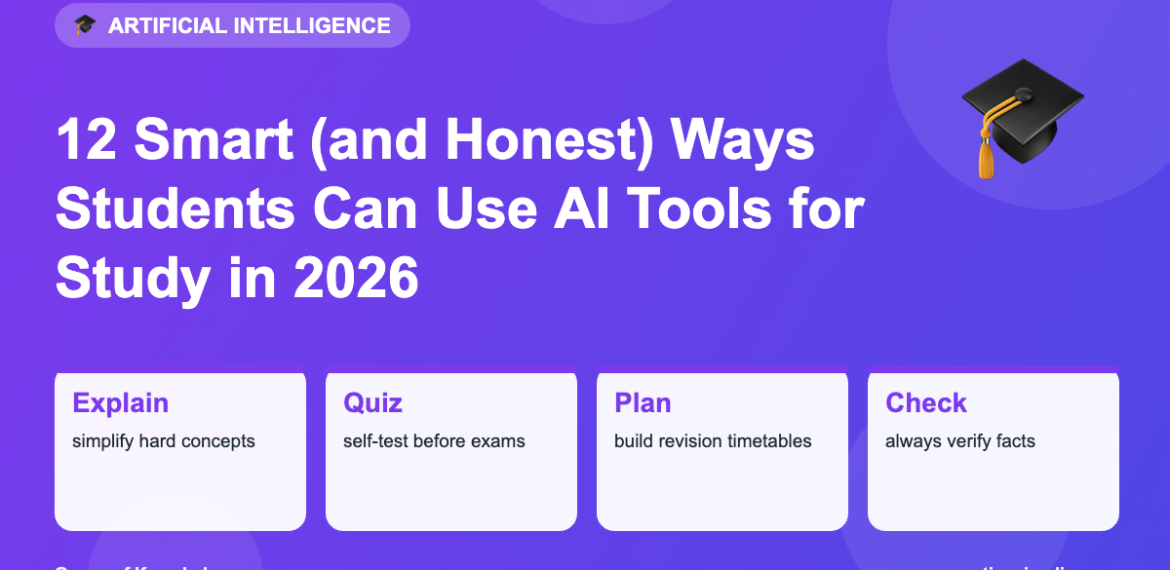
AI chatbots can be a patient tutor available at midnight before an exam. Used well, they help you understand topics faster and practise more. Used badly, they produce copied homework and wrong facts. Here are 12 smart, honest ways to use AI for study.

12 ways to use AI for studying
- Explain a concept simply: “Explain Ohm’s law like I am in Class 8, with a real example.”
- Get a second explanation: if your textbook confuses you, ask for an analogy.
- Generate practice questions from your syllabus chapter and check your answers.
- Make flashcards for definitions, dates and formulas.
- Build a revision timetable working back from your exam dates.
- Summarise your own notes into one-page revision sheets.
- Practise languages: chat in English, Hindi or French and ask for corrections.
- Improve your writing: ask for feedback on the structure and grammar of an essay you wrote.
- Debug code step by step and ask why the fix works.
- Prepare for interviews and vivas with mock questions.
- Break down research papers by pasting the abstract and asking for key points.
- Plan projects with milestones and a checklist.
What not to do
- Do not submit AI-written assignments as your own; many schools and universities treat this as plagiarism.
- Do not trust numbers, dates or quotes without checking the textbook or an official source.
- Do not share personal details, exam papers or passwords.
- Do not let AI replace practice: solving problems yourself is what builds marks.
Best prompt for exam revision
“I have my Class 10 Science exam in 14 days. Chapters: Light, Electricity, Life Processes. I can study 2 hours a day. Make a day-wise plan with one self-test every third day, then quiz me on Light now, one question at a time.”
Free AI tools students commonly use
| Tool | Good for |
|---|---|
| ChatGPT (free tier) | Explanations, practice questions |
| Google Gemini | Study help linked with Google tools |
| Microsoft Copilot | Summaries, writing help |
| NotebookLM | Studying from your own PDFs and notes |
| Khanmigo | Guided tutoring (where available) |
A simple weekly AI study routine
| Day | What to do with AI |
|---|---|
| Monday | Ask for a simple explanation of the week’s hardest topic |
| Wednesday | Generate 10 practice questions and attempt them without help |
| Friday | Paste your answers and ask for mistakes and tips |
| Sunday | Make a one-page summary and 20 flashcards for revision |
Frequently asked questions
Is it cheating to use ChatGPT for homework?
Using it to understand topics and practise is learning. Copying its answer as your own work usually breaks school rules. Follow your institution’s policy.
Can AI give wrong answers?
Yes. AI can sound confident and still be wrong, especially with numbers and recent events. Always cross-check.
Is AI useful for competitive exams?
It helps with concept clarity and question practice, but rely on standard books and official previous papers for accuracy.
Keep exploring
Facts are based on widely accepted official, scientific and historical sources at the time of writing. Spotted something that needs updating? Let us know.
Related reading on Tiwaripedia
- Prompt Engineering for Beginners: How to Write Better AI Prompts (With Examples)
- How to Spot AI Images and Deepfakes: A Practical Guide
Keep reading on Tiwaripedia
- Machine Learning vs Deep Learning vs Generative AI: Differences Explained Simply
- What Is Agentic AI? AI Agents Explained Simply (With Real Examples)
- How to Edit Photos With Google Gemini AI (Nano Banana): Step-by-Step Guide and Best Prompts
- AI and Jobs: Advantages and Disadvantages of Claude, Copilot, Agentic and Generative AI (2026)
- How to Spot AI Images and Deepfakes: A Practical Guide
- Prompt Engineering for Beginners: How to Write Better AI Prompts (With Examples)
More guides: All Artificial Intelligence articles
