

Last updated: October 2026 · 5 min read
For thousands of years, the Nile has been a lifeline in the desert. Without it, the civilisation of ancient Egypt could not have existed. Here are 10 incredible facts about this legendary river.
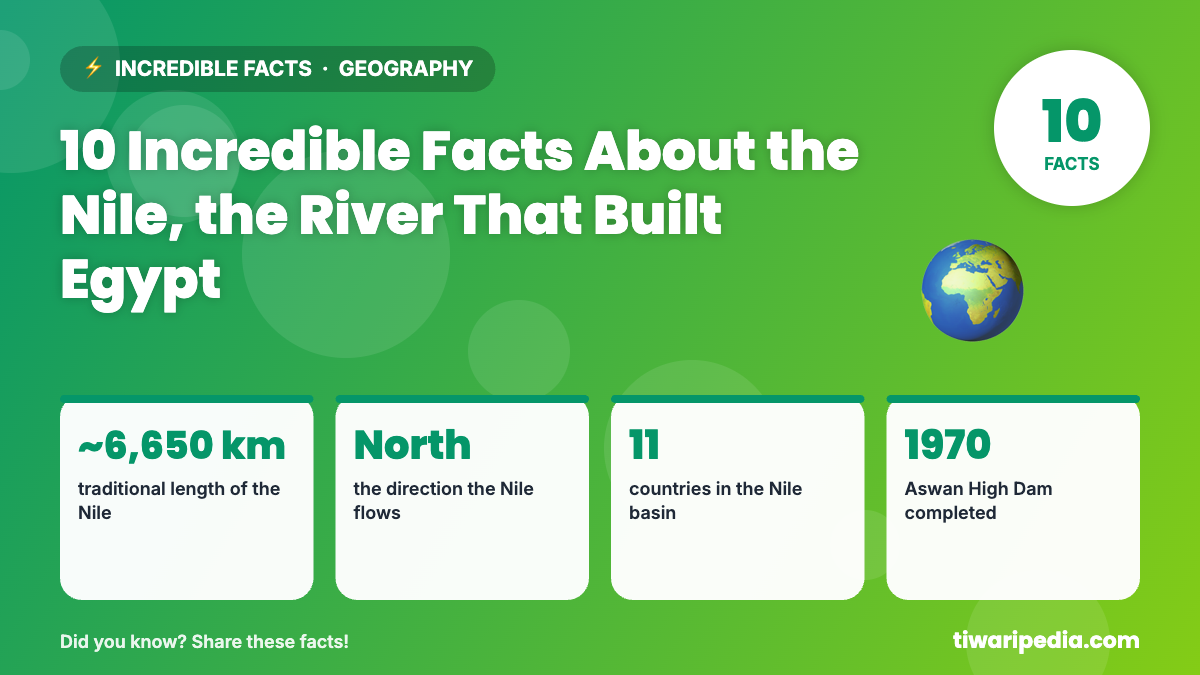
10 incredible facts about the Nile River
1. It is one of the longest rivers on Earth
The Nile is traditionally listed as the world’s longest river, at about 6,650 km, though some scientists argue the Amazon is longer.
2. It flows north
Unlike many large rivers, the Nile flows from south to north, from East Africa to the Mediterranean Sea.
3. It has two great branches
The White Nile begins in the Lake Victoria region, and the Blue Nile starts at Lake Tana in Ethiopia. They meet at Khartoum in Sudan.
4. The Blue Nile brings the floods
During the Ethiopian rainy season, the Blue Nile supplies most of the river’s water and the rich silt that once flooded Egypt’s fields each year.
5. Its basin covers 11 countries
The Nile basin stretches across Egypt, Sudan, South Sudan, Ethiopia, Uganda, Kenya, Tanzania, Rwanda, Burundi, the Democratic Republic of the Congo and Eritrea.
6. Ancient Egypt depended on its floods
The yearly flood left fertile black soil along the banks. Egyptians organised their calendar around the flood, sowing and harvest seasons.
7. Most Egyptians still live beside it
The vast majority of Egypt’s population lives in the narrow Nile Valley and Delta, a small fraction of the country’s land area.
8. A giant dam tamed it
Egypt’s Aswan High Dam, completed in 1970, ended the annual floods, generates electricity and created Lake Nasser, one of the largest artificial lakes in the world.
9. Temples were moved to save them
When Lake Nasser was formed, the huge temples of Abu Simbel were cut into blocks and moved to higher ground in the 1960s in an international rescue effort led by UNESCO.
10. It is home to the Nile crocodile
The Nile crocodile, one of the largest crocodile species, lives along the river and across much of Africa.
The Nile at a glance
| Detail | Answer |
|---|---|
| Length | About 6,650 km |
| Main branches | White Nile and Blue Nile |
| Where they meet | Khartoum, Sudan |
| Ends in | The Mediterranean Sea, through a wide delta in Egypt |
| Countries in the basin | 11 |
| Biggest dam | Aswan High Dam in Egypt; the Grand Ethiopian Renaissance Dam on the Blue Nile |
The Aswan High Dam
Completed in 1970, the Aswan High Dam stopped the yearly floods in Egypt and created Lake Nasser, one of the largest artificial lakes in the world. It provides hydroelectric power and stores water for irrigation in dry years. However, it also traps the fertile silt that once enriched farmland, so Egyptian farmers now rely more on fertilisers. Building the dam also required moving ancient monuments such as the temples of Abu Simbel to higher ground in a famous international rescue effort.
The Nile and the pyramids
Most of ancient Egypt’s great monuments, including the pyramids of Giza, the temples of Karnak and Luxor and the Valley of the Kings, stand close to the river. The Nile was the main highway of ancient Egypt: boats carried huge stone blocks, grain and people up and down the country. The river also shaped religion, with the god Hapi linked to the yearly flood.
Sharing the Nile today
Because the river crosses many countries, water sharing is a sensitive issue. Egypt depends on the Nile for almost all its fresh water, while upstream countries such as Ethiopia want to use it for electricity and development. The Grand Ethiopian Renaissance Dam on the Blue Nile has been the focus of long negotiations between Ethiopia, Sudan and Egypt about how quickly its reservoir is filled and how water is released.
Wildlife of the Nile
- Nile crocodile: one of the largest crocodile species in the world.
- Hippopotamus: once common in Egypt, now found mainly in the river’s southern parts.
- Nile perch and tilapia: important fish for local food and fishing.
- Papyrus reeds: used by ancient Egyptians to make paper, boats and baskets.
For more on the river basin, see the Nile Basin Initiative.
Frequently asked questions
Where does the Nile end?
It flows into the Mediterranean Sea through the Nile Delta in northern Egypt.
Why was the Nile important to ancient Egypt?
It provided water, fertile soil for farming, fish and a highway for transport and trade.
Which is the longest river in India?
The Ganga is the longest river flowing mainly within India.
Keep exploring
Facts are based on widely accepted scientific, historical and official sources at the time of writing. Spotted something that needs updating? Let us know.
Keep reading on Tiwaripedia
- 10 Incredible Facts About Hollywood
- Why Do Time Zones Exist? How World Time Works
- 10 Incredible Facts About the Moon: From Moonquakes to Chandrayaan-3
- 12 Incredible Facts About Apollo 11 and the First Moon Landing
- 10 Incredible Facts About Water, the Molecule of Life
- 10 Incredible Facts About Robots
More guides: All Facts articles

[…] 10 Incredible Facts About the Nile, the River That Built Egypt […]