

Last updated: October 2026 · 5 min read
An EMI (Equated Monthly Instalment) is the fixed amount you pay every month to repay a loan. Each EMI has two parts: interest and principal. Knowing how it is calculated helps you choose the right tenure and save money.
The EMI formula
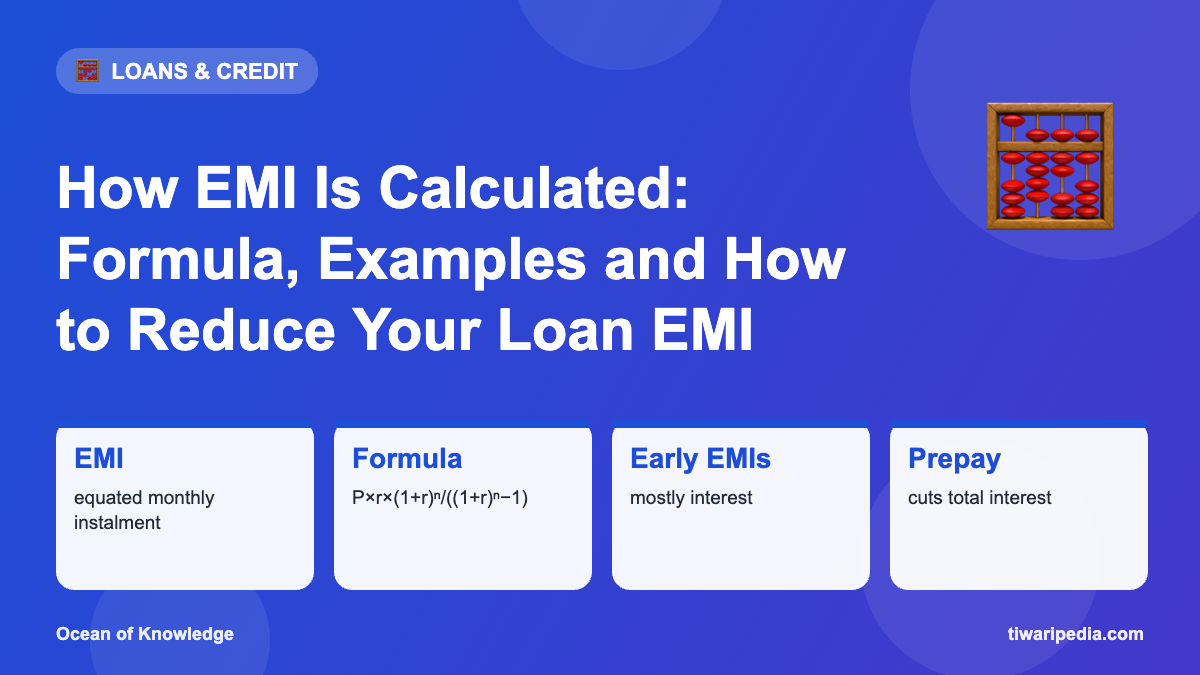
EMI = P × r × (1 + r)n ÷ [(1 + r)n − 1]where P = loan amount, r = monthly interest rate (annual rate ÷ 12 ÷ 100) and n = number of monthly instalments.
Worked example
Loan of ₹10 lakh at 9% a year for 10 years:
- r = 9 ÷ 12 ÷ 100 = 0.0075
- n = 120 months
- EMI ≈ ₹12,668
- Total paid ≈ ₹15.2 lakh, so total interest ≈ ₹5.2 lakh
How rate and tenure change your EMI (₹10 lakh loan)
| Rate | 10 years EMI | Total interest | 20 years EMI | Total interest |
|---|---|---|---|---|
| 8% | ₹12,133 | ₹4.56 lakh | ₹8,364 | ₹10.07 lakh |
| 9% | ₹12,668 | ₹5.20 lakh | ₹8,997 | ₹11.59 lakh |
| 10% | ₹13,215 | ₹5.86 lakh | ₹9,650 | ₹13.16 lakh |
A longer tenure lowers your EMI but more than doubles the total interest.
Amortisation: why early EMIs are mostly interest
In the first years, interest is calculated on a large outstanding balance, so most of the EMI goes towards interest. As the balance falls, more of each EMI goes towards principal. Your lender’s amortisation schedule shows this month by month.
Ways to reduce EMI or total interest
- Improve your credit score before applying to get a lower rate.
- Make a bigger down payment.
- Prepay part of the loan whenever possible.
- Choose a shorter tenure if you can afford the EMI.
- Consider a balance transfer to a lender with a lower rate.
- Increase your EMI by 5-10% each year as your income grows.
Step-by-step: how each EMI is split
Using the same ₹10 lakh loan at 9% for 10 years (EMI ₹12,668), here is how the first three payments are divided:
| Month | Interest (balance × 0.75%) | Principal repaid | Balance left |
|---|---|---|---|
| 1 | ₹7,500 | ₹5,168 | ₹9,94,832 |
| 2 | ₹7,461 | ₹5,207 | ₹9,89,625 |
| 3 | ₹7,422 | ₹5,246 | ₹9,84,379 |
Each month the interest part falls slightly and the principal part rises. In the last years of the loan, almost the whole EMI goes towards principal.
Flat rate vs reducing balance: a costly difference
Some lenders, especially for consumer goods and some vehicle loans, quote a flat rate. Flat interest is charged on the original loan amount for the whole tenure, even though you repay part of it every month.
| ₹10 lakh for 5 years at 9% | Flat rate | Reducing balance |
|---|---|---|
| Monthly EMI | ₹24,167 | ₹20,758 |
| Total interest | ₹4.50 lakh | ₹2.45 lakh |
A 9% flat rate is roughly equal to a 16% reducing-balance rate. Always ask the lender for the effective annual rate.
Fixed vs floating rate loans
- Fixed rate: your EMI stays the same for the fixed period. It is predictable but usually starts higher.
- Floating rate: linked to an external benchmark such as the RBI repo rate. EMIs or tenure go down when rates fall and up when they rise.
- RBI rules do not allow banks to charge foreclosure or prepayment penalties on floating-rate loans taken by individuals for non-business purposes.
How much EMI can you afford?
Lenders look at your EMI-to-income ratio. Many prefer that all your EMIs together stay under about 40–50% of your monthly take-home pay. For comfortable personal finances, keeping total EMIs nearer 30–35% leaves room for savings, insurance and emergencies.
Costs beyond the EMI
- Processing fee, often a percentage of the loan amount.
- Loan insurance that some lenders bundle with the loan.
- Late-payment charges and their effect on your credit score.
- Prepayment charges on fixed-rate loans, if any.
For rules on loan pricing and borrower rights, see the Reserve Bank of India.
Does a lower EMI always mean a better loan?
No. Stretching the tenure lowers the EMI but increases total interest a lot, as the table above shows. A slightly higher EMI over a shorter period can save lakhs of rupees. Compare loans using the interest rate, processing fee and total amount repaid, not the EMI alone.
Quick EMI check for common loans
| Loan | Typical tenure | What to watch |
|---|---|---|
| Home loan | 15–30 years | Floating rate changes, prepayment benefits |
| Car loan | 3–7 years | Flat-rate quotes, insurance add-ons |
| Personal loan | 1–5 years | High rates, processing fees |
| Education loan | 5–15 years | Moratorium period interest |
Key takeaways
- EMI depends on loan amount, rate and tenure.
- Early EMIs are mostly interest, so early prepayment saves the most.
- Always compare the effective rate and total cost.
Frequently asked questions
Is EMI calculated on reducing balance?
Yes, for most home, car and personal loans from banks. Some lenders quote flat rates, which are more expensive than they look.
Does a repo rate hike increase my EMI?
For floating-rate loans linked to the repo rate, the rate rises; lenders usually extend tenure or increase EMI.
Can I calculate EMI in Excel?
Yes: use =PMT(rate/12, months, -loan). For the example above: =PMT(9%/12,120,-1000000).
Keep exploring
This article is for general information, not financial, tax or legal advice. Rates, limits and rules change; always confirm on the official website or with a qualified advisor before you act. Spotted something that needs updating? Let us know.
Keep reading on Tiwaripedia
More guides: All Loans & Credit articles
