

Last updated: October 2026 · 5 min read
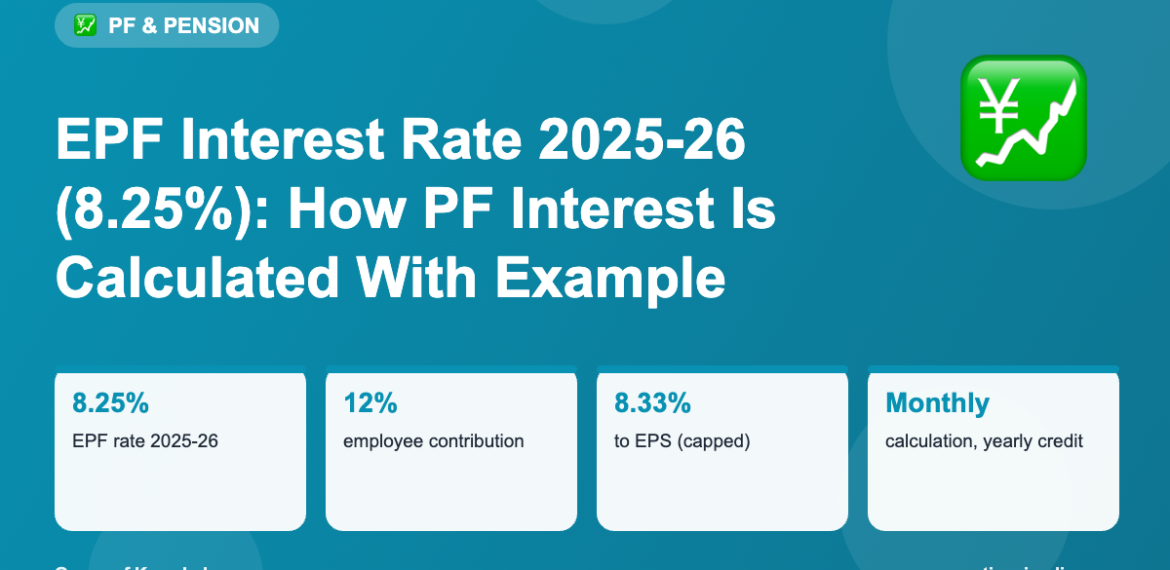
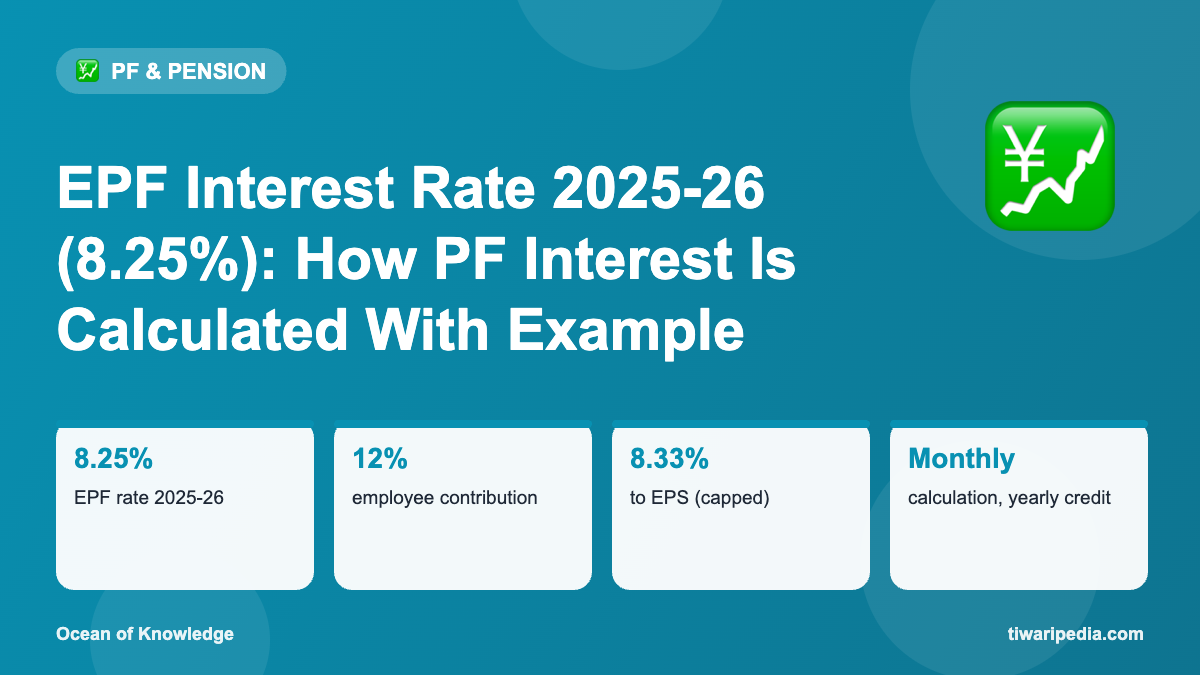
The Employees’ Provident Fund (EPF) is a retirement savings scheme run by the EPFO for salaried employees. For 2025-26, EPFO retained the interest rate at 8.25%, the same as 2024-25, benefiting over 7 crore members.
How contributions work
| Component | Contribution |
|---|---|
| Employee | 12% of basic salary + dearness allowance |
| Employer | 12% of basic + DA, split as below |
| Employer share to EPS (pension) | 8.33% of wages, capped at ₹15,000 wages (max ₹1,250 a month) |
| Employer share to EPF | Remaining 3.67% (more if wages exceed the cap) |
| Employer to EDLI (insurance) | 0.5% (paid separately) |
How interest is calculated
Interest is calculated monthly on the running balance at the end of each month, using rate ÷ 12, and is credited to your account once a year after the financial year ends. No interest is paid on the EPS (pension) portion.
Worked example
Basic + DA = ₹30,000 a month. Employee contribution = ₹3,600; employer’s EPF share = ₹3,600 – ₹1,250 = ₹2,350. Monthly EPF credit = ₹5,950.
With an opening balance of ₹2,00,000, monthly interest at 8.25% ÷ 12 (0.6875%) is calculated on each month’s closing balance. Over the year, total interest comes to roughly ₹19,000-₹19,500, credited after March.
EPF interest rate history (recent)
| Year | Rate |
|---|---|
| 2025-26 | 8.25% |
| 2024-25 | 8.25% |
| 2023-24 | 8.25% |
| 2022-23 | 8.15% |
| 2021-22 | 8.10% |
| 2020-21 | 8.50% |
Tax on EPF
- Employee contributions qualify for deduction under the old regime (within the ₹1.5 lakh limit).
- Interest on employee contributions above ₹2.5 lakh a year (₹5 lakh if no employer contribution) is taxable.
- Withdrawal after 5 years of continuous service is tax-free.
- Employer contribution to EPF, NPS and superannuation above ₹7.5 lakh a year is taxable.
How to check interest credit
Use the EPFO member passbook portal, the UMANG app, SMS to 7738299899 (“EPFOHO UAN”) or a missed call to 9966044425 from your registered mobile. Interest for a year usually appears a few months after the rate is notified.
Interest formula in simple steps
- Add your EPF balance at the end of every month of the financial year (April to March).
- Add up these 12 monthly closing balances.
- Multiply the total by the annual rate divided by 1,200. At 8.25%, that is total × 8.25 ÷ 1,200.
- The result is the interest credited for the year. It becomes part of next year’s opening balance, so interest earns interest from then on.
Because contributions are added every month, money deposited in April earns almost a full year of interest, while money added in March earns very little in that year.
When does EPF interest get credited?
The process has three steps. First, EPFO’s Central Board of Trustees recommends a rate. Then the Ministry of Finance approves it and the Ministry of Labour notifies it. Only after that is interest posted to member accounts. Interest for a financial year usually shows in the passbook a few months after it ends. Even if the passbook update is late, interest is still calculated up to 31 March, so members do not lose anything because of the delay.
EPF vs PPF vs fixed deposit
| Feature | EPF | PPF | Bank FD |
|---|---|---|---|
| Who can invest | Salaried employees in covered establishments | Any resident Indian | Anyone |
| Interest rate | 8.25% (recent years) | Set every quarter by the government | Set by each bank |
| Lock-in | Until retirement, with partial withdrawals allowed | 15 years, with partial withdrawals after 5 years | Chosen tenure |
| Tax on interest | Tax-free within limits | Tax-free | Taxable |
| Employer contribution | Yes | No | No |
For most salaried employees, EPF offers one of the best guaranteed, tax-efficient returns available, mainly because the employer adds money as well.
Voluntary Provident Fund (VPF)
You can ask your employer to deduct more than 12% of basic pay and credit it to your EPF. This is called VPF. It earns the same interest rate as EPF. However, the interest on your total yearly contribution above ₹2.5 lakh is taxable, so high earners should keep this limit in mind.
Common mistakes that cost you interest
- Having more than one UAN: old balances may stay separate and get missed. Merge them through the EPFO portal.
- Not transferring old PF after a job change: keep everything under one UAN so your service record stays continuous, which matters for tax-free withdrawal.
- Incomplete KYC: link Aadhaar, PAN and bank account with your UAN to avoid trouble during claims.
- Withdrawing early: every early withdrawal loses years of compounding at a strong rate.
Official rate notices and member services are on the EPFO website.
What happens to your EPF when you change jobs?
Your UAN stays the same for life. When you join a new employer, they link your new member ID to the same UAN. You should then submit an online transfer claim so the old balance moves to the new account. Transferring keeps your service continuous, which matters for tax-free withdrawal after 5 years and for pension eligibility under EPS after 10 years of service.
Key takeaways
- EPF earned 8.25% in recent years, credited once a year.
- Interest is worked out on monthly closing balances.
- Keep one UAN, complete KYC and avoid early withdrawals to get the full benefit.
Frequently asked questions
What is the EPF interest rate for 2025-26?
8.25%, as recommended by EPFO’s Central Board of Trustees and approved by the government.
Is EPF interest compounded?
Interest is calculated monthly and credited annually, so it compounds yearly.
Does the employer contribution earn interest?
Yes, the EPF portion does; the EPS portion goes to the pension fund and does not earn account interest.
Keep exploring
This article is for general information, not financial, tax or legal advice. Rates, limits and rules change; always confirm on the official website or with a qualified advisor before you act. Spotted something that needs updating? Let us know.
Keep reading on Tiwaripedia
More guides: All PF & Pension articles
