

Last updated: October 2026 · 3 min read
An education loan helps students pay for college fees, hostel, books and travel in India or abroad. Repayment usually begins after the course ends, and interest paid can reduce your tax under the old regime.
What expenses are covered
- Tuition and college fees.
- Hostel and accommodation.
- Books, laptop and equipment.
- Exam, library and lab fees.
- Travel and living expenses for studies abroad.
- Insurance premium for the student.
Eligibility
- Indian citizen with admission to a recognised course through entrance test or merit.
- Parent or guardian usually joins as co-borrower.
- For larger loans, collateral such as property or FDs may be required.
- Some lenders lend for top global universities without collateral.
Collateral and guarantees
Under the Credit Guarantee Fund Scheme for Education Loans (CGFSEL), banks can give loans up to ₹7.5 lakh without collateral or third-party guarantee. Under PM Vidyalaxmi (approved in 2024), students admitted to top-ranked institutions can get collateral-free loans with a government credit guarantee and interest subvention for eligible families.
Moratorium and repayment
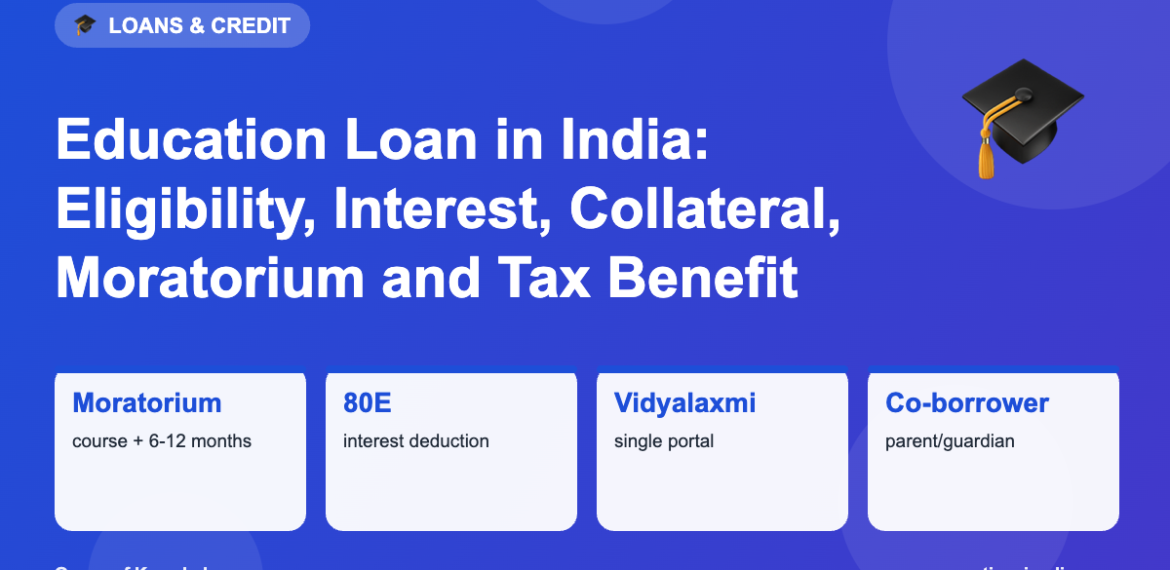
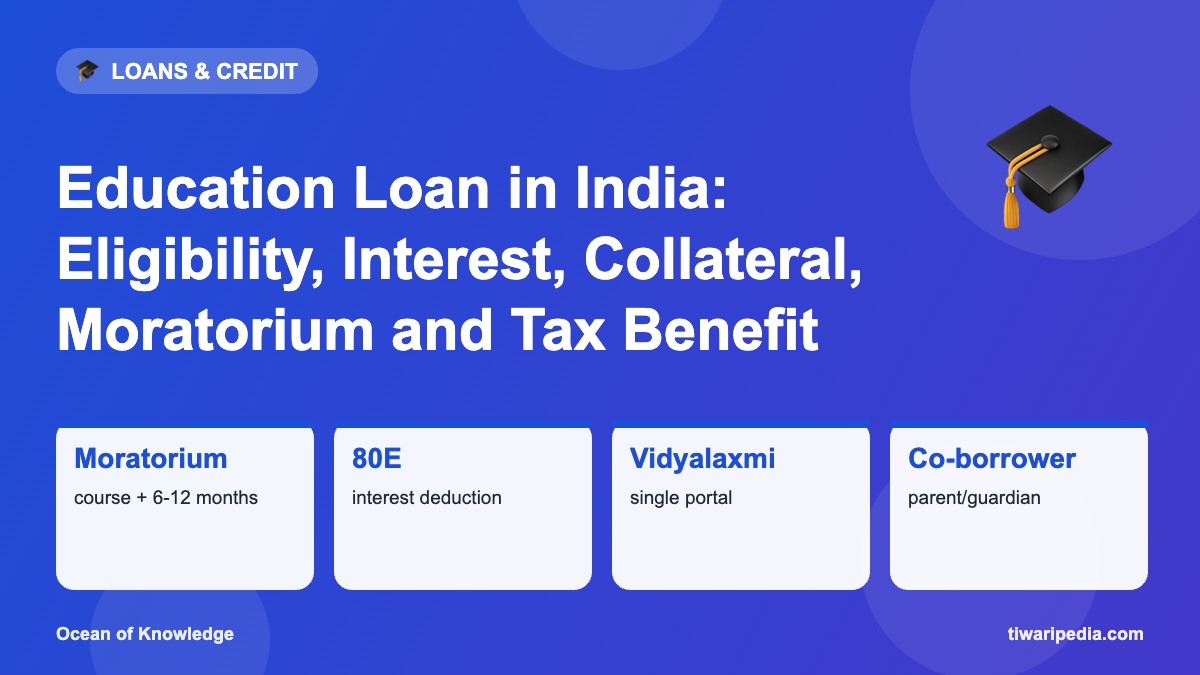
The moratorium period is usually the course duration plus 6-12 months. Interest may accrue during this time; paying simple interest during the moratorium reduces your later burden. Repayment terms often extend up to 10-15 years.
Tax benefit
Under the old tax regime, the entire interest on an education loan for higher studies of self, spouse, children or a student for whom you are guardian is deductible (Section 80E, renumbered under the Income-tax Act, 2025) for up to 8 years. There is no upper limit, but principal is not deductible.
How to apply
- Compare lenders’ rates, processing fees and collateral rules.
- Apply through the PM Vidyalaxmi portal or the Vidya Lakshmi portal, or directly at a bank.
- Submit admission letter, fee structure, academic records, KYC and co-borrower income proof.
- Loan is disbursed in stages directly to the institution.
Frequently asked questions
Can I get an education loan without collateral?
Yes, typically up to ₹7.5 lakh under credit guarantee schemes, and more for top institutions under PM Vidyalaxmi.
When do I start repaying?
After the moratorium, usually 6-12 months after course completion or after getting a job, whichever is earlier.
Is education loan interest tax-deductible in the new regime?
No. The Section 80E deduction is available only in the old tax regime.
Keep exploring
- CIBIL score explained
- How EMI is calculated
- New vs old tax regime
- More Loans & Credit articles on Tiwaripedia
This article is for general information, not financial, tax or legal advice. Rates, limits and rules change; always confirm on the official website or with a qualified advisor before you act. Spotted something that needs updating? Let us know.




