

Last updated: October 2026 · 3 min read
Budget 2026 kept income tax slabs unchanged, so for the financial year 2026-27 (called Tax Year 2026-27 under the new Income-tax Act, 2025), salaried individuals again choose between the new tax regime (default) and the old tax regime. Here is how they compare.
New tax regime slabs (FY 2026-27)
| Taxable income | Tax rate |
|---|---|
| Up to ₹4 lakh | Nil |
| ₹4-8 lakh | 5% |
| ₹8-12 lakh | 10% |
| ₹12-16 lakh | 15% |
| ₹16-20 lakh | 20% |
| ₹20-24 lakh | 25% |
| Above ₹24 lakh | 30% |
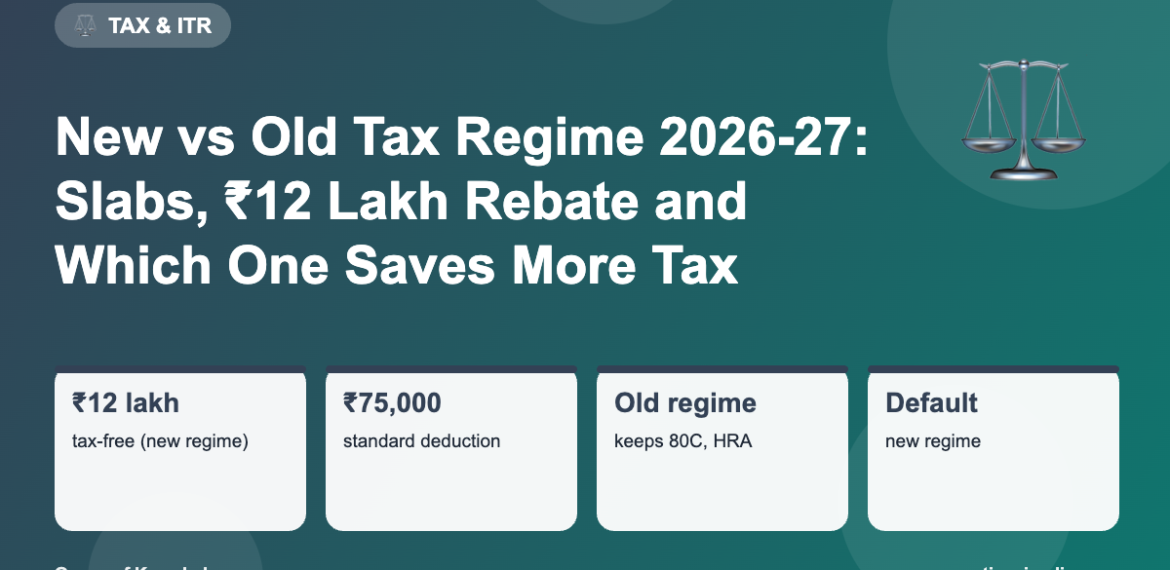
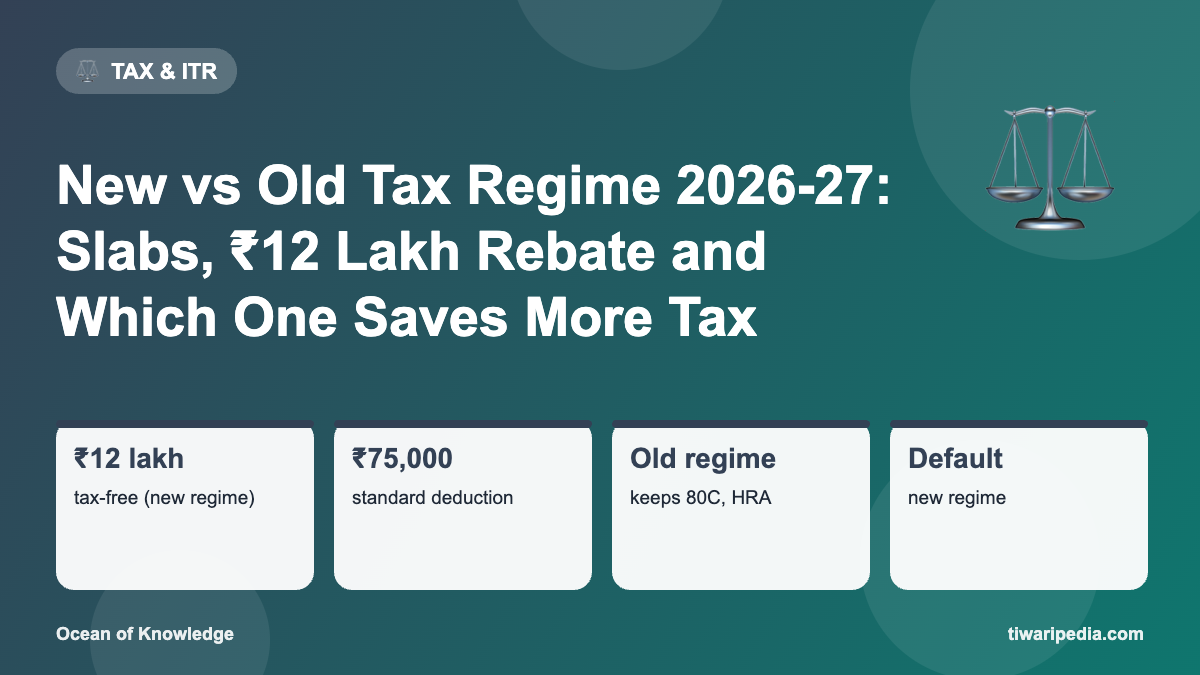
A rebate of up to ₹60,000 means no tax on taxable income up to ₹12 lakh. With the ₹75,000 standard deduction, a salaried person earning up to ₹12.75 lakh pays nil tax. Marginal relief applies just above ₹12 lakh. Health and education cess of 4% is added to tax.
Old tax regime slabs (below 60 years)
| Taxable income | Tax rate |
|---|---|
| Up to ₹2.5 lakh | Nil |
| ₹2.5-5 lakh | 5% |
| ₹5-10 lakh | 20% |
| Above ₹10 lakh | 30% |
Rebate makes tax nil up to ₹5 lakh taxable income. Standard deduction is ₹50,000. Senior citizens (60-80) get a ₹3 lakh basic exemption; super seniors (80+) get ₹5 lakh.
What each regime allows
| Deduction/exemption | New regime | Old regime |
|---|---|---|
| Standard deduction (salary) | ₹75,000 | ₹50,000 |
| Section 80C (PPF, ELSS, LIC, EPF, tuition, principal) | No | Up to ₹1.5 lakh |
| 80D health insurance | No | Yes |
| HRA and LTA | No | Yes |
| Home loan interest (self-occupied) | No | Up to ₹2 lakh |
| Employer NPS contribution | Yes (up to 14% of salary) | Yes (up to 10%) |
| Extra NPS ₹50,000 (80CCD(1B)) | No | Yes |
| Family pension deduction | Yes | Yes |
Under the Income-tax Act, 2025, these sections have new numbers (for example, 80C becomes Section 123 and the rebate under 87A becomes Section 156), but the benefits work the same way.
Worked example
Ravi earns a salary of ₹15 lakh. Under the new regime, taxable income after the ₹75,000 standard deduction is ₹14.25 lakh, and tax works out to about ₹93,750 + cess. Under the old regime, he needs deductions of roughly ₹5 lakh or more (80C ₹1.5 lakh, 80D, HRA, home loan interest, NPS) for the old regime to beat the new one.
Rule of thumb: if your total deductions and exemptions are small, the new regime usually wins; if you have large HRA, home loan interest and full 80C/80D use, compare both with a calculator.
How to choose and switch
- The new regime is the default; tell your employer if you want the old regime for TDS.
- Salaried people without business income can choose either regime every year while filing the return.
- People with business or professional income can switch back to the old regime only once.
- Use the Income Tax Department’s tax calculator before deciding.
Frequently asked questions
Is income up to ₹12 lakh tax-free in 2026-27?
Under the new regime, yes, because of the rebate; salaried people get nil tax up to ₹12.75 lakh with the standard deduction. This does not apply to special-rate income such as certain capital gains.
Did Budget 2026 change tax slabs?
No. Budget 2026 retained the slab rates and the ₹12 lakh rebate introduced in Budget 2025.
Which regime is better for home loan borrowers?
Often the old regime, because it allows up to ₹2 lakh interest deduction for self-occupied property plus principal under 80C, but compare your full numbers.
Keep exploring
- Income Tax Act 2025 explained
- How to file ITR online
- PPF account explained
- More Tax & ITR articles on Tiwaripedia
This article is for general information, not financial, tax or legal advice. Rates, limits and rules change; always confirm on the official website or with a qualified advisor before you act. Spotted something that needs updating? Let us know.




