

Last updated: October 2026 · 3 min read
SAP BRIM (Billing and Revenue Innovation Management), now marketed as part of SAP S/4HANA for subscription and usage-based billing, handles high-volume, recurring and usage-based billing for telecoms, utilities, media, SaaS and manufacturers selling “as-a-service”. Its process is often called Quote-to-Cash or Lead-to-Cash.
BRIM components
| Component | Role |
|---|---|
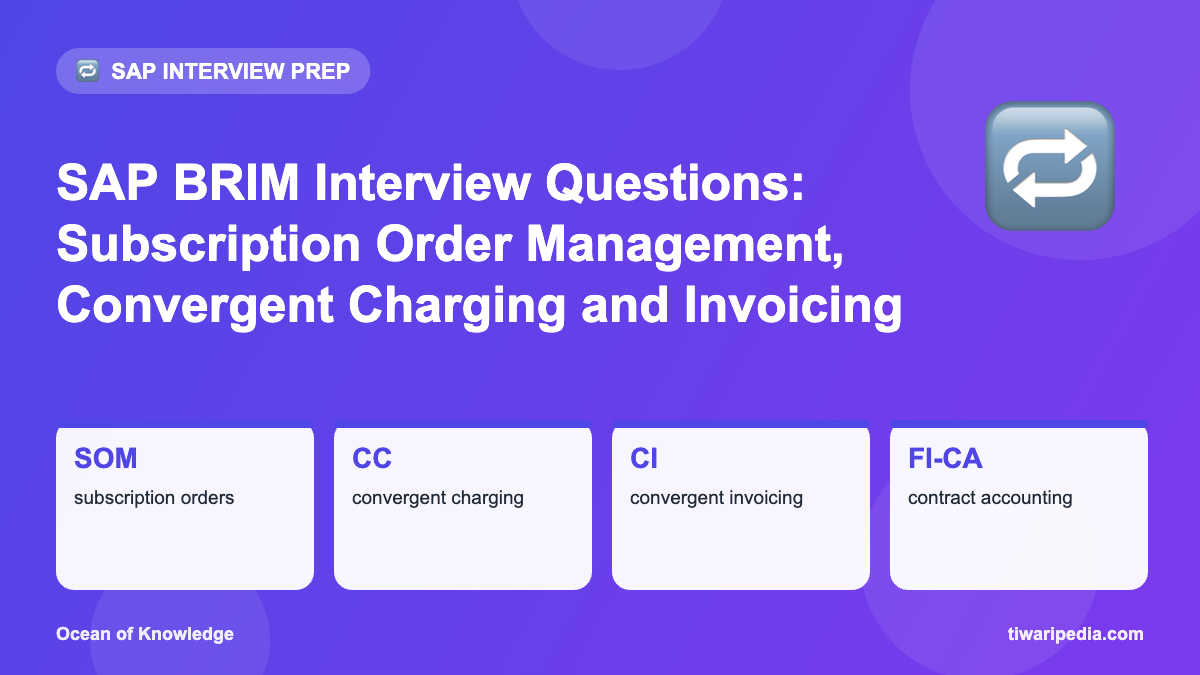
| Subscription Order Management (SOM) | Creates and manages subscription contracts and product configurations |
| Convergent Mediation (CM) | Collects and normalises usage records (CDRs, meter reads) |
| Convergent Charging (CC) | Rates and charges usage using pricing plans |
| Convergent Invoicing (CI) | Aggregates billable items into bills and invoices |
| Contract Accounting (FI-CA) | Manages receivables, payments, dunning and collections for high volumes |
| Revenue Accounting (RAR) | Recognises revenue under IFRS 15 / Ind AS 115 |
End-to-end flow
- Customer order and subscription contract created in SOM.
- Usage collected by Convergent Mediation.
- Convergent Charging rates usage and creates charged items.
- Billable items (BITs) flow to Convergent Invoicing.
- Billing documents and invoices are created in CI.
- Postings go to FI-CA as open items; payments, dunning and collections follow.
- Revenue is recognised in RAR.
Top interview questions and answers
1. What is a billable item (BIT)?
A record in Convergent Invoicing representing a charge to be billed, with amount, quantity, contract account and billable item type.
2. Billing vs invoicing in CI?
Billing groups and processes billable items into billing documents; invoicing combines billing documents (and other FI-CA items) into a customer invoice with taxes.
3. What is a contract account in FI-CA?
An account that groups business-partner transactions with common payment and dunning rules; one BP can have many contract accounts.
4. What is a provider contract?
A contract in FI-CA/SOM that links a customer to subscribed products and charging parameters, replicated to Convergent Charging.
5. What does Convergent Charging do?
It rates usage and recurring fees in real time or batch using charge plans and pricing, and sends charged items to CI.
6. What are consumption items?
In newer releases, usage records stored in CI before rating, allowing rating within S/4HANA for simpler scenarios.
7. Why use FI-CA instead of AR?
FI-CA is designed for millions of customers and transactions, mass processing of payments, dunning and correspondence.
8. How does BRIM support IFRS 15?
Through integration with Revenue Accounting and Reporting, which identifies performance obligations and recognises revenue over time.
Test yourself: scored BRIM quiz
Interview tips
- Explain an industry use case: telecom postpaid, utilities metering or SaaS subscriptions.
- Draw the SOM-CC-CI-FI-CA flow with document examples.
- Discuss performance and volume challenges and how mass runs were scheduled.
Frequently asked questions
Which industries use SAP BRIM?
Telecom, utilities, media and entertainment, high-tech/SaaS, transport and manufacturers selling subscriptions or pay-per-use.
Is SAP BRIM part of S/4HANA?
Yes. Convergent Invoicing and FI-CA are part of S/4HANA; Convergent Charging and Mediation are separate components; SAP now markets the capabilities as subscription and usage-based billing.
What skills do BRIM consultants need?
FI-CA and CI configuration, understanding of SD/CRM order management, charging concepts and strong data/volume testing.
Keep exploring
- SAP FICO interview questions
- SAP Service Management interview questions
- SAP Solution Architect guide
- More SAP Interview Prep articles on Tiwaripedia
Facts are based on widely accepted official, scientific and historical sources at the time of writing. Spotted something that needs updating? Let us know.




