

Last updated: October 2026 · 3 min read
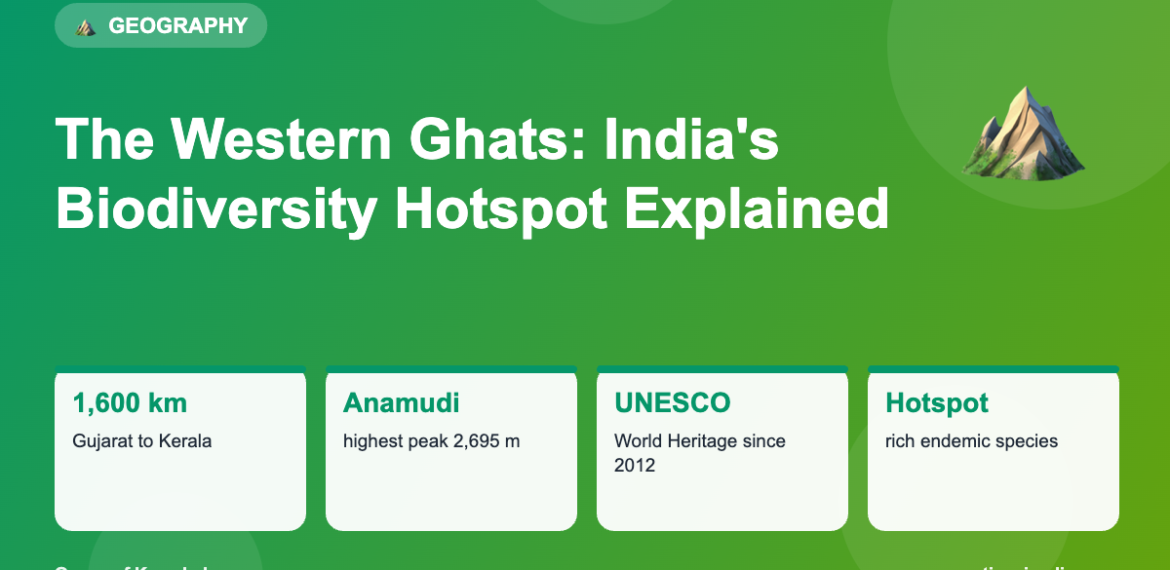
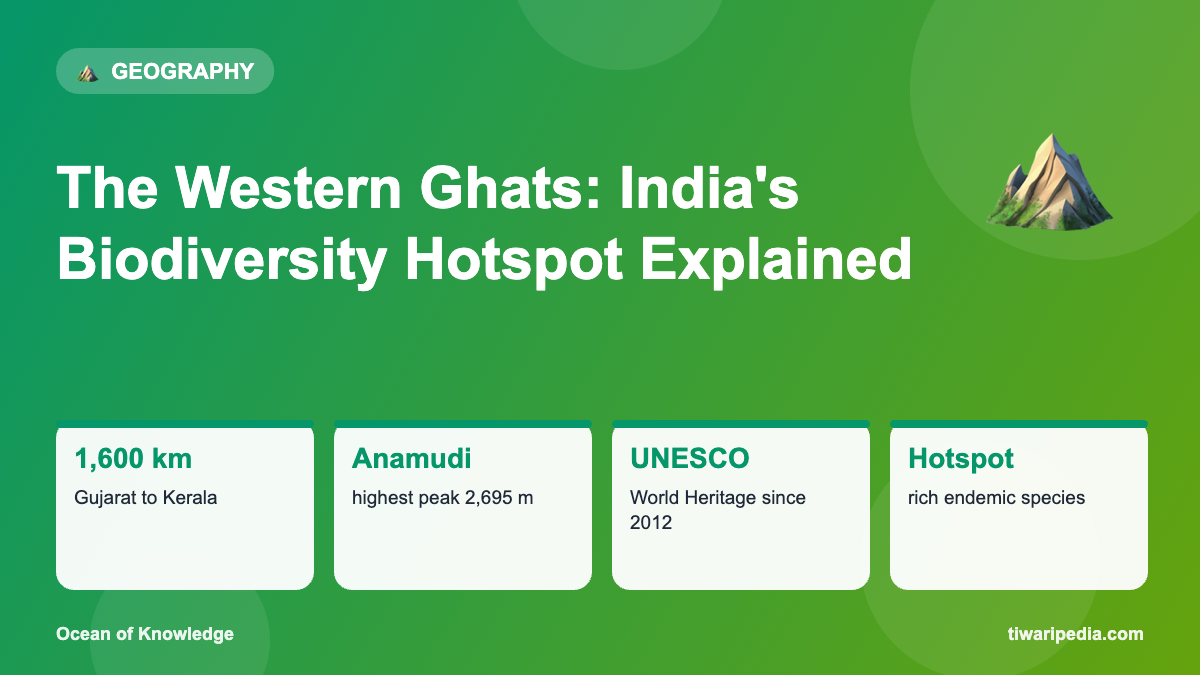
Stretching about 1,600 km along India’s west coast, the Western Ghats (Sahyadri) are a chain of mountains and forests older than the Himalayas. They catch the monsoon, feed major rivers and are one of the world’s most important biodiversity hotspots.
Where are the Western Ghats?
The range runs parallel to the Arabian Sea coast through six states: Gujarat, Maharashtra, Goa, Karnataka, Kerala and Tamil Nadu, from the Tapi river in the north to near Kanyakumari in the south.
Key facts
| Feature | Detail |
|---|---|
| Length | About 1,600 km |
| Highest peak | Anamudi, Kerala (2,695 m), the highest in peninsular India |
| Other peaks | Doddabetta (Nilgiris), Kalsubai (Maharashtra) |
| Famous passes | Palghat Gap, Thal Ghat, Bhor Ghat |
| UNESCO status | World Heritage Site since 2012 |
Rivers born in the Western Ghats
Many great peninsular rivers begin here and flow east to the Bay of Bengal, including the Godavari, Krishna and Kaveri. Short, fast west-flowing rivers like the Sharavathi create waterfalls such as Jog Falls.
Biodiversity
The Ghats cover under 6% of India’s land yet hold a large share of its plant and animal species, many found nowhere else (endemic).
- Lion-tailed macaque and Nilgiri tahr
- Malabar giant squirrel and great hornbill
- Hundreds of frog species, many discovered recently
- Shola forests and grasslands in the Nilgiris
Role in the monsoon
The Ghats block moist south-west monsoon winds, giving the west coast very heavy rain and leaving a drier “rain shadow” on the Deccan side. Places like Agumbe in Karnataka receive some of India’s highest rainfall.
Threats and conservation
Deforestation, mining, quarrying, dams and unplanned tourism threaten the region and have worsened landslides in places like Wayanad. Expert panels led by Madhav Gadgil and K. Kasturirangan recommended protecting ecologically sensitive areas.
Frequently asked questions
Are the Western Ghats older than the Himalayas?
Yes. The Western Ghats are geologically much older than the young, still-rising Himalayas.
Which is the highest peak of the Western Ghats?
Anamudi in Kerala’s Idukki district, at 2,695 metres.
What is the other name of the Western Ghats?
Sahyadri, especially in Maharashtra and Karnataka.
Keep exploring
- The Himalayas
- How the Indian monsoon works
- Major rivers of India
- More Geography articles on Tiwaripedia
Facts are based on widely accepted official, scientific and historical sources at the time of writing. Spotted something that needs updating? Let us know.




