

Last updated: October 2026 · 3 min read
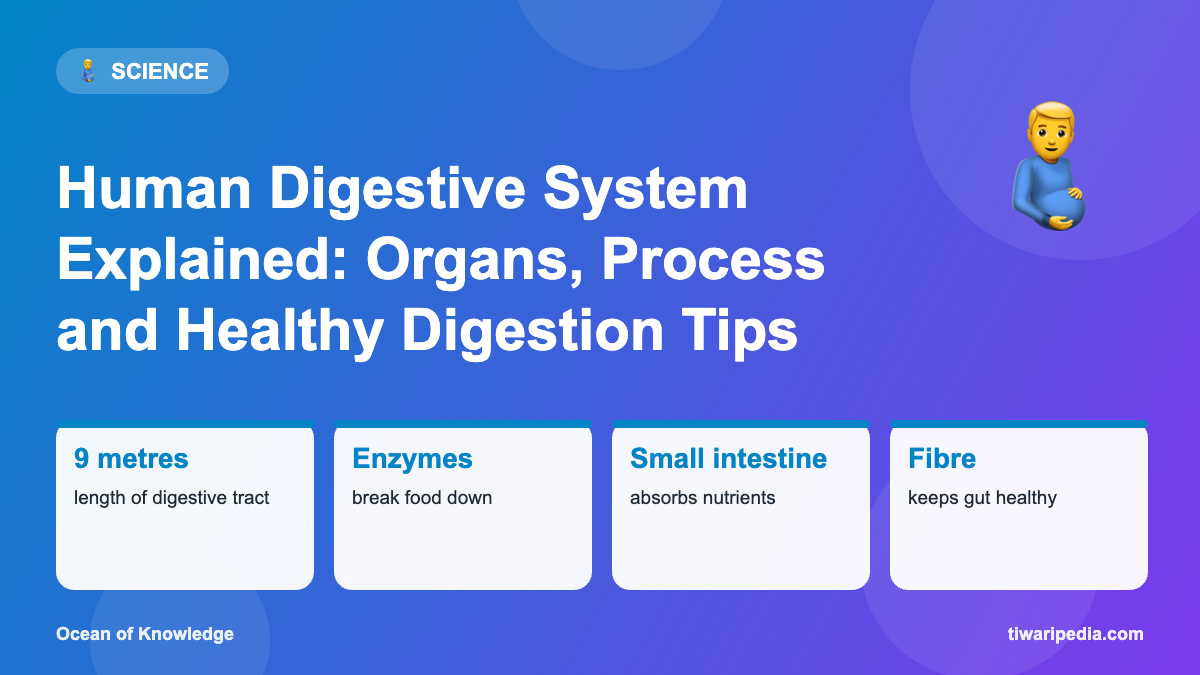
Every roti, dal and fruit you eat is broken down into tiny molecules your body can absorb. This work is done by the digestive system, a long tube from mouth to anus, helped by organs like the liver and pancreas.
The journey of food, step by step
| Organ | What happens |
|---|---|
| Mouth | Teeth chew food; saliva’s amylase starts digesting starch. |
| Oesophagus | Muscle waves (peristalsis) push food to the stomach. |
| Stomach | Hydrochloric acid and pepsin start digesting protein; food becomes a thick liquid called chyme. |
| Small intestine | Bile and pancreatic enzymes finish digestion; villi absorb nutrients into the blood. |
| Large intestine | Water and salts are absorbed; gut bacteria ferment fibre. |
| Rectum and anus | Waste is stored and removed. |
Helper organs
- Liver: makes bile, which breaks fat into small droplets.
- Gall bladder: stores and releases bile.
- Pancreas: releases enzymes (amylase, lipase, trypsin) and the hormone insulin.
Key enzymes
| Enzyme | Made in | Digests |
|---|---|---|
| Salivary amylase | Salivary glands | Starch |
| Pepsin | Stomach | Proteins |
| Lipase | Pancreas | Fats |
| Trypsin | Pancreas | Proteins |
| Lactase | Small intestine | Milk sugar |
How long does digestion take?
Food usually spends a few hours in the stomach, several hours in the small intestine, and up to a day or more in the large intestine. Total transit time commonly ranges from about 24 to 72 hours, depending on the person and the meal.
Tips for healthy digestion
- Eat fibre: whole grains, dals, vegetables and fruit.
- Drink enough water.
- Chew food well and eat slowly.
- Include curd or other probiotic foods.
- Stay active; a short walk after meals helps.
- See a doctor for persistent pain, blood in stools or sudden weight loss.
Frequently asked questions
Which is the longest part of the digestive system?
The small intestine, about 6-7 metres long in adults.
Why does the stomach not digest itself?
A thick layer of mucus protects the stomach lining from acid.
What are villi?
Tiny finger-like projections in the small intestine that increase the surface area for absorbing nutrients.
Keep exploring
Facts are based on widely accepted official, scientific and historical sources at the time of writing. Spotted something that needs updating? Let us know.




